Answering the common buyer question, these stainless steel heat exchangers are designed to transfer heat efficiently between two water circuits while resisting corrosion from pool chemicals. They’re best for pool owners, spa operators, and hot tub enthusiasts who want durable, long-lasting performance. The top picks below emphasize 316L stainless steel construction, strong heat transfer, and compatibility with common inlet/outlet sizes. Use this guide to compare capacity, port configurations, and installation considerations to choose the right unit for your seasonal or year-round heating needs.
| Product | Best For | Key Benefit |
|---|---|---|
| AB Pool Heat Exchanger 155kBtu Stainless Steel 316L Same Side Ports | Medium to large residential pools | Solid corrosion resistance; compact dual-port design |
| QUELECO Stainless Steel Heating Coil Heat Exchanger | Outdoor wood-fired hot tubs | Customizable dimensions and coil-style design |
| OtaniReno 200K BTU Stainless Steel Heat Exchanger | High-demand pools and spas | High heat transfer capacity; durable 304/316L options |
| AB 300 kBTU Heat Exchanger | Large pools and multi-zone systems | High capacity; 316L stainless steel for longevity |
| VEVOR Pool Heat Exchanger, 210K BTU | Residential and commercial spa and pool setups | High efficiency with 316L construction |
AB Pool Heat Exchanger 155kBtu Stainless Steel 316L Same Side Ports

This unit uses 316L stainless steel to resist chemical corrosion in pool environments. It supports a pool heating capacity up to 11,900 gallons with 155 kBtu/hr output, based on a 60°C (140°F) delta. Best for mid-size residential pools and solar/spa integrations where space is limited. The design includes same-side ports for easier plumbing. A 1-year warranty offers coverage against manufacturer defects.
Who it’s best for: homeowners needing reliable stainless steel heat exchange without complex plumbing. Why selected: robust anti-corrosion material and moderate heating capacity suit typical backyard setups. Caution: ensure compatibility with your existing port sizes and flow rates to avoid bottlenecks.
QUELECO Stainless Steel Heating Coil Heat Exchanger

This coil-type exchanger uses 304 stainless steel tubing and is designed for outdoor wood-fired heating of hot tubs. The coil is 1″ in outer diameter and 29 feet long, with 3/4″ male NPT connections. It can be customized for dimensions, water connectors, and heating capacity. Best for outdoor hot tubs heated by wood burning where a simple, stored-heat approach is preferred. Selected for durability and customization options.
Who it’s best for: outdoor tub owners seeking a coil-style, wood-fired heat source. Why selected: coil design facilitates outdoor installations and easy integration with existing wood stoves. Caution: this coil is sold as a coil only; other components shown in images are for illustration.
OtaniReno 200K BTU Stainless Steel Heat Exchanger

With a 200 kBtu/hr rating, this exchanger targets faster heating for pools, spas, or hot tubs. It’s built from 304 stainless steel for durability and consistent heat transfer, especially where a higher delta is present between incoming and heated water. Best for users who need quicker warm-up times without extending equipment footprints. Caution: actual performance depends on system design and flow rates; confirm compatibility with your heater and pump.
AB 300 kBTU Heat Exchanger
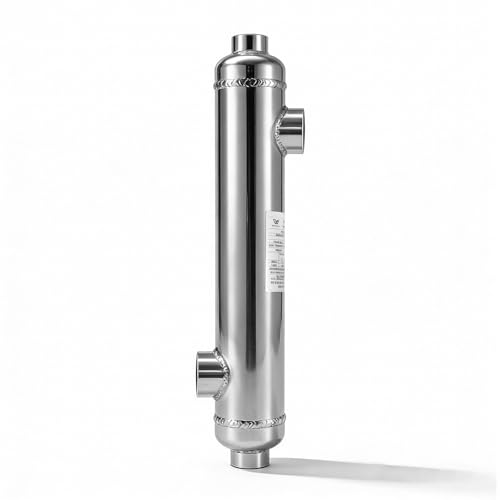
This high-capacity unit is designed for larger pools or multi-zone systems. Built from 316L stainless steel, it offers resilience against chemical treatment and continuous use. Best for larger residential installations or spa complexes requiring robust heating performance. Limitation: higher capacity units may require more substantial plumbing and space planning. Warranty included for manufacturer defects.
VEVOR Pool Heat Exchanger, 210K BTU

VEVOR’s 210K BTU exchanger uses 316L stainless steel tubing and a large transfer area to boost heat efficiency for spa and pool applications. It’s suitable for both indoor and outdoor setups, including humid environments, with an operating range suited to typical residential systems. Best for homeowners prioritizing durability and steady performance over long season use. Caution: ensure proper installation to handle the pressure and flow requirements of your heater.
AB Plate Heat Exchanger, 4″x12″ 30 Plates

This plate heat exchanger uses 316L stainless steel plates brazed with copper to deliver high heat transfer rates. It’s designed for 250,000 to 330,000 BTU per hour capacity, depending on application. Best for floor heating, snow melting, or hydronic systems requiring robust plate heat transfer in a compact footprint. Caution: plate assemblies require proper torque and seal checks to avoid leaks.
Buying Guide: Key Purchase Considerations
- Capacity and delta temperature: Match BTU/hr ratings to your pool or spa size and desired heating delta (typical reference: 60°C/140°F).
- Material and corrosion resistance: 316L stainless steel offers superior chemical resistance for pools; 304 may be sufficient in less aggressive environments.
- Port configuration: Check inlet/outlet sizes (1″, 1.5″, FPT/NPT) and port alignment to fit your existing plumbing.
- Coil vs plate design: Coils are common for wood-fired or compact outdoor setups; plate exchangers excel in high-flow, high-heat transfer scenarios.
- Maintenance and warranty: Look for manufacturer coverage against corrosion, leaks, and defects, plus ease of cleaning and inspection.
- Installation space and mounting: Larger units may need more room for service access and routing of hoses and fittings.
Frequently Asked Questions
- What does BTU/hr indicate for a heat exchanger?
– It measures the heat transfer rate; higher BTU/hr means faster heating for given water temperature differences. - Is 316L stainless steel necessary for pool use?
– 316L is highly corrosion-resistant and preferred in chemically treated pools and hot tubs; 304 may be acceptable in milder conditions. - Can I mix different heat exchanger brands?
– Mixing can work if fittings, port sizes, and pressure ratings align; otherwise, consult a professional installer. - How do I choose between coil and plate exchangers?
– Coils suit outdoor, wood-fired or compact layouts; plates offer higher efficiency for larger systems and stable flow. - Do heat exchangers require electricity?
– Many do not, depending on the system; some rely on the existing pump and heat source without additional power needs. - What maintenance is required?
– Periodic inspection for leaks, cleaning of any mineral buildup, and ensuring fittings remain tight.