Find the right T316 stainless steel cable for outdoor railing projects and coastal environments. This guide compares top 1/8″ and 3/16″ cables, highlighting suitability for DIY decks, stairs, and balustrades. Ideal buyers include homeowners tackling outdoor railings, DIY enthusiasts, and small contractors seeking durable corrosion resistance. Below, a quick summary table helps you compare key specs at a glance.
| Product | Diameter | Length | Strand Type | |
|---|---|---|---|---|
| CELYND Stainless Steel Cable for Railing – 500FT 1/8″ | 1/8″ | 500 ft | 7×7 | 1800 lbs |
| Black Stainless Steel Cable for Railing – 500FT 1/8″ | 1/8″ | 500 ft | 7×7 | 1800 lbs |
| CELYND Stainless Steel Cable for Railing – 250FT 3/16″ | 3/16″ | 250 ft | 7×19 | 3700 lbs |
| RECTOO 100FT 1/8″ T316 Stainless Steel Cable | 1/8″ | 100 ft | 7×7 | 1800 lbs |
| Muzata 500 ft 1/8″ Stainless Steel Cable Railing System | 1/8″ | 500 ft | 7×7 | 1800 lbs |
CELYND 500FT 1/8″ T316 Wire Rope Kit

This 500-foot kit uses marine-grade T316 stainless steel. It features a 7×7 strand construction for strength and flexibility, with a stated breaking strength of 1800 pounds. The cable is designed for deck railing handrails and other outdoor uses, offering resistance to rust and corrosion in harsh environments. It ships with a cutter for easy customization, making it suitable for long runs or multiple sections in a single project.
- Best for long deck projects or multi-section installations where uninterrupted runs are needed.
- Better for outdoor coastal environments thanks to T316 composition.
- Avoid if you need 3/16″ diameter for higher load scenarios—this is 1/8″.
Black 1/8″ T316 Stainless Steel Cable Kit

This kit pairs a blackened 7×7 stainless steel wire rope with a sleek, modern finish. The T316 stainless steel provides corrosion resistance, making it suitable for indoor or outdoor installations, including coastal settings. With the same 1800 pounds breaking strength as other 1/8″ options, it suits railing and handrail systems where appearance is a consideration. The black finish adds style, but you should still account for potential edge changes during cutting and crimping.
- Best for modern black railing aesthetics and coastal use.
- Better for visually integrated railings where color coordination matters.
- Avoid if you require a larger diameter for higher load requirements.
CELYND 250FT 3/16″ T316 Wire Rope
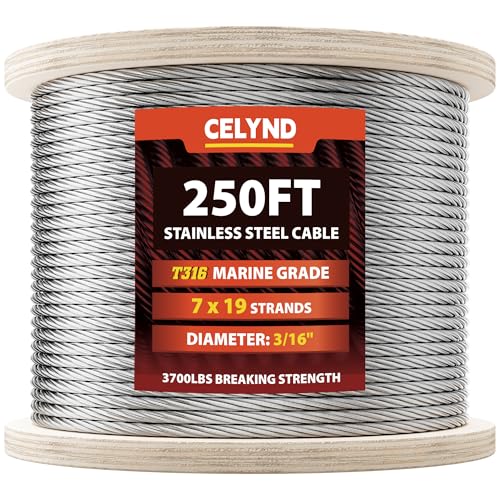
This 250-foot length uses a heavier 3/16″ diameter and 7×19 strand configuration for higher load capacity. The stated breaking strength is 3700 pounds, making it suitable for more demanding railing projects or heavier-duty DIY installations. It’s designed for outdoor use with marine-grade T316 stainless steel and includes features that facilitate cutting and crimping. Use this where tighter bends are not a constraint and higher tensile strength is needed.
- Best for higher load requirements on decks or large stair railings.
- Better for projects where 3/16″ diameter is preferred for rigidity and strength.
- Avoid if you need long runs beyond 250 feet without splicing sections.
ZONEGRACE 1000FT 1/8″ T316 Cable Kit

This DIY-ready kit offers a long 1000-foot supply of 1/8″ T316 stainless steel cable with a 7×7 strand configuration. It has a breaking strength around 1800 pounds and a working load suitable for typical railing projects. The kit is designed for flexible installation across indoor or outdoor railings, including coastal settings. It includes a cutter, enabling clean cuts and proper fraying control.
- Best for large projects or future-proofing with ample length on hand.
- Better for installations where you need consistent, reliable 1/8″ cable over long runs.
- Avoid if you only need a short length or want a lighter project footprint.
KALLSDY 500FT 1/8″ T316 Cable Kit

This KALLSDY kit uses 316 stainless steel and 7×7 strands for durable, corrosion-resistant performance. With a seemingly robust breaking strength and a focus on DIY-friendly flexibility, it supports railing and decorative uses where ease of handling matters. The kit includes a cutter and is suitable for coastal environments due to its high corrosion resistance.
- Best for flexible runs and easy handling in DIY projects.
- Better for coastal environments due to 316 grade.
- Avoid if you require 3/16″ diameter for added stiffness and higher load.
RECTOO 100FT 1/8″ T316 Cable With Cutter

RECTOO offers a 100-foot run of 1/8″ T316 stainless steel cable in a 7×7 configuration, designed for indoor and outdoor use, including coastal environments. It provides a strong balance of strength and flexibility, making it suitable for decks, stair handrails, and porch fences. A caveat: shorter lengths may require splicing to cover long runs.
- Best for shorter runs or sections needing quick replacement.
- Better for projects where precise cut-lengths are needed.
- Avoid if you must cover long continuous spans without splicing.
Buying Guide
What diameter should I choose?
For most residential deck railings, 1/8″ is standard and provides adequate strength with easy handling. For higher load requirements or thicker rails, 3/16″ offers greater stiffness and load capacity. Consider the total span and bending points when selecting diameter.
Which strand construction matters?
7×7 strands offer flexibility and ease of bending, ideal for railing runs with curves or tight corners. 7×19 strands provide higher stiffness and load capacity, better for longer spans or where crimping and fittings must hold higher tension. Your choice affects cutting, crimping, and long-term durability.
Is marine-grade stainless steel essential?
Yes for outdoor and coastal installations. T316 stainless steel contains nickel and molybdenum that improve corrosion resistance in saltwater exposure, humid environments, or where cleaning solutions are frequent. If your project is indoors only, 304 or standard stainless can suffice, but T316 is safer for harsher environments.
What should I know about tension and installation?
Most cables specify a safe working load around a fraction of the breaking strength. Plan tension wisely and consider using included clamps, thimbles, or sleeves when the kit provides them. Make clean cuts to avoid fraying and match crimping tools to the connector sleeves to ensure secure terminations.
Are additional accessories important?
Clamps, thimbles, and crimping sleeves help create durable terminations. Kits that include these components reduce the need for extra purchases and ensure consistent installation quality. If your kit lacks them, budget for compatible hardware and a cable cutter designed for stainless steel cable.
What if I have a coastal or saltwater environment?
Prioritize 316 stainless steel (T316) with a corrosion-resistant coating or finish, since these environments accelerate rust. Black finishes can offer aesthetic appeal but still rely on the base alloy for protection. Regular maintenance, such as wiping salt spray after exposure, extends lifespan.
How do I compare these options quickly?
- Best for long runs: CELYND 500FT 1/8″ kit or ZoneGrace 1000FT kit.
- Best for higher load demands: CELYND 250FT 3/16″ or Muzata 500 ft kit.
- Best for aesthetics: Black stainless steel cable kit.
FAQ
- What is the typical breaking strength for 1/8″ T316 cable? Answer: About 1800 pounds in 7×7 construction.
- Is 3/16″ stainless steel cable necessary for all decks? Answer: Not always; use 3/16″ for higher load or longer spans, otherwise 1/8″ is usually sufficient.
- Can I cut T316 stainless steel cable at home? Answer: Yes, with the right cutter; ensure clean cuts to avoid fraying.
- Are clamps and thimbles needed? Answer: They improve durability and termination quality; use included components when available.
- Is 7×7 better than 7×19? Answer: 7×7 is more flexible; 7×19 is stiffer and typically stronger under certain loads.
- Do I need protective coating for coastal use? Answer: T316 stainless steel itself is corrosion-resistant; coatings can add extra protection but are not required.