If you’re sourcing conveyor belts for manufacturing, packaging, or logistics, you’ll want reliable, durable options that fit your system. This guide highlights five top belt conveyors from dependable brands, with practical buying considerations for different applications. It’s ideal for operations managers, procurement specialists, and shop floor supervisors looking to compare features, performance, and suitability at a glance.
Below is a quick reference table showing the five selected products, their primary strengths, and the intended use case.
| Product | Best For | Key Benefit | Limitation to Consider |
|---|---|---|---|
| VEVOR Belt Conveyor, 59 x 7.8″ | Small to medium packaging lines | Stainless steel build, adjustable tension and speed | Compact size may limit throughput |
| Moonshan Belt Conveyor Desktop 20″ | Desk or small workshop setups | Reverse switch, stepless speed control | Desktop form factor limits production scale |
| VEVOR PVC Belt Conveyor 47″ x 7.8″ | General transport and small parts handling | Balanced size with robust drive | Single direction or reversible option not specified |
| VEVOR Belt Conveyor 59 x 15.7″ | Inkjet coding or labeling lines | Larger table surface, adjustable speed | Wider footprint requires more space |
| Moonshan Desktop 39″ Conveyor | Packaging and lab setup | Step-less speed regulation, PVC belt | Desktop design may limit continuous flow |
VEVOR Belt Conveyor, 59 x 7.8” — Industrial-Grade Stainless Steel
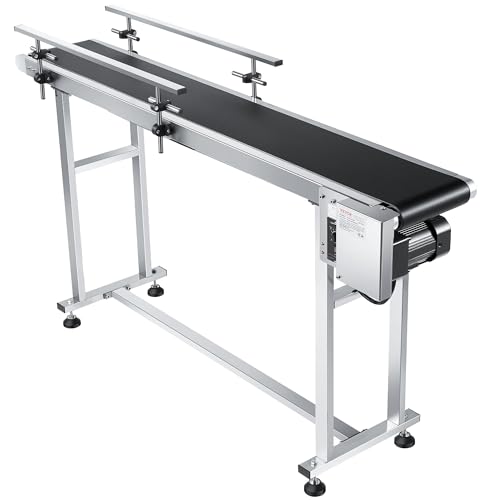
This 59 by 7.8-inch belt conveyor combines a robust stainless steel frame with a PVC belt optimized for wear resistance and anti-static performance. The system supports adjustable belt tension via a rotating screw and features infinitely adjustable support feet to maintain stability in dynamic environments. It runs at speeds from 30 to 120 RPM and can operate in both directions, making it suitable for small to mid-scale assembly lines or packaging tasks. Best for shops needing durable construction plus flexible direction and speed control. A potential limitation is its compact size, which may constrain throughput on larger production lines.
Moonshan Belt Conveyor Desktop 20″, Reverse & Stepless Speed

This Moonshan model is designed for desktop use with a 20-inch belt. It features a reverse switch for flexible flow on production lines and stepless speed control, allowing precise adjustment to match downstream processes. The reverse direction capability supports dynamic manufacturing setups and quick reconfiguration. Best for small workshops, packaging lines, or labs where space is at a premium. A caution: desktop form factors may limit continuous heavy-duty use and require careful placement to avoid tipping during operation.
VEVOR PVC Belt Conveyor 47″ x 7.8″

With a 47 by 7.8-inch PVC belt and 0.08-inch thickness, this VEVOR model emphasizes wear resistance and anti-static properties for reliable transportation of medium-sized items. The system includes a rotating screw for belt tension adjustment and infinitely adjustable feet to stabilize the belt on uneven floors. It accommodates speeds from 30 to 120 RPM and supports bidirectional operation. Best for mid-sized packaging tasks or lab-to-line transfers. Better for those who need a balance of belt surface area and compact footprint; watch for throughput needs if lines require rapid, high-volume movement.
VEVOR Belt Conveyor, 59 x 15.7″ — Inkjet Coding Applications

This larger VEVOR conveyor provides a spacious 59 by 15.7-inch surface, ideal for inkjet coding or similar downstream tasks. The stainless steel frame and anti-static PVC belt support stable, long-term operation with adjustable speeds from 30 to 120 RPM and bidirectional running. Best for production lines requiring a wider belt to accommodate longer items or greater throughput. A potential limitation is the footprint; ensure you have adequate floor space for installation and safe operation.
Buying decisions for conveyor belts depend on several practical factors. Consider belt material, width, length, thickness, motor control, and the ability to adjust speed and direction. Stainless steel frames are preferred for durability and hygiene in food processing or pharmaceutical contexts, while PVC belts with anti-static properties suit electronics or packaging lines that handle static-sensitive items. Whether you need desktop units for small workstations or larger tables for full assembly lines, matching the belt size and speed range to your workflow minimizes downtime and maximizes efficiency.
Buying Guide
What belt material should you choose?
PVC belts are common for general transport due to wear resistance and affordability. Anti-static formulations are advantageous when moving electronic components or products sensitive to static. Stainless steel frames enhance durability and sanitation, suitable for heavy use and clean environments.
Which belt width and length fit my system?
Measure the widest item to be conveyed and account for necessary clearance on both sides of the belt. A wider belt supports more items across the same length, while a longer belt increases surface area for longer items or slower throughput. Ensure mounting or frame space can accommodate the chosen dimensions.
How important is speed control?
Speed control matters for downstream processes such as labeling, coding, or packaging. Systems with stepless or fine-grained speed adjustment allow seamless integration with other equipment. Bidirectional capability is useful when reverse movement is part of your workflow.
What about installation and maintenance?
Look for adjustable feet for level setup, simple tension adjustments with a screw mechanism, and corrosion-resistant finishes for longevity. Regular inspection of belt wear, tension, and guardrails helps maintain safe operation and consistent performance.
Who should consider these specific models?
– For compact lines and robust duty: VEVOR Belt Conveyor, 59 x 7.8″ or 47″ x 7.8″ models are well-balanced choices.
– For desktop or lab environments: Moonshan desktop conveyors are suited to small-scale operations where space is limited.
– For larger packaging or coding tasks: Moonshan 39″ desktop or Moonshan 20″ desktop models provide flexible speed control and reliable direction changes.
– For high-throughput or wide-item handling: The 59 x 15.7″ VEVOR and the larger 59 x 15.7″ model provide more belt surface and robust power for heavier lines.
Short FAQ
- What makes a conveyor belt suitable for packaging lines? Answer: A belt with adequate width, stable drive, smooth surface, and adjustable speed reduces jams and improves throughput.
- Do these belts support bidirectional operation? Answer: Some models offer bidirectional running, which can simplify line configuration and re-routing.
- Is stainless steel necessary for all applications? Answer: Not always; stainless steel is preferred in harsh environments or foodsafe settings, while PVC belts suffice for general transport.
- Can desktop conveyors be used in production? Answer: Yes, for small-scale tasks, testing, or compact workstations; ensure they don’t become a bottleneck for larger lines.
- How do I decide belt tension? Answer: Use the rotating screw adjustment to set belt tension so the belt tracks correctly without slipping under load.
- What maintenance should I perform regularly? Answer: Inspect belt wear, guardrails, tension, and footing; clean surfaces to prevent buildup and ensure safe operation.