The best heavy duty sump pumps for industrial and residential use provide powerful drainage, robust build quality, and reliable operation in challenging conditions. This guide highlights five top picks suited for basements, sewage ejector setups, and below-grade sump pits. Each option targets different needs—from high-flow sewage pumping to rugged cast-iron construction—so you can choose the right fit for your space and water challenge. The buyer types below indicate who benefits most: homeowners needing basement dry-out, contractors handling job sites, and facilities managers requiring dependable daily operation.
| Product | Best For | Key Benefit |
|---|---|---|
| FOTING 1.5HP 9000GPH | Heavy-duty basements and septic setups | Highest flow among selections |
| Tsurumi HS2.4S | Debris-laden water | Integrated agitator and semi-vortex impeller |
| WAYNE CDU790-1/3 HP | Medium drainage, easy install | Top suction design, cast iron and stainless build |
| AQUASTRONG 1 HP 4200 GPH | Groundwater and sump basins with debris | Shreds debris with stainless blades |
| Wayne 3/4 HP | Smaller spaces needing strong flow | Strong performance, corrosion-resistant housing |
The following sections describe each product in detail, including who it’s best for, why it was chosen, and a practical note on limitations or cautions.
FOTING 1.5HP 9000GPH Sump Pump

Best for high-volume needs, this 1.5HP PSC motor pump can move up to 9000 GPH and lift water up to 29 ft. It features a heavy cast iron body, a non-clogging vortex impeller, and a 2″ NPT discharge. An adjustable tethered float switch enables auto or manual operation, and the 10-foot power cord supports straightforward installation. Choose this for basements, septic basins, or submerged installations where solids up to 2″ must be managed. Caution: Do not lift the pump by the power cord to avoid damage.
Tsurumi HS2.4S Submersible Trash Pump

Best for debris-laden water, the HS2.4S uses a semi-vortex impeller and an integrated agitator to handle debris up to 0.3 inches. A 1/2 HP motor on 115V provides reliable power, with a 20-foot cord for flexible placements. The angled 2″ discharge aids hose compatibility and setup. This is ideal for construction sites and remediation projects where solids are present. Caution: Avoid prolonged operation with materials larger than 0.3″ to reduce wear.
WAYNE CDU790-1/3 HP Submersible Sump Pump

Best for compact basements, this 1/3 HP pump handles up to 4,600 GPH with a corrosion-resistant epoxy-coated housing and stainless steel fasteners. The top suction design minimizes air locks and reduces debris-related clogging. It’s quick to install—often under 15 minutes. Choose this when space is limited but reliable daily drainage is needed. Limitation: Lower flow compared to higher-horsepower models.
AQUASTRONG 1 HP Sewage Grinder Pump
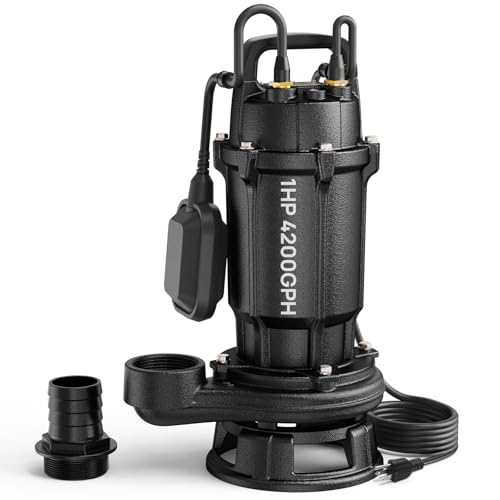
Best for challenging sewage setups, this 1 HP grinder pump delivers about 4200 GPH with a 2″ discharge. Stainless steel blades shred soft and semi-rigid debris, reducing clogs in basements and sump ejector systems. It’s suitable for basement basins and wells, with a 115V single-phase supply. Do not use for gasoline or biogas environments. Caution: Avoid flushing bulky materials that could exceed the grinder’s capacity.
AQUASTRONG Sump Pump 1 HP 4500 GPH

Best for flexible drainage in pools, basements, or window wells, this 1 HP pump yields up to 4500 GPH with a 30 ft lift. It features a bottom suction design for reduced debris intake and a 1-1/4″ discharge compatible with various adapters. It’s portable and has a 10 ft power cord. Caution: Not designed for prolonged running in excessively dirty water without filtration.
Wayne 3/4 HP Heavy Duty Submersible Sump Pump

Best for mid-sized spaces needing strong flow, this 3/4 HP Wayne pump removes up to 5,490 GPH. It uses a stainless steel motor housing and cast-iron volute for durability. The top suction design reduces air lock and clogging. It’s straightforward to install in about 15 minutes. Limitation: For indoor use only.
Buying Guide: Key Purchase Considerations
- Flow rate vs. head height: Higher GPH provides faster drainage, but consider vertical lift (feet) needed from your pit to discharge location.
- Discharge size and fit: Most models use 1.5″ to 2″ discharge; ensure hose or pipe adapters match existing plumbing.
- Material and build: Cast iron and stainless steel housings offer durability in harsh environments; plastic housings are lighter but may wear sooner.
- Float switch options: Auto mode with tethered or built-in switch offers hands-off operation; ensure float range fits your pit depth.
- Debris handling: For sewage or effluent pumps, a grinder or robust impeller reduces clogs; for clean water, a standard impeller may suffice.
- Power supply and cords: Check voltage (usually 115V) and cord length; longer cords provide flexibility but require proper strain relief.
- Installation space: Top suction or compact designs help in tight pits; consider access for maintenance.
FAQs
- What should I consider when choosing a sump pump for a basement with debris? Answer: Look for a grinder or a pump with an integrated impeller designed to handle solids up to 1/4–2 inches, depending on the model.
- How important is the discharge diameter? Answer: A larger discharge (2″ vs 1.5″) improves compatibility with hoses and reduces backpressure, aiding higher flow.
- Is a cast iron body better than stainless steel? Answer: Cast iron offers stiffness and durability for heavy-duty use, while stainless steel resists corrosion in moist environments.
- Can I install these pumps myself? Answer: Many models are designed for quick, DIY installation, typically within 15–30 minutes, depending on pit access and plumbing readiness.
- What maintenance is recommended? Answer: Regularly inspect and clean the intake, check the float switch operation, and verify electrical connections for safety.
- Which pump is best for a high-flow basement sump with frequent water influx? Answer: The FOTING 1.5HP 9000GPH model provides the highest flow among listed options, suitable for heavy-duty scenarios.