When choosing small industrial dust collectors, look for consistent airflow, effective filtration, and sturdy construction fit for a compact shop. This guide highlights five solid options that balance power, portability, and maintenance. It’s ideal for woodshops, hobbyists upgrading from basic vacuums, or small professional spaces needing cleaner air. The buyers below are best for different needs: high-flow tasks and larger debris, quiet operation, easy mobility, and reliable filtration. A quick summary table follows to compare core specs at a glance.
Summary Table
- Jet DC-1100VX-CK — Best overall for durability and single-stage economy.
- Jet JCDC-1.5 — Best cyclone-style separation for higher CFM at mid horsepower.
- VEVOR 1550 CFM — Best for strong airflow and dual-bag storage.
- WEN DC3401 — Best mobile, compact option with solid performance.
- WEN DC3474 — Best wall-mount capability for quick access in tight spaces.
Jet Vortex Cone Dust Collector with 2-Micron Canister Filter

Brand: Jet
Key features: Durable motor design; easy bag installation with quick-connect bags; efficient single-stage operation for economical and quiet use.
Best for: Small shops that want a robust, straightforward single-stage collector with simple maintenance. The fixed 2-micron canister filter helps capture fine dust while keeping operation quiet.
Limitations: Single-stage systems may require more frequent bag changes in very dusty environments compared to cyclone designs.
Jet Cyclone Dust Collector, 2-Micron Filter, 1-1/2 HP

Brand: Jet
Key features: Two-stage cyclone separation; debris pulled down to a 20-gallon steel drum before reaching the filter; direct-mounted filter reduces hose-induced inefficiencies.
Best for: Tasks generating heavy debris where you want more of the airflow by staging debris before filtration. Good for medium-sized shops with multiple tools.
Limitations: Slightly larger footprint than some single-stage units; installation spacing should be considered in tight spaces.
VEVOR Dust Collector, 1550 CFM, 2.5 Micron

Brand: VEVOR
Key features: Powerful 1550 CFM airflow; dual 42-gallon bags for extended operation; 2.5-micron filtration for fine dust.
Best for: Workshops needing strong airflow and longer run times between bag changes, especially when handling both chips and fine dust.
Limitations: Higher power usage; setup may require a dedicated circuit and careful placement for optimal dust collection coverage.
WEN Woodworking Dust Collector, 5.7-Amp
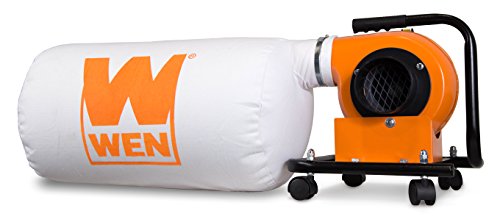
Brand: WEN
Key features: 5.7-amp motor; 12-gallon bag; mobile base; 4-inch dust port; optional wall mount.
Best for: Small to mid-sized shops needing a compact, mobile system that can be wheeled between workstations or mounted on a wall for space efficiency.
Limitations: Lower bag capacity means more frequent emptying in busy sessions; space for routing hoses can influence performance in very tight rooms.
WEN Woodworking Dust Collector, 7.4-Amp with 15-Gallon Bag

Brand: WEN
Key features: 7.4-amp motor; 9-inch impeller; 4-inch dust port; 15-gallon bag; wall-mount option for quick access.
Best for: Shops needing a larger on-wall dust collector with stronger suction and a bigger bag to reduce trips to empty.
Limitations: Heavier than compact units; wall mounting requires secure mounting infrastructure and proper spacing from work areas.
Buying Guide
How Much Airflow Do You Need?
Airflow, measured in CFM, should match your tools and shop size. Larger machines and longer duct runs benefit from higher CFM and efficient filtration. Consider a model with extra capacity to handle peak tasks.
What Filtration Type Is Best?
2-micron to 5-micron filtration covers most woodworking dust. Cyclone designs help keep filters cleaner by separating larger debris first. Decide whether you prioritize finer capture or simpler maintenance.
Mobility vs. Fixed Installations
Mobile units are ideal for multi-tool workflows, while wall-mounted or stationary units save floor space in small shops. Ensure mounting strategies or casters support stable operation.
Maintenance And Bag Capacity
Larger bags reduce downtime but can add weight and require more effort to empty. Consider how easy it is to access bags and whether the unit permits quick bag replacement.
Power And Electrical Considerations
2-Pole or 3-Pole circuits, voltage requirements, and dedicated circuits impact installation. Ensure your shop’s electrical setup can safely support the collector’s motor load.
Noise And Vibration
Single-stage collectors tend to be quieter, while cyclone setups can introduce more mechanical noise. If your workspace is shared or has noise restrictions, factor this into your choice.
Compatibility With Tools And Ducting
Check that the dust collector’s inlet size matches your tools’ ports and that you can integrate hoses and ducts without excessive bends that reduce suction.
FAQ
- What is the difference between single-stage and cyclone dust collectors?
Single-stage units filter air after the blower, while cyclone units use a two-stage approach to separate debris before filtration, improving efficiency for larger debris. - Is a higher CFM always better for a small shop?
Not always. Higher CFM helps with larger tools and longer duct runs, but it may be unnecessary if you have a compact space and limited dust output. - Can I use these collectors with wall mounting?
Yes, several models offer wall-mount options or are portable. Check weight, mounting hardware, and space before installation. - How often should I replace or clean the filter?
Frequency depends on usage and dust load. Follow the manufacturer’s guidelines and inspect the filter for clogging signs regularly. - Do these units require professional installation?
Most do not, but electrical considerations and proper ducting can benefit from professional input in complex setups.