Answering the needs of industrial spaces, garages, warehouses, and outdoor work zones, portable industrial air conditioners deliver robust cooling without permanent installation. This guide highlights five reliable options, clarifying who each unit is best for and why. The top picks emphasize durability, high BTU output, and ease of mobility. Use this to compare cooling capacity, condensate handling, and noise levels to choose the right spot cooler for your workflow. Below is a quick buying table to compare key specs at a glance.
| Product | BTU / Capacity | Best For | Notable Consideration |
|---|---|---|---|
| Amarite Industrial Spot Air Conditioner | 6000 BTU | Small to mid-size spaces; intradepartmental work areas | R32 refrigerant; quieter operation |
| BILT HARD 6,800 BTU Industrial Spot Cooler | 6,800 BTU | Compact factories and workshops | Water tank, portable with wheels |
| BILT HARD 12,000 BTU Portable Air Conditioner | 12,000 BTU | Large shops and warehouses | Higher capacity; condensate tank |
| HayWHNKN 11,000–12,000 BTU Spot Cooler | 12,000 BTU (approx) | Big spaces, indoor/outdoor use | Dual-hose design enhances efficiency |
| DREO Portable Air Conditioner 12,000 BTU | 12,000 BTU | Bedrooms to large rooms with smart controls | Smart control options; drainage-free option |
Amarite Industrial Spot Air Conditioner

Best for compact industrial setups, the Amarite 6000 BTU model emphasizes reliability with an all-copper wire compressor for stability and longevity in garages and light warehouses. It uses R32 refrigerant to reduce environmental impact and supports quiet operation for hosted work sessions or break-times. Best for: small workshops, maintenance bays, and limited-space spots where portability matters.
Why selected: This unit focuses on stability and low noise while maintaining solid cooling, making it a practical choice where space and noise control are priorities. Caution: The 6000 BTU capacity is best for smaller server rooms or modest industrial areas; larger inventories may require higher BTU units.
BILT HARD 6,800 BTU Industrial Spot Cooler
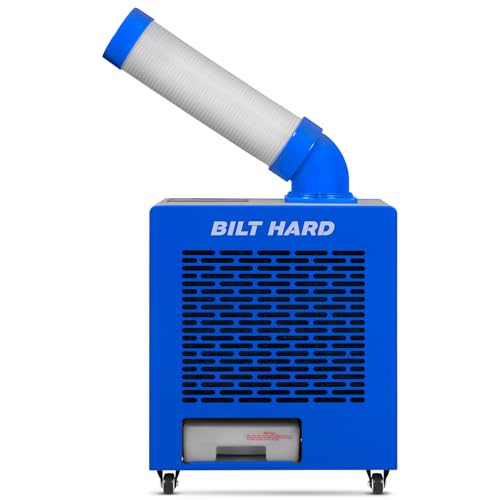
Best for small to mid-size industrial spaces, this 6,800 BTU unit pairs robust cooling with efficient 115V operation and eco-friendly R32. It features a fully enclosed rotary compressor, high-efficiency aluminum blades, and a 0.8 gallon condensate tank. Best for: compact warehouses, manufacturing corners, and machine shops needing steady, directional cooling. Caution: Water tank capacity is modest—plan for intermittent drainage in high-humidity environments.
BILT HARD 12,000 BTU Portable Air Conditioner

Best for larger spaces or demanding industrial zones, this 12,000 BTU spot cooler delivers strong cooling with a 1-ton capacity and 380 CFM airflow. It uses R32 refrigerant and is designed for mobility with four universal wheels and a directionally adjustable duct. Best for: big workshops, assembly lines, or warehouse bays requiring robust, moveable cooling. Caution: Higher BTU units may require careful duct placement to maximize efficiency.
HayWHNKN 12,000 BTU Industrial Spot Cooler

Best for large indoor/outdoor spaces, the HayWHNKN model emphasizes high efficiency with aluminum blades and dual-hose setup for improved cooling reach. It includes a 14L water tank and easy mobility with four wheels. Choose this if you need stronger airflow across larger footprints and more flexible exhaust routing. Caution: Assembly and setup may be more involved than single-hose designs.
DREO Portable Air Conditioner 12,000 BTU

Best for rooms that require smart control and quiet operation, the DREO 12,000 BTU unit offers a true 12,000 BTU capacity with app/voice/remote control options. It provides duct flexibility, drainage-free cooling in certain conditions, and a 61–86°F adjustable range. Best for: offices near production floors, control rooms, or spaces needing quiet cooling. Caution: Some features may rely on smart connectivity; verify compatibility with your setup.
Buying Guide: Key Considerations For Portable Industrial A/C
- Cooling Capacity: Match BTU to space size and heat load. Industrial spaces often benefit from 6,000–12,000 BTU units; larger rooms may require multiple units or 12,000 BTU+ models.
- Single vs. Dual Hose: Dual-hose models pull in away-from-room air to cool more efficiently and reduce indoor humidity; single-hose units are simpler but may be less efficient in large spaces.
- Ventilation and Ducting: Check duct length, directional flexibility, and ease of directing cold air exactly where needed in work zones.
- Condensate Management: Tanks and drainage ports simplify maintenance; drainage-free or auto-evaporating designs reduce manual emptying in humid environments.
- Power Requirements: Most units run on standard 115V outlets; monitor amperage, especially for high-BTU models in spaces with limited electrical capacity.
- Portability: Wheels, handles, and secure positioning matter for frequent relocations between work areas or shifts.
- Refrigerant Type: R32 is common and more eco-friendly than older R22; confirm refrigerant compatibility with your facility’s environmental standards.
Frequently Asked Questions
- What size portable industrial air conditioner do I need for a workshop? Answer: Estimate the space in square feet and consider heat sources; for many workshops, 6,000–12,000 BTU units cover mid-to-large areas, with larger spaces requiring multiple units or higher BTU capacity.
- Are dual-hose units better for industrial settings? Answer: Yes, dual-hose units typically deliver more efficient cooling and better humidity control in large spaces, especially when exhaust air is drawn from outside the area.
- Is R32 refrigerant safe for indoor use? Answer: R32 is widely used for its lower environmental impact compared with R22; ensure proper ventilation and installation by a professional if needed.
- Can these units operate continuously in warehouses? Answer: They are designed for continuous use in industrial environments, but follow manufacturer guidelines on maintenance, condensate handling, and electrical load.
- Do these units require drainage? Answer: Some models include drainage ports or tanks; others are drainage-free depending on humidity and operating conditions.
- How portable are these units in practice? Answer: Most units include wheels and handles for mobility; some models offer quick-rotate ducts and multiple mounting options for flexible placement.