Finding a reliable heat exchanger can help maintain the perfect pool temperature while keeping energy use in check. This article reviews five top options designed for swimming pools, spas, and hot tubs, highlighting material quality, heat capacity, and ease of installation. Each product section includes a quick look at key features to help you compare options at a glance.
| Product | Material | Approx. Capacity | Connection Size | |
|---|---|---|---|---|
| AB Swimming Pool Heat Exchanger 360kBtu | 316L Stainless Steel | 360 kBtu/hr | 2″ & 1 1/2″ FPT | Large pools, high-demand heating |
| JENLER Swimming Pool Heat Exchanger | 304 Stainless Steel | Efficient heat transfer (high efficiency) | Standard fittings | Versatile installations |
| AB Pool Heat Exchanger 210 kBtu | 316L Stainless Steel | 210 kBtu/hr | 1 1/2″ & 1 1/2″ FPT | Smaller to mid-size pools |
| DEIGEHJRE Pool Heat Exchanger | 304 Stainless Steel | 200 kBtu/hr | 1″ & 1 1/2″ FPT | Durable, fast heating |
| AB Pool Heat Exchanger 300 kBtu | 316L Stainless Steel | 300 kBtu/hr | 2″ & 1 1/2″ FPT | High-capacity, spa and pool heating |
Note: The table above provides a snapshot. Individual setups should consider system flow, water chemistry, and heater compatibility to optimize performance and longevity.
AB Swimming Pool Heat Exchanger 360kBtu

AB’s pool heat exchanger employs a spiral twist bellows design intended to maximize energy conversion and provide economical heating. It supports a substantial heating capacity suitable for larger pools, with a 360 kBtu/hr rating based on a 60°C (140°F) temperature difference. Constructed from corrosion-inhibited stainless steel 316L, it’s designed for environments treated with pool chemicals. The unit ships with mounting brackets for easier installation and offers two ports: 2″ FPT for pool water and 1 1/2″ FPT for hot water. Maintenance is described as straightforward to protect service life and minimize ongoing costs.
Key considerations
- Material: 316L stainless steel ensures corrosion resistance in chemically treated water.
- Installation: Brackets included; check space for two-port setup.
- Compatibility: Ensure matching temperature differentials and flow rates with your heat source.
JENLER Swimming Pool Heat Exchanger

JENLER’s exchanger is crafted from premium 304 stainless steel, delivering rust and saltwater resistance for durability in pool, spa, and hot tub environments. It emphasizes efficient heat transfer with minimized pressure loss, supporting reliable heating in a variety of systems. The unit is compatible with solar heating setups (solar panels not included), broadening its environmental appeal. Its versatile design makes it suitable for homeowners, fitness enthusiasts, and anyone seeking steady water temperatures across different installations, from residential pools to spa configurations.
Key considerations
- Material: 304 stainless steel offers strong corrosion resistance.
- Efficiency: Designed to maximize heat transfer and minimize pressure drop.
- Flexibility: Works with multiple heating configurations, including solar-assisted setups.
AB Pool Heat Exchanger 210 kBtu

This AB model offers a 210 kBtu/hr capacity with full 316L stainless steel construction. It uses same-side ports with 1 1/2″ FPT connections, simplifying retrofits or new installations where compact footprint matters. The corrosion resistance and chemical compatibility align with standard pool treatment regimes, and AB provides a one-year warranty against manufacturer defects, signaling a commitment to reliability for mid-range pool heating needs.
Key considerations
- Capacity: Suitable for mid-sized pools or spa-hot tub combos.
- Construction: 316L stainless steel for durability and chemical resistance.
- Warranty: Manufacturer-backed protection reduces ownership risk.
DEIGEHJRE Pool Heat Exchanger
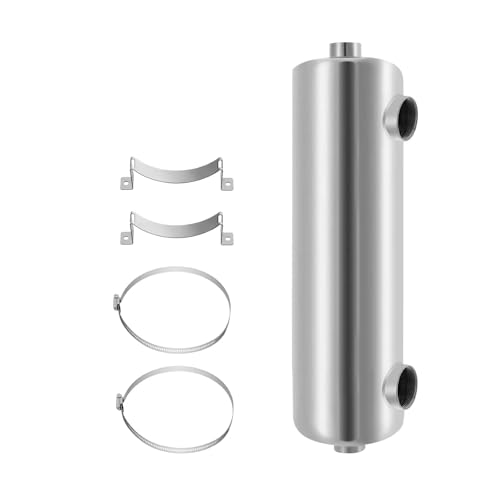
DEIGEHJRE’s unit uses 304 stainless steel to withstand demanding pool environments and deliver reliable heat transfer. With a 200 kBtu/hr rating, it provides fast heating for pools and spas, especially when there is a temperature difference of around 60°C (140°F) between hot and incoming water. The design supports constant temperature maintenance and is suitable for various high-temperature applications. This exchanger emphasizes quick response times and durable construction for long-term operation.
Key considerations
- Heating speed: 200 kBtu/hr helps warm water rapidly.
- Durability: 304 stainless steel resists corrosion and deformation.
- Versatility: Works across pools, spas, and hot tubs with compatible circuits.
AB Pool Heat Exchanger 300 kBtu
This AB unit delivers 300 kBtu/hr, making it a strong choice for larger pools or when heating needs exceed mid-range systems. It uses 316L stainless steel and features same-side ports with 2″ and 1 1/2″ FPT connections. The product emphasizes corrosion resistance and a one-year warranty, signaling suitability for regular pool use with chemical treatment. Its robust construction supports sustained performance in demanding environments.
Key considerations
- Capacity: High-capacity option for sizable pools or spa combinations.
- Material: 316L stainless steel for longevity with chemical exposure.
- Warranty: 1 year to cover manufacturer defects.
Buying Guide: Key Purchase Considerations
When selecting a pool heat exchanger, consider the following factors to ensure the best fit for your system and climate:
-
<liHeat capacity and flow: Match the exchanger’s BTU rating to your pool size, desired temperature rise, and circulation flow. Oversizing can waste energy, while undersizing may fail to meet heating needs.
- Material and corrosion resistance: Stainless steel 304 or 316L provide durable resistance to pool chemicals and saltwater. The environment (chlorine, salt, and pH levels) influences longevity.
- Port size and configuration: Check inlet/outlet thread sizes (FPT) and port arrangement (same-side or opposite-side) to ensure compatibility with existing plumbing and heat sources.
- Installation and maintenance: Look for units with straightforward mounting and accessible cleaning provisions. Brackets and warranty terms add long-term value.
- Compatibility with heat sources: Ensure the exchanger is compatible with your heater, solar system, or boiler. Some units pair well with solar panels as an environmental feature, though solar panels may not be included.
- Warranty and service: A clear warranty and accessible support reduce risk. Check what defects are covered and for how long.
- Operational efficiency: Consider models with design features that maximize heat transfer while minimizing pressure drop to improve overall system efficiency and energy savings.
To optimize performance, ensure proper sizing for your pool, verify chemical compatibility, and schedule professional installation if needed. A correctly matched heat exchanger can maintain comfortable water temperatures with efficient energy use across seasons.