Answering the need for on-the-spot weighing during material handling, these pallet trucks integrate precise scales with reliable lifting. They are best for warehouses, distribution centers, and retail logistics teams that value faster stock checks and streamlined workflows. The top picks below cover high capacity, durable build, and user-friendly weighing displays to support inventory accuracy and faster shipment processing. This guide targets buyers seeking a compact, powered or manual scale pallet jack that keeps weight data readily available during transport.
- Product focus: heavy-duty weighing pallet jacks with built-in scales
- Best for: medium-to-large facilities with frequent weigh-and-move tasks
- Considerations: capacity, readability, battery life, and durability
Product Comparisons
| Product | Capacity | Fork Size | Key Scale Feature | Best For |
|---|---|---|---|---|
| SUNMAX Full-Electric Pallet Jack | 4400 lbs | 48″ x 27″ | High-precision A/D, weighs and counts, livestock function | |
| Kaixun Pallet Jack Scale | 6600 lbs | 45″ x 27″ | ±0.1% accuracy, Lb/Kg display | |
| APOLLOLIFT Scale Pallet Jack | 5500 lbs | 45″ x 27.7″ | 0.1% weighing accuracy, long battery life | |
| 5Seconds Pallet Jack Scale Truck | 5500 lbs | 27″ x 48″ | 0.1% readability, built-in digital scale | |
| VisionTechShop TPS-1 | 5000 lbs | 48″ x 27″ | Lb/Kg switch, 2″ LCD with backlight |
SUNMAX Full-Electric Pallet Jack With Built-In Scale
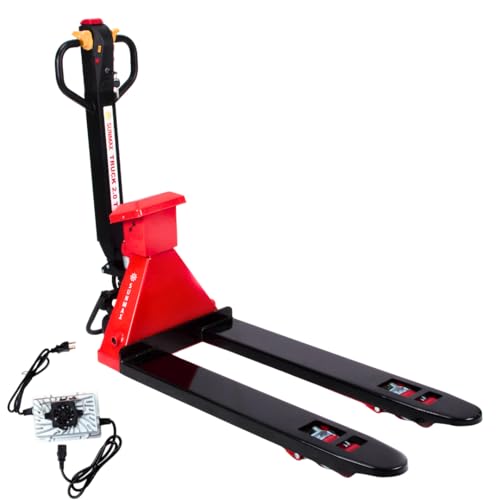
Capacity and speed deliver heavy-duty performance. Best for facilities that demand rapid transport with on-the-fly weighing and counting. The device includes an internal scale with high-precision A/D conversion and a livestock function for specialized weighing tasks. It features electronic brakes and an emergency stop for safety. Caution: higher upfront cost versus manual options, and maintenance needs may be greater due to electric components.
Kaixun Pallet Jack Scale

With a 6600 lbs capacity and an LCD that switches between pounds and kilograms, this model is ideal for users who need precise measurements in mixed-unit environments. The long battery life supports extended shifts, and its fast recharge minimizes downtime. Choose this if you require the highest capacity among manual-scale options and robust battery performance. Limitation: heavier build may impact maneuverability in tight spaces.
APOLLOLIFT Scale Pallet Jack

This scale pallet jack integrates weighing with transportation to streamline workflow. It offers 0.1% weighing accuracy and a long battery runtime. Best for warehouses seeking quick weight checks without separate scales. Caution: ensure battery maintenance aligns with daily usage to avoid downtime during peak operations.
APOLLOLIFT Scale Pallet Truck
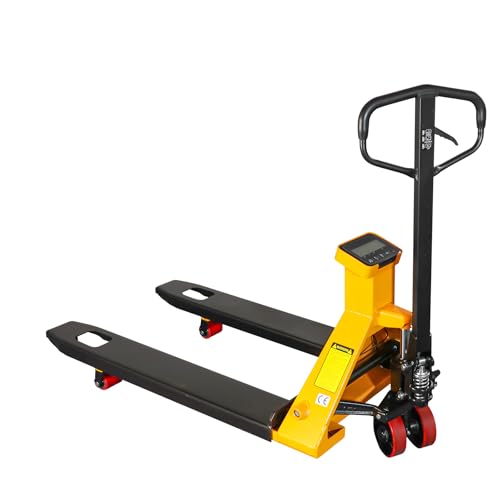
Equipped with a 6″ angled LCD with LED backlight and easy unit switching, this scale improves readability in dim environments. It carries a 5500 lbs capacity and IP54-rated protection for dust and moisture. Best for facilities requiring rugged protection and clear readouts. Limitation: heavier construction may require more floor clearance during turning.
5Seconds Pallet Jack Scale Truck

This model combines a 5500 lb capacity with a 0.1% readability scale. It is well-suited to warehouses requiring one-step weighing and movement. Best for high-volume environments where quick inventory checks are essential. Caution: the shorter forks may limit pallet compatibility with certain loads.
VisionTechShop TPS-1 Pallet Jack Scale

Equipped with Lb/Kg switchable weighing and a 5000 lbs capacity, this model emphasizes readability with a large backlit LCD. It is ideal for warehouses needing straightforward, durable measurement alongside transport. One potential caveat is ensuring the battery and electronics are compatible with your facility’s maintenance routines.
Buying Guide
What capacity do you need?
Choose a pallet jack with a capacity that covers your heaviest pallets. If you frequently handle pallets near the limit, consider models in the 5500–6600 lbs range for safety and longevity.
Should you prioritize handheld readability or digital precision?
Look for a scale with a high-precision reading (0.1% is common) and a readable display. Lb/Kg switchable units help staff in mixed-unit environments and improve accuracy in shipping records.
What about power vs. manual operation?
Electric models speed up travel and reduce manual effort, but require charging and more maintenance. Manual-scale jacks are simpler and typically less expensive, with lower downtime risk due to battery issues.
Battery life and charging considerations
Long battery life is essential for long shifts. Check expected runtime per charge and recharge times. Fast charging minimizes downtime during peak periods.
Durability and environment
Assess IP ratings, steel construction, and protection against dust and moisture. In dusty or damp environments, IP54 or similar protections help prevent scale and electronics damage.
Which features drive best value?
High capacity plus precision scale, easy-to-read displays, quick unit switching, and reliable safety features (emergency stop, electronic brakes) typically indicate better value for most warehouses.
FAQ
Q: Are pallet jack scales accurate enough for shipping documentation?
A: Yes, most models advertise 0.1% weighing accuracy, which is suitable for inventory checks and basic shipping records when used as part of a defined workflow.
Q: Do these scales work with standard pallets?
A: Most models use standard fork dimensions (around 27″ to 48″ fork widths) and are designed for common pallet sizes, but confirm fork length and pallet compatibility with your load types.
Q: Can I use these indoors and outdoors?
A: Indoor use is common. Weather resistance varies; models with IP54 protection are better suited for areas with dust or light moisture. Always store in appropriate conditions when not in use.
Q: How important is the display size?
A: A larger LCD or backlit display reduces reading errors, especially in low-light facilities or busy warehouses where quick checks are essential.
Q: What maintenance is required?
A: Regular battery charging, calibration checks, and inspection of wheels and forks help maintain accuracy and safety. Follow manufacturer maintenance guidelines for best results.