Answering the common buyer intent: these industrial water cooling systems keep CO₂ laser tubes and laser engravers within safe temperatures during operation, reducing downtime and extending tube life. The top picks below are best for: construction-focused workshops needing reliable continuous cooling, studios running higher-wattage lasers, and multi-device setups that demand efficient heat dissipation. The table compares key specs for quick reference.
| Product | Max Flow | Tank Capacity | |
|---|---|---|---|
| VEVOR CW-3000 | 12 L/min | 12 L | Up to 80W CO2 lasers; air-cooled |
| VEVOR CW-6000 | 65 L/min | 15 L | Two 300W setups; high-demand workflows |
| OMTech CW-5202 | 3.2 GPM (≈12 L/min) | 6 L | Two devices; up to 150W tubes |
| VEVOR CW-3000 (alternate use) | 12 L/min | 12 L | CO2 laser cooling; air-assisted |
| S&A CW-5000 DG | 2.64 GPM (≈10 L/min) | 7 L | 80W-100W tubes; compact setups |
VEVOR CW-3000 Industrial Water Cooler

The CW-3000 is an air-cooled, 12 L/min system designed to cool CO₂ laser tubes up to 80W. It uses a 30W water pump and a 12 L tank to sustain cooling without frequent refills. An observation window helps monitor water levels at a glance. Best for small to mid‑range CO₂ laser setups that require reliable, compressor-free cooling.
Who this is for: shop operators with limited space and a need for quiet, low-maintenance cooling. Why selected: simple airflow-based cooling minimizes moving parts, reducing failure points. Caution: performance can taper with very high ambient temperatures or continuous high-wattage loads beyond 80W.
VEVOR Industrial Water Chiller, 5460 BTU/h
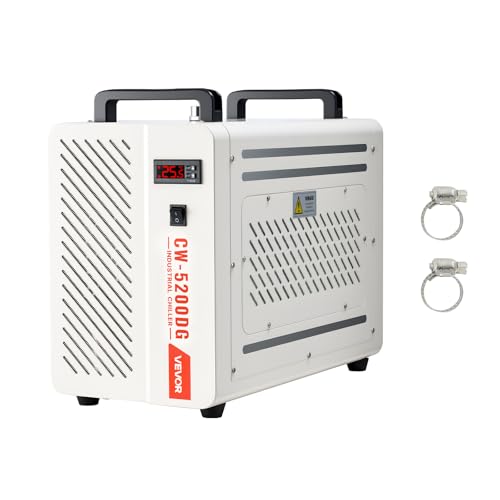
This chiller uses a compressor-driven cooling system to rapidly remove heat from laser tubes up to 150W. It offers 1.8 gal (7 L) tank capacity and a maximum flow of 3.4 GPM (13 L/min). Features constant temperature and intelligent modes for stable operation. Best for mid-to-large laser setups that require precise temperature control.
Who this is for: facilities needing consistent cooling with a reliable temperature setpoint. Why selected: stronger cooling capacity than entry-level chillers; modern control modes help maintain stability. Caution: requires proper electrical setup (single-phase 205–240V) and clearance for airflow around the unit.
VEVOR Industrial Water Chiller, 5460 BTU/h (4.2 GPM)

This model doubles the flow to 4.2 GPM with a 7 L tank and a compressor-based cooling system. It maintains temperature in constant or ambient-adaptive modes and uses a viewing window for refill reminders. Best for operators who need faster coolant circulation for multiple devices or higher watts within the 150W range.
Who this is for: workshops running multi-device or higher-demand lasers. Why selected: higher flow supports quicker heat removal; the dual-mode control adds flexibility. Caution: higher flow may require more powerful pumps and adequate electrical supply.
VEVOR CW-6000 Industrial Water Chiller

The CW-6000 pushes 65 L/min with a 15 L tank and is built to cool two 300W laser tubes simultaneously. Its 3.5 kW cooling capacity and brisk circulation keep two high-load devices at stable temperatures longer. Best for dual-tube applications or higher-wattage laser systems.
Who this is for: operations with dual lasers or frequent high-volume cuts. Why selected: robust flow and tank size minimize refills during long sessions. Caution: higher energy draw and larger footprint; ensure adequate ventilation.
VEVOR Industrial Chiller, 27,300 BTU/h

This high-capacity chiller is designed for one 600W or two 300W laser tubes, delivering 18.5 GPM max and a 40 L tank. It supports demanding operations and large-format engraving tasks. Best for professional shops with multiple high-wattage tubes running concurrently.
Who this is for: industrial facilities needing maximum cooling capacity for multiple high-power lasers. Why selected: superior flow and large tank support continuous duty. Caution: large unit with significant power and installation considerations.
Buying Guide
What size and capacity do you need?
Match tank capacity to your typical run length. Larger tanks reduce refill frequency but require more space. Consider your average duty cycle and whether you run a single high-wattage tube or multiple devices.
What level of flow matters for you?
Higher GPM or L/min numbers translate to faster heat removal. If you operate at 100W+ lasers or run two devices, seek models with 3–4+ GPM or 13–18 L/min and a robust pump.
Compressor vs. air-cooled systems
Compressor-based chillers can offer precise temperature control and stronger cooling for higher wattages. Air-cooled options are quieter and simpler but may be less effective at sustained high loads.
Temperature control and modes
Look for dual modes: constant temperature for precise setpoints and ambient/intelligent modes that adjust to environment. This helps prevent overheating during longer sessions.
Installation considerations
Ensure adequate space for the unit, proper ventilation, and compatible electrical supply. Check clearance for air intake/outlet and for maintenance access to the fill port and viewing window.
Maintenance and reliability
Choose units with corrosion-resistant inlet/outlet fittings and clear fill indicators. Brass ports and sealed tanks reduce leaks and evaporation, supporting longer service intervals between fills.
Which setup is best for you?
- Small shop or hobbyist: consider compact, air-cooled CW-3000 variants for up to 80W tubes.
- Mid‑volume lab or shop with one high-wattage laser: a 5460 BTU/h chiller with 7 L tank provides stable control and adequate flow.
- Dual-laser operations or higher wattage: large-capacity models like the CW-6000 or the 27,300 BTU/h chiller deliver the necessary cooling headroom.
FAQ
- What is the difference between air-cooled and compressor chillers?
Answer: Air-cooled chillers rely on ambient air for cooling and are simpler, while compressor chillers actively remove heat with refrigerant, offering more precise control for higher power loads. - How do I know if I need a dual-device chiller?
Answer: If you run two CO2 laser tubes or plan to operate multiple devices concurrently, a unit with dual ports and higher flow provides safer temperature margins. - Can I use these chillers with different voltage supplies?
Answer: Many models are designed for common residential or shop voltages; check the specific unit for single-phase AC requirements and any voltage restrictions. - Is a larger tank always better?
Answer: A larger tank reduces refill frequency but increases unit size. Balance tank size with available space and your typical run time. - Are brass fittings important?
Answer: Yes, brass inlet/outlet fittings offer better corrosion resistance and leak resistance over time, especially in humid workshop conditions. - Do these units require maintenance?
Answer: Regularly check coolant levels, observe the viewing window, and ensure vents and fans are free of dust to maintain cooling efficiency.