Answering buyer questions about industrial-grade battery charging, recovery, and maintenance. This guide highlights five reliable options that cater to fleets, workshops, and serious DIY users. Each product is evaluated for durability, versatility, and ease of use in demanding environments. The sections below explain who each model is best for, why it’s a strong choice, and any practical limitations to consider.
Quick Buyer’s Guide
| Product | Best For | |
|---|---|---|
| Schumacher SC1445 | Automotive fleets and heavy-use garages | 250A engine start, 135-minute timer |
| CRAFTSMAN CMXCESM233 | All-in-one starting and charging needs | 2-in-1 device with multiple boost and charge modes |
| DeWalt DXAEC200 | Professional shops needing alternator check | 200A engine start, 40A charging, 3A maintainer |
| TowerTop Battery Charger | Multiple battery types and long-term maintenance | 4 current settings, auto desulfator, winter mode |
| Schumacher SC1364 | 4-in-1 versatility for 12V systems | Starter, charge, maintain, recondition |
Note: All models are designed for 12V and/or 6V lead-acid batteries commonly used in automotive, marine, and industrial applications. When selecting, consider battery type (AGM, gel, flooded, deep-cycle), required engine-start power, and whether you need maintenance or desulfation features for extended battery life.
Schumacher Electric Wheeled Manual 10A Car Charger with 250A Start, SC1445

Overview: A rugged, wheeled unit with a 250A engine start and a 135-minute manual timer for precise charging control. Best for fleets and high-demand vehicles where rapid restarts and controlled charging are essential. The durable steel case and integrated wheels support frequent shop use.
Best for: Vehicle fleets, trucks, and high-performance cars that require immediate engine starts and managed charging cycles.
Why chosen: Combines strong starting power with adjustable charging control, reducing downtime and enabling tailored maintenance cycles.
Caution: Heavier unit may require more storage space and can be less convenient for small, home garages.
Associated Equipment US20 6/12V Value Battery Charger Blue 24 Inch

Overview: A value-priced charger designed for basic 6V/12V batteries with a compact 24-inch form factor. Best for light-duty applications or as a budget backup charger in a shop or field service kit.
Best for: Small garages or hobbyists needing a straightforward charger without advanced maintenance features.
Why chosen: Simple operation and US-made identity make it a practical entry point for essential charging needs.
Caution: Lacks advanced desulfation or automatic shutoff features found in higher-end models.
CRAFTSMAN Wheeled Manual 10A Charger & 250A Start, CMXCESM233

Overview: A 2-in-1 device that starts and charges with a 250A engine start, 50A boost, and a 25A/10A charging schedule. The 135-minute timer gives precise control over charging stages.
Best for: Shops needing a versatile tool to quickly bring a battery up to charge while also offering a strong engine-start capability.
Why chosen: The integrated timer and multiple boost options enable efficient handling of varying battery states and vehicle types.
Caution: Heavier and larger than compact units, which may impact storage in smaller spaces.
DeWalt DXAEC200 Professional Rolling Charger, 200A Start

Overview: A professional rolling charger with a 200A engine start, 40A charging, and a 3A maintainer. It also checks the alternator and can recondition a battery for potential recovery of degraded capacity.
Best for: Businesses that require an all-in-one unit for starting power, regular charging, and diagnostics in a workshop setting.
Why chosen: The built-in alternator check and reconditioning capability add diagnostic value beyond basic charging.
Caution: Primarily designed for lead-acid batteries; compatibility with certain newer chemistries may be limited.
TowerTop 12V Smart Car Battery Charger

Overview: A 12V charger with 4 current settings (2A/10A/25A/AUTO) and a 25A max output. It includes auto-desulfation, engine start capability, and winter mode. It is designed for a broad range of 12V sealed lead-acid batteries.
Best for: Users who need an adaptable charger that can handle multiple battery types and provide ongoing maintenance during storage.
Why chosen: The auto-desulfation and memory of last settings make it convenient for seasonal use and long-term maintenance cycles.
Caution: Not explicitly listed for lithium or LiFePO4 chemistries; verify battery compatibility before use.
Schumacher Electric Wheeled Automatic 6A Charger and 150A Start, SC1364

Overview: A 4-in-1 device that starts, charges, maintains, and reconditions batteries with a 150A start and 6-amp to 2-amp charging range. Includes a smart trickle charge to avoid overcharging.
Best for: Shops needing a versatile, ready-to-use unit that supports multiple stages of battery care for automotive and marine use.
Why chosen: The 4-in-1 functionality provides flexible options for battery recovery and ongoing maintenance in one device.
Caution: May be larger and heavier than basic chargers, requiring more storage and setup space.
Schumacher Electric Wheeled Automatic 6A Charger and 300A Start, SC1400
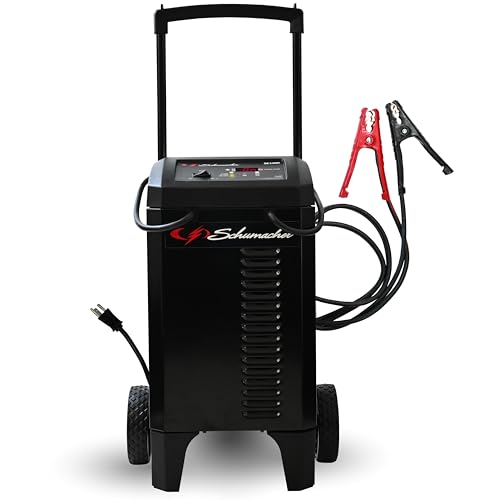
Overview: A high-power 4-in-1 device with 300A engine start, 60A to 20A boost charging, and both 12V and 6V charging/maintaining modes. Includes automatic trickle maintenance to protect batteries over time.
Best for: Heavy-duty applications where maximum starting power plus continuous maintenance is required for mixed fleets or large marine installations.
Why chosen: The combination of high-start current and broad charging options makes it suitable for frequent critical starts in industrial settings.
Caution: Higher power draw means more robust electrical setup is necessary; ensure adequate space and power supply in workshops.
Buying Guide
What to consider when choosing an industrial battery charger
- Battery type compatibility: Check if the unit supports AGM, GEL, flooded, EFB, MF, and deep-cycle batteries. Some models exclude lithium-based chemistries.
- Starting power vs. charging rate: Higher engine-start amperage is essential for fleet vehicles and heavy equipment; balance with a suitable charging current for routine maintenance.
- Maintenance features: Look for automatic shutoff, trickle charging, auto-desulfation, and reconditioning modes to extend battery life.
- Durability and mobility: For shop environments, select units with steel casings, wheels, handles, and good protective features.
- Diagnostics and alternator checks: If vehicle health visibility matters, prefer models with alternator testing or reconditioning options.
How to compare models quickly
- Powerful engine-start capability (e.g., 150A–300A) is best for fleets or large batteries.
- Maintenance and desulfation features help protect long-term battery health in seasonal or remote operations.
- All-in-one devices are convenient but may be bulkier; ensure workspace fit.
FAQ
- What battery types are these chargers compatible with? Most support lead-acid variants (AGM, GEL, flooded, EFB, deep-cycle). Check each model for lithium compatibility.
- Can these chargers start engines? Yes, many offer high-amp engine starts (ranging from 150A to 300A) for quick restarts.
- Do they include a maintenance or desulfation mode? Several models feature smart trickle charging, auto shutoff, and desulfation to extend battery life.
- Is a diagnostic function available? Some units include alternator checks and battery reconditioning to assess battery health.
- Are these portable? Many models are wheeled for mobility in garages and service yards.