Answering buyers seeking reliable tri-clamp butterfly valves for sanitary or industrial use, this guide highlights five top options. These valves suit brewing systems, dairy processing, fermentation vessels, and clean-in-place operations. The best picks balance durability, temperature tolerance, and compatibility with 1.5″ or 2″ tri-clamp fittings. This overview helps choose a valve by tubing size, clamp compatibility, and sealing performance, without guessing about long-term reliability.
Summary table of selected products:
| Product | Tube OD | Material | Best For | |
|---|---|---|---|---|
| Pindex 2 Pack 1.5 Inch | 1.5″ (38 mm) | 304 Stainless Steel | Small-batch fermenters, home brewers | Includes four gaskets |
| DERNORD 2 Inch Tri Clamp Sanitary Butterfly Valve | 2″ | 304 Stainless Steel | Larger vessels, commercial setups | Higher ferrule size |
| DERNORD 2 Pack 1.5 Inch Tri Clamp | 1.5″ | 304 Stainless Steel | Compact systems, easy replacement | Pull handle option |
| JMCOLMT 1.5 Inch Butterfly Valve | 1.5″ | 304 Stainless Steel | Sanitary lines, quick access | Hydraulically tested |
| QiiMii 1.5″ Sanitary Tri Clamp | 1.5″ | 304 Stainless Steel | Precision control in CIP lines | Two pack, EPDM seal |
Notes: All products use 304 stainless steel tri-clamp connections and are designed for temperatures roughly from 15°F to 200°F. The best choice depends on tube diameter, clamp compatibility, and the specific application—brewing, dairies, or industrial processing.
Pindex 2 Pack 1.5 Inch Tri Clamp Butterfly Valve

Pindex offers a two-pack of 1.5″ tri-clamp butterfly valves with pull handles and a full set of 1.5″ TC fittings. Best for smaller fermentation queues or hobbyist setups where quick valve adjustments matter. The valves use 304 stainless steel and provide a high-density gasket seal for water and dust protection, with IP68-rated protection for added reliability in damp environments. Suitable for low to moderate pressure systems (≤10 bar / 145 psi) and temperatures from 15°F to 200°F.
Who this is best for: home brewers, small-batch fermenters, or DIY dairy setups needing a compact 1.5″ valve with robust gasket sealing. Why selected: strong gasket design and complete 1.5″ TC compatibility. Caution: ensure gasket replacement availability and check ferrule tolerances for your exact tubing dimension.
DERNORD 2 Pack 2 Inch Tri Clamp Sanitary Butterfly Valve

DERNORD’s 2″ tri-clamp butterfly valves are designed for larger sanitary lines and higher flow scenarios. They use 304 stainless steel with a 2″ ferrule and a support structure suitable for commercial vessels. Temperature range aligns with typical CIP lines (15°F to 200°F), and the valve is rated for a maximum pressure around 1.6 MPa. Best for: dairies, breweries, or fermentation systems requiring a larger valve and sturdy tri-clamp interface. Caution: larger ferrule size requires compatible clamps and space considerations in compact installations.
DERNORD 2 Pack 1.5 Inch Tri Clamp Sanitary Butterfly Valve

This 1.5″ option from DERNORD brings a compact, high-durability valve with pull handle, built for 1.5″ tri-clamp connections. It’s ideal for smaller lines in breweries and clean environments where space is limited. The valve is made from 304 stainless steel and rated for operation in the 15°F to 200°F range, with a maximum pressure around 1.6 MPa. Best for: smaller production runs or retrofit projects needing quick valve access. Caution: ensure the 1.5″ ferrule and gasket fit your existing clamps exactly to prevent leaks.
JMCOLMT 1.5 Inch Butterfly Valve With Pull Handle

JMCOLMT offers a 1.5″ sanitary butterfly valve with a pull handle, in 304 stainless steel, designed for Tri-Clamp connections. It is rated from 15°F to 200°F and tested for reliability, with a max pressure around 1.5 MPa. Best for: sanitary piping in breweries and microbreweries that need easy actuation and reliable sealing. Caution: hydraulic testing data is implied by the product description; verify testing standards with your procurement team.
Aienxn 2PCS 1.5 Inch Sanitary Butterfly Valve

Aienxn’s 2-pack 1.5″ sanitary butterfly valves feature a pull-style handle and 304 stainless steel body. They provide three positions by pulling and turning, aiding precise flow control. Temperature tolerance ranges from 15°F to 200°F, making them suitable for CIP processes and fermentation lines. Best for: operators needing straightforward handle operation and repeatable positioning. Caution: ensure the pull handle clearance fits your valve hood or mounting space.
QiiMii 1.5″ Sanitary Tri Clamp Butterfly Valve

QiiMii offers a 1.5″ sanitary tri-clamp butterfly valve in 304 stainless steel with a trigger-style handle. The valve features an EPDM seal and a compact, hygienic design suitable for food-grade applications. Temperature range from 15°F to 200°F and a 1.5″ tube OD. Best for: CIP lines and precise shut-off in small to mid-sized sanitary systems. Caution: EPDM seals may have limitations with certain solvents; verify compatibility with cleaning agents.
JMCOLMT 1.5 Inch Butterfly Valve 2 Pack
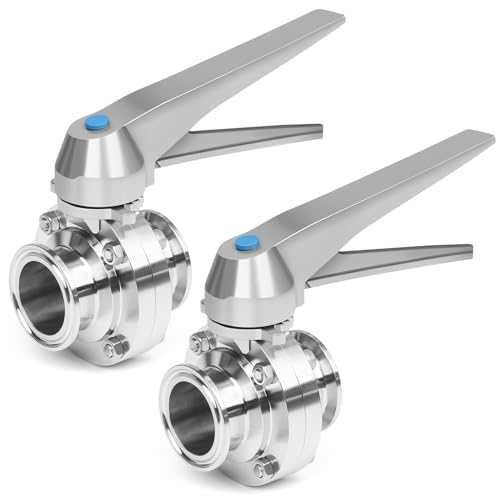
JMCOLMT’s 1.5″ butterfly valve set includes two valves with a 50.5MM ferrule and 1.5″ tube OD. The valve operates between 15°F and 200°F and is rated up to 1.5 MPa. Best for: replacement valves in existing sanitary lines or quick upgrades for 1.5″ tri-clamp systems. Caution: ensure 50.5MM ferrule size matches your current clamps to avoid misfit.
BOKYWOX 2″ SUS304 Tri Clamp Sanitary Pneumatic Valve

BOKYWOX provides a 2″ sanitary pneumatic tri-clamp valve with a single-acting actuator. Made from SUS 304 stainless steel, it uses a clamp connection and supports a 0-90° valve rotation with a working pressure up to 0-1.6 MPa. Best for: automated CIP or process lines needing pneumatic actuation and repeatable positioning. Caution: pneumatic components require a compatible control system and regular maintenance for seal integrity.
Buying Guide
What size do you need? For small hobby setups, 1.5″ valves are common and easier to install in tight spaces. For larger fermenters or industrial lines, 2″ valves offer higher flow but require more space and clamp hardware. Material and gasket compatibility matter: 304 stainless steel is standard and corrosion-resistant, while EPDM seals perform well in many hygienic environments but may have solvent limits.
Which handle style works best? Pull handles give quick positive positioning, while trigger or lever handles can offer smoother, finer control. Consider whether you need a valve pre-assembled with clamps or as a retrofit replacement for existing tri-clamp lines.
Max pressure and temperature ranges should align with your processing conditions. If your system operates near the upper limits (close to 200°F or high psi), verify that the gasket material and ferrule sizes match your equipment. Always ensure proper sanitization compatibility with CIP processes and cleaning chemicals.
Maintenance and replacement parts matter. Having spare gaskets and ferrules on hand reduces downtime. Check compatibility with your existing tri-clamp fittings (1.5″ vs 2″ and ferrule sizes around 50.5 mm or 64 mm). If automation is involved, pneumatic actuators or integrated control systems should be considered for future upgrades.
FAQ
- What is the typical tube OD for these valves? Most options shown fit 1.5″ or 2″ tri-clamp connections, which correspond to tube ODs around 38 mm and 50.5 mm respectively.
- Are these valves suitable for dairy or beer processing? Yes, all are designed for sanitary applications with stainless steel bodies and gasket seals, suitable for CIP and fermentation environments.
- What is the importance of the gasket material? The gasket (often EPDM) seals the valve to prevent leaks; compatibility with cleaning agents and temperatures is crucial for sanitation and longevity.
- Do these valves require special maintenance? Regular gasket inspection and replacement, clamp integrity checks, and cleaning between batches are recommended to maintain performance.
- Can I mix valves from different brands in one system? It’s best to maintain consistent tube OD, ferrule size, and clamp type to ensure a proper seal and compatibility across the system.
- Is there a preferred handle type? Pull handles offer quick actuation; trigger or lever handles can provide controlled movement. Choose based on handling preference and space constraints.