Answering the need for reliable secondary containment, this guide highlights top IBC tote spill containment pallets. The selections are ideal for warehouses, manufacturing floors, and DIY shops that require safe, compliant liquid containment for drums and IBC totes. Each product is best for different space, capacity, and handling needs. The table below compares five standout options to help you pick the right fit for your operations.
| Product | Best For | Key Benefit | Capacity |
|---|---|---|---|
| Enpac IBC Tote Spill Containment Pallet (8,000 Lb) | High-demand facilities | Strong, EPA/OSHA compliant containment | 385 gallons |
| Enpac IBC Tote Cross-Contain Spill Pallet | Simple, compact setups | All-in-one sump design, no raised platform | 385 gallons |
| ENPAC IBC Spill Containment Pallet (3000 Lb) | Cost-conscious upgrades | Durable, versatile with grate options | 385 gallons |
| LYAYAN Drum Spill Containment Pallet | Smaller spaces, budget-minded | Low-profile, stackable with 20-gallon sump | 20 gallons |
| Enpac IBC Space-Saver Spill Pallet | Narrow footprints | Space-efficient with removable platform | Not specified (IBC compatible) |
Enpac IBC Tote Spill Containment Pallet, 8,000 Lb Load Capacity
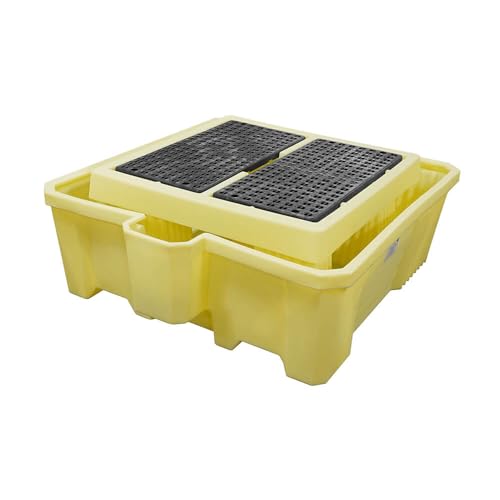
This 8,000 lb capacity pallet provides a 385-gallon spill capacity, designed for EPA secondary containment requirements for two stacked IBCs. The 100% polyethylene construction resists corrosion from oils, fuels, solvents, and chemicals. It is forkliftable and built for long-term use in harsh environments. Best for high-throughput facilities needing robust containment and easy transport.
Best for: facilities with frequent IBC handling and strict compliance needs. Why chosen: high load and large containment capacity support rigorous spill control and inspection readiness.
Caution: ensure compatible forklift access and confirm space for the 81″ x 72.5″ footprint in tight layouts.
Enpac IBC Tote Cross-Contain Spill Pallet, Sump Only

This sump-only design fits a single IBC directly into the sump, removing the need for a raised platform and reducing weight capacity concerns. It’s a cost-effective alternative to standard pallets and is forkliftable with four-way entry for easy relocation. Best for: operations seeking a straightforward, compact containment option without extra structuring.
Best for: setups prioritizing simple installation and mobility. Limitation: may lack space for additional containment accessories or raised supports in some configurations.
ENPAC IBC Spill Containment Pallet, 8,000 Lb (Second Listing)
Another Enpac model mirrors the high-capacity design with EPA/OSHA compliance and robust all-season construction. It emphasizes long-term durability and resistance to corrosion, ensuring reliable containment for challenging chemical and liquid storage. Best for: facilities needing a redundant or backup option with similar capacity and compliance points.
Best for: high-usage environments requiring dependable containment redundancy. Caution: verify pallet dimensions to ensure fit in existing racking or aisles.
ENPAC IBC Spill Containment Pallet, 3000 Lb
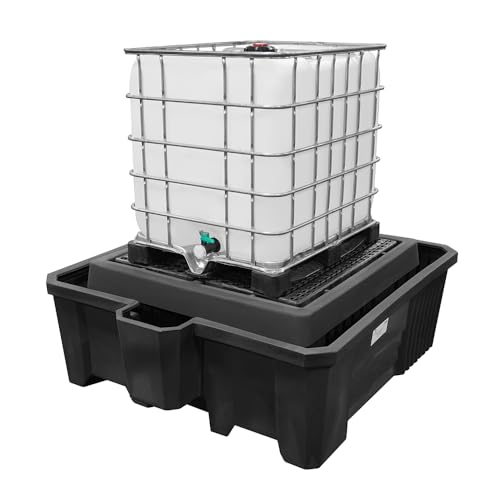
This model uses recycled polyethylene for durability and value, with an integrated dispensing feature via a 5-gallon pail holder. Forkliftable design supports efficient transport, and the platform’s construction suits general containment needs while maintaining cost efficiency. Best for: smaller operations or budget-focused buyers who still require reliable EPA/OSHA compliance.
Best for: cost-conscious facilities that still require practical dispensing capability. Caution: ensure the 5-gallon pail holder aligns with your dispensing workflow and access points.
LYAYAN Drum Spill Containment Pallet

This heavy-duty, low-profile pallet supports up to 2,000 lbs and features a 20-gallon sump with a built-in drain for liquid recovery. The compact 48″ x 24″ footprint and modular, stackable design help maximize space in busy shops. Best for: smaller facilities needing space-efficient containment with straightforward liquid recovery.
Best for: space-constrained environments seeking scalable containment. Caution: the sump capacity is relatively small compared with IBC-focused pallets, so plan for anticipated spill volume.
Enpac IBC Space-Saver Spill Pallet

Designed for narrow footprints with a removable platform, this model is ideal for facilities needing a compact IBC containment solution without sacrificing access. The ergonomic height improves dispensing efficiency. Best for: facilities with tight layouts or limited aisle width.
Best for: space-limited operations. Caution: ensure the overall footprint fits your rack and traffic flow; some users may need extra access space for maintenance.
KONGQXIAA Heavy-Duty Spill Containment Pallet
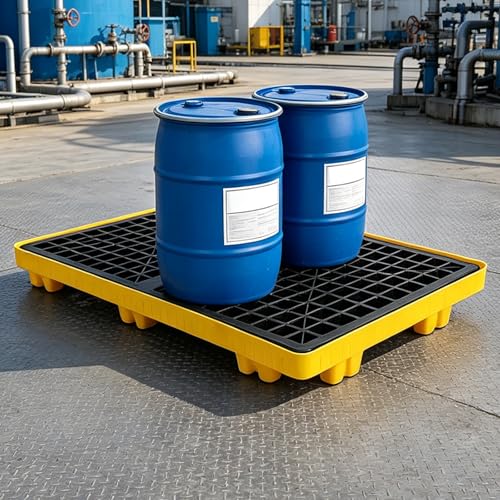
This modular, leak-proof design supports a variety of drum and IBC sizes with forklift compatibility. The anti-slip surface and detachable components allow for flexible stacking and stable storage in industrial settings. Best for: warehouses needing durable, reusable containment with adaptable configurations.
Best for: versatile, long-term containment needs. Limitation: modular setups require careful assembly to maintain leakproof performance across configurations.
Global Industrial Low Profile Spill Containment Modular Platform

With a low-profile design, this platform offers easy loading with a 60-gallon capacity and high load rating, plus fork pockets for straightforward maneuverability. Best for: facilities needing a slim, space-saving option for multiple drums or IBCs. Caution: 60 gallons of capacity may require more frequent emptying if drip rates are high.
Buying Guide
- Capacity and space: Match spill capacity to your expected liquid volumes and available floor space. Large IBCs benefit from higher capacity pallets, while smaller shops can use low-profile or cross-contain designs.
- Forkliftability and maneuverability: Ensure the pallet’s weight and entry points align with your forklift type and aisle width. Four-way access improves relocation flexibility.
- Compliance: Look for EPA and OSHA alignment to satisfy regulatory requirements for secondary containment and documentation readiness.
- Durability and material: Polyethylene pallets resist rust and chemical attack; recycled materials can offer value but ensure long-term performance needs are met.
- Design features: Removable grates, built-in dispensers, and integrated drains can improve dispensing efficiency and liquid recovery, but may add cost or complexity.
- Space efficiency: Narrow footprints or space-saving models help in crowded facilities; consider whether a modular design will scale with future needs.
FAQ
- What is typical spill capacity for IBC pallets? Answer: Many models offer around 385 gallons, suitable for two stacked IBCs in containment.
- Are these pallets forklift-ready? Answer: Yes, most listed options feature forklift pockets or four-way forklift entry for easy transport.
- Do these pallets comply with regulatory standards? Answer: Several options are marketed as EPA/OSHA compliant; verify certification documents for your site.
- Can I connect multiple pallets to save space? Answer: Some models are modular or stackable, allowing expansion while maintaining containment integrity.
- Is a sump-only design enough for containment? Answer: It can be sufficient for simple setups, but if you use IBCs, a raised platform or grate might be necessary for stability and access.
- What should I consider for space-limited areas? Answer: Low-profile or space-saver pallets can maximize floor space while keeping containment compliant.