Choosing the right I-beam hand-pushed trolley starts with load capacity, beam compatibility, and safety features. This guide highlights five top options for American buyers, covering common beam sizes, straight and curved tracks, and varying budgets. Best for industrial garages, automotive shops, and light manufacturing, these trolleys are rated to move loads smoothly with manual control. Each pick is described in practical terms, focusing on who benefits most and why it’s a solid choice in real-world settings.
| Product | Trolley Capacity | Best For |
|---|---|---|
| POWLAB I Beam Trolley | Up to 3 tons | |
| YATOINTO 1T Dual Wheels | 1 ton | |
| Ultimation Heavy Duty 1,000 lb | 1,000 lbs |
When evaluating options, consider flange width range, wheel configuration, safety features, and compatibility with straight or curved tracks. The products below are selected for their balance of capacity, adjustability, and practical safety elements that help ensure easy operation and longer service life in demanding environments.
POWLAB I Beam Trolley 3 Ton Manual Adjustable

This trolley is designed for heavy-duty use with a 3-ton capacity and adjustable flange width from 3.66″ to 8.46″ (93-215 mm). It fits both I-beams and H-beams, aided by included washers for a precise fit. Best for workshops needing one trolley across multiple beams, especially where curved tracks are present.
Why it’s selected: Strong manganese steel construction and corrosion resistance suit demanding environments. The design includes hex nuts, collision bumpers, and anti-drop pins to boost safety and durability. Choose this for high-load, flexible beam compatibility.
Limitations: The adjustment range is broad, but setup may require careful alignment on unusual beam configurations. Ensure flange width measurements are exact before installation.
YATOINTO 1T Dual Wheels Beam Trolley
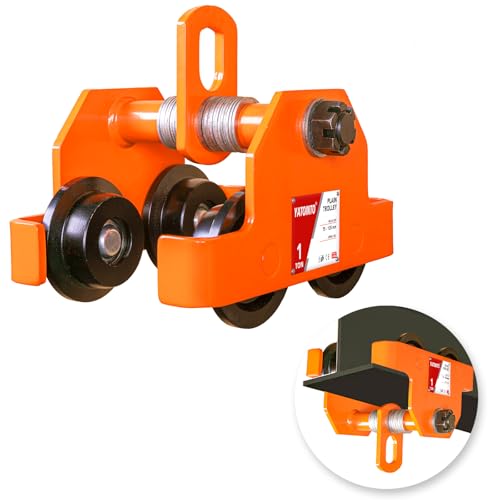
Best for: shops needing reliable performance on straight and curved beams with adjustable flange width 3″–5″. The dual-track design and sealed bearings support smooth operation under varying loads. This trolley is suitable for frequent lifting tasks in compact spaces.
Why it’s selected: It offers a clear 1-ton capacity with practical adjustability and robust wheel construction. The included features, such as bumper guards and lifting rings, emphasize safety and stable handling in busy environments.
Limitations: While capable, it’s tailored for lighter to mid-range loads compared to heavier models; verify total load requirements before relying on it for maximum capacity tasks.
Ultimation Heavy Duty 1,000 Pound Capacity

Best for: automotive assembly lines and warehouses that require robust side guide rollers and precise maneuverability on 3″, 4″, and 6″ tall I-beams. Its four-wheel design supports stable movement on both straight and curved paths with a 1,000-pound maximum load.
Why it’s selected: A rugged cast iron body and side guide rollers deliver dependable glide and control. Durable construction helps sustain long-term use in high-traffic settings, making it a strong all-around option.
Limitation: The focus on versatility across beam heights means it may be heavier than some lighter-duty models, affecting ease of manual handling in tight spaces.
I-beam Hand-pushed Monorail Trolley with 3m Chain

Best for: operations requiring a longer reach with a 3m/9.8ft chain included, suitable for transferring loads along a monorail system. It’s rated for 1–5 tons, which covers a broad range of lifting tasks with a sturdy chain.
Why it’s selected: The chain-equipped design adds versatility for horizontal transport beyond standard trolley movement. Durable side plates and baked enamel finish help protect against wear.
Limitation: This model leans toward heavier loads and intermediate chain management; ensure compatibility with your mounting and hoisting setup to maximize safety.
VEVOR Manual Trolley 2.2k lbs Capacity

Best for: workshops needing adjustable width from 2.5″ to 7″ with strong alloy steel build and enhanced safety features. Suitable for straight and curved beams in mid-range projects.
Why it’s selected: It emphasizes a combination of adjustability, durability, and protective features like a hex nut, collision bumper, and anti-drop pin to improve safety during lifting tasks.
Limitation: The adjustment uses washers for beam fit; consult beam dimensions carefully to avoid over-tightening or looseness that could affect tracking.
VEVOR Manual Trolley 4.4k lbs Capacity
Best for: heavy-duty shops that require higher load capacity and flexible width adjustment (2.5″–7″). It supports larger loads on straight and curved I-beams, with robust alloy steel construction for durability.
Why it’s selected: The model mirrors the safety and durability approach across VEVOR’s line, offering dependable performance with protective features and long-term resilience in demanding environments.
Limitation: Higher load ratings mean more weight; consider handling requirements and installation clearance in tight spaces.
Buying Guide: I-Beam Hand-Pushed Trolleys
What beam sizes can you work with? Look for adjustable flange widths that cover your typical beams. A wider range reduces the need for multiple trolleys across a facility.
What load capacity do you need? Choose a model with a rating that accounts for peak loads and future needs. Avoid under-sizing for safety and efficiency.
What safety features matter? Hex nuts, collision bumpers, anti-drop pins, and protective guards can prevent accidents and extend life in harsh environments.
Are curved tracks a factor? If you use curved beams, ensure the trolley has well-designed wheels and side guides that maintain stability around turns.
How important is ease of maintenance? Sealed bearings, corrosion-resistant materials, and durable finishes reduce downtime and service costs over time.
Frequently Asked Questions
- What is the typical load capacity for a hand-pushed I-beam trolley? Most models in this category range from 1,000 to 4,400 pounds, with some variations outside this range.
- Can these trolleys be used on curved beams? Yes, several models feature dual wheels and track-friendly designs suitable for curved tracks.
- Do adjustable flange widths fit all beam types? Adjustable ranges help, but always measure your beam flange width and verify compatibility before purchase.
- What safety features are most important? Look for anti-drop pins, collision bumpers, lock nuts, and protective side plates to minimize risk during operation.
- Are there maintenance tips to extend trolley life? Regularly inspect wheels, bearings, and locking mechanisms; keep rails clean; apply appropriate lubrication as recommended by the manufacturer.
- Should I choose a monorail or standard trolley? Monorail trolleys are useful for longer, linear runs with chain accessories; standard trolleys excel on multi-directional beam tracks with simple changes in direction.