Answering the need for high-thrust, reliable motors for large drones, these heavy-lift options are designed for industrial UAVs, mapping platforms, cinematography rigs, and long-endurance flights. This guide highlights five motors that balance thrust, efficiency, and durability for demanding payloads. Best for professional operators, survey teams, and heavy-lift payload missions.
| Product | Best For | Key Benefit |
|---|---|---|
| Pro Max 10010-95KV | Industrial multicopters | High thrust per motor with strong torque |
| MAD M13 EEE 90KV | High-end payloads | Efficient thrust at 7–9 kg payload range |
| MAD M30 PRO IPE 100KV | Heavy lift platforms | Extreme thrust and reliability in tough conditions |
| MAD M6C10 EEE 150KV | Agricultural/large drones | Thrust suited for 2.5–5 kg payloads with CF propellers |
| PRO 4215-380kv | Long-range heavy lifters | High power with robust insulation for harsh environments |
Pro Max 10010-95KV Brushless Motor

Best for: professional UAVs requiring heavy payloads and long endurance. The 95KV design provides high torque at low RPM for controlled heavy-lift flights. Suitable for industrial multis and long-endurance platforms that demand precise payload handling.
Why selected: This motor delivers up to 19.16 kg of thrust per unit, enabling substantial payload capabilities. The low KV helps maintain stable thrust under load, making it a reliable choice for cinematography rigs and surveillance drones.
Limitations: Datasheet emphasizes heavy-lift performance; users should ensure compatible ESCs and propellers to maximize stability under full payload.
FFTY 4214 380KV Brushless Motor

Best for: cinematic aerial photography, heavy lift, and industrial inspection drones. With 380KV, it aims for a balance of speed and lift for mid-to-large sized frames.
Why selected: Features indicate compatibility with 12–14 inch FPV drones and a maximum thrust around 4.7 kg, making it a solid choice for projects requiring reliable lift with good efficiency. Limitations include a higher KV that may not be ideal for very heavy payloads without larger propellers or multiple motors.
MAD M13 EEE 90KV Brushless Motor

Best for: high-demand aerial applications with 7–9 kg single-axis payloads on 36-inch carbon fiber props. Engineered to maximize thrust-to-weight for efficient lift in professional UAVs.
Why selected: Optimized for heavy loads while sustaining efficiency under 12S voltage, making it well-suited for long-endurance flights and demanding mappings. Caution: ensure propeller compatibility with the 36-inch CF props to achieve stated thrust.
MAD M30 PRO IPE 100KV Motor
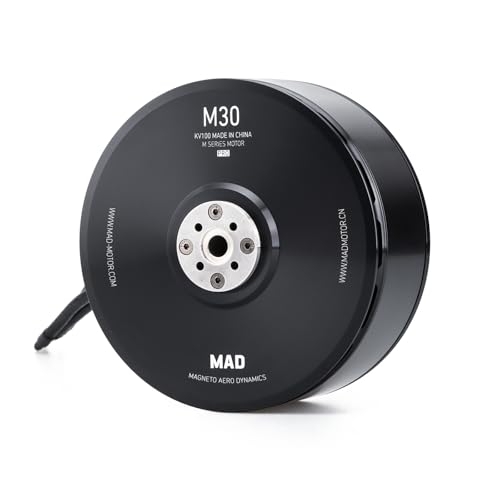
Best for: industrial UAVs demanding extreme thrust and reliability. Suitable for platforms that operate in rigorous conditions and require endurance flight under load.
Why selected: The heavy-class design targets 12–15 kg single-axis payloads, making it a strong option for large, mission-critical drones. Caution: IP44 rating indicates some protection but not fully waterproof; avoid prolonged exposure to heavy moisture without enclosure.
MAD M6C10 EEE 150KV Brushless Motor

Best for: agricultural drones and large payload operations needing moderate thrust with efficient power use. The multiple KV options (150KV being one) suit different frame and prop combos.
Why selected: Delivers up to 10.4 kg thrust per axis, optimized for 2.5–5 kg payload ranges, and pairs well with 18–24 inch carbon fiber props. Caution: verify prop compatibility and voltage range for safe operation under load.
Buying Guide: Heavy Lift Motor Considerations
- Payload and frame size: Align motor thrust with your drone’s total payload and frame weight. Larger frames often need higher-thrust motors paired with proper propellers.
- Kv and voltage range: Lower Kv motors (like 90–100 Kv) excel under heavy loads with higher torque, while higher Kv motors suit lighter lifts and smaller frames. Ensure ESC compatibility and battery capacity.
- Efficiency and cooling: Look for designs with efficient windings, heat dissipation paths, and, if needed, active cooling or IP ratings for dusty or wet environments.
- Durability under harsh conditions: For industrial or field use, select motors with robust shafts, bearings, and magnet configurations to withstand impacts and temperature swings.
- Propeller compatibility: Verify propeller size and hub compatibility (M4x30mm, 12-slot stators, CF propellers) to maximize thrust and stability.
- Maintenance and serviceability: Consider availability of replacement parts and ease of maintenance for long-term operation in remote or high-demand environments.
FAQ
- What does KV indicate on a drone motor?
– KV is the motor’s constant relating RPM per volt under no-load conditions; lower KV motors produce more torque at a given voltage, beneficial for heavy lifts. - Why would I choose a 90KV motor over a 380KV motor for heavy lift?
– A 90KV motor provides higher torque and efficiency under load, which is preferable for heavy payloads and larger props, while a 380KV motor may spin faster with less load. - How important is motor insulation and temperature rating?
– Important for reliability; high-temperature insulation reduces the risk of winding damage during long flights or high current draws. - Can I mix motor brands on a single drone?
– It’s generally best to use matched motors and props per motor to ensure balanced thrust and predictable flight characteristics. - What is IP rating and why does it matter?
– IP rating indicates protection against dust and water. For outdoor or coastal operations, higher IP ratings help protect motors in challenging environments.