Find the right exhaust fan for a food trailer by matching airflow, power, and durability to your cooking setup. This guide highlights five top options, each suited for different trailer sizes, grease-heavy environments, and noise preferences. Whether you need high volume for a busy kitchen or a compact, low-profile unit for limited space, these picks help you keep smoke and heat under control.
| Product | Airflow (CFM) | Motor | |
|---|---|---|---|
| FICBXRA Restaurant Hood Grease Rated Exhaust Fan (0.5 HP, 1900–2600 CFM) | 1900–2600 | 0.5 HP | High speed, upblast, ideal for grease-laden kitchens |
| CAPTIVE-AIRE Low Profile Grease Rated Exhaust Fan (1.5 HP equivalent, 1500–2200 CFM) | 1500–2200 | 0.75 HP | Low profile with mounting options for trailers |
| CXRCY 1400 CFM Upblast Roof Exhaust Fan | 1400 | 2700 RPM copper motor | All-copper motor, energy-efficient |
| VEVOR Commercial Kitchen Exhaust Fan (612 CFM) | 612 | 180W copper motor | Weatherproof, quiet operation |
| FICBXRA 800 CFM Canopy Hood Exhaust Fan | 800 | 0.25 HP | Grease-rated, compact canopy mount |
FICBXRA Restaurant Hood Grease Rated Exhaust Fan (0.5 HP, 1900–2600 CFM)

Best for high-demand food trailers that generate substantial grease and smoke. This direct-drive centrifugal upblast model delivers 1900–2600 CFM with a 110V single-phase motor, making it suitable for larger trailer kitchens or peak service periods. It is UL705 and ETL rated for safety and compliance. Caveat: higher airflow can mean increased noise, so plan installation with ducting and sound considerations in mind.
CAPTIVE-AIRE Low Profile Grease Rated Exhaust Fan (High Speed, 1,500–2,200 CFM)

Best for smaller or trailer-mounted kitchens needing a compact, grease-rated solution with robust airflow. The unit is designed for high-speed operation and includes mounting and optional accessories tailored for food trucks and concession trailers. Best for operators prioritizing a low-profile footprint without sacrificing air removal. Limitation: base dimensions are sizable; ensure surrounding space supports installation.
CXRCY 1400 CFM Upblast Roof Exhaust Fan

Best for operators needing durable, energy-efficient exhaust with strong airflow in a roof-mounted setup. The all-copper motor delivers reliable performance, and the aluminum housing with weatherproof design protects against harsh outdoor conditions. Choose this if you want robust, long-term operation in variable trailer environments. Limitation: roof mounting may require professional installation and appropriate curb pieces.
FICBXRA Restaurant Canopy Hood Exhaust Fan (800 CFM)
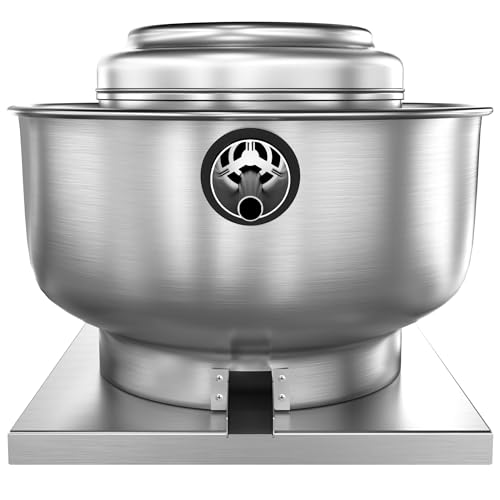
Best for mid-sized trailers needing reliable grease-rated performance in a compact form. At 800 CFM with 0.25 HP, it fits smaller footprints while delivering steady air removal for moderate cooking volumes. It’s ETL certified, supporting safe operation in busy concession settings. Caution: airflow is lower than larger units; consider multiple units if you run high-volume cooking.
Buying Guide: How to Choose a Food Trailer Exhaust Fan
- Match CFM to your stove output, trailer size, and ventilation goals. Higher CFM handles more heat and grease but requires more power and potentially louder operation.
- Direct-drive fans are common in food trailers for simplicity and reliability; pulley systems can offer additional speed control but add complexity.
- Look for grease-rated builds and corrosion-resistant housings (stainless steel or aluminum) for trailer kitchens and outdoor exposure.
- Determine roof vs. wall mounting, curb requirements, and ducting compatibility. Low-profile designs help in tight spaces.
- Confirm voltage and single-phase availability in the trailer supply. Ensure the circuit can handle peak startup currents.
- Higher CFM can increase noise. Factor noise ratings into placement and potential sound dampening options.
- Easy-access housings and readily available replacement parts reduce downtime and long-term costs.
FAQ
- What CFM should I choose for a small food trailer? A unit in the 600–900 CFM range is typically suitable for compact setups with moderate cooking output.
- Are grease-rated fans necessary? Yes, for safety and air quality, grease-rated models are designed to handle high grease loads and maintain performance.
- Do I need a roof-mounted or wall-mounted exhaust? Roof-mounted units suit most trailers; wall-mounted can work for larger or taller trailers with appropriate curb hardware.
- How important is a copper motor? Copper motors are durable and efficient, beneficial for demanding, long-running operation typical in busy kitchens.
- Can I install these myself? Basic installations are possible with standard venting, but some setups may require professional service for proper curb, ducting, and sealing.
- What about noise? Higher airflow tends to increase noise; consider location and potential sound dampening when planning the setup.