Answering the buyer’s search for reliable air filtration, this guide highlights five solid options designed to remove moisture, oil, and particulates from compressed air. Each pick targets a specific use case—from high-capacity industrial drying to compact, auto-drain filtration. The table below compares core specs to help you decide which system fits your needs.
| Product | Type | Best For | Max Pressure | Key Feature |
|---|---|---|---|---|
| VEVOR Compressed Air Dryer (125 CFM) | Refrigerated Dryer | Mid-to-large industrial setups | >232 PSI | Automatic drainage with color screen |
| 1/2″ NPT Air Compressor Water Separator (RVMARINEPAT) | All-in-one Filter, Regulator, Desiccant | General shop use with auto drain | 0-240 PSI | Visible sight glasses, 5μm and 0.01μm filters |
| VEVOR Air Compressor Filter Regulator (3-Stage) | Filter Regulator Dryer | Tools and equipment with dry air need | Max 175 PSI | 5μm, 0.3μm, 0.1μm filtration with auto drain |
| NANPU Z Series 3-Stage System | 3-Stage Filtration | Paints and industrial tasks | Up to 218 PSI | 0.01μm coalescing + activated charcoal |
| NANPU 3/4″ NPT Industrial 4-Stage System | 4-Stage Filtration | High-precision drying and filtration | 30-175 PSI range | Blue/pink desiccant indicator and field replaceable filters |
VEVOR Compressed Air Dryer, 125 CFM

Best for mid-to-large industrial setups needing a reliable refrigerated drying solution. This 125 CFM unit handles substantial airflow while removing moisture, oil, and impurities. It uses R410a refrigerant and a color screen control panel for easy monitoring. The automatic drainage helps minimize manual maintenance, making it suitable for continuous operation in workshops or production lines. Best for buyers who prioritize consistent moisture control and a compact footprint within a larger compressor system.
Who this is for: buyers running 20–30 HP compressors seeking dependable, automatic dryness with a clear control interface. Why selected: high flow capacity and efficient heat exchange support rapid moisture removal in demanding environments. Caution: ensure compatible ducting and power setup (110–120V) for optimal operation.
1/2″ NPT Air Compressor Water Separator

Best for general shop air systems requiring a compact, all-in-one filtration setup. This unit combines a water trap, 5-micron filter, regulator, and a coalescing 0.01-micron filter to capture moisture and oil aerosols. Visual indicators alert when filter elements need replacement, helping maintain air quality with minimal downtime. Choose this if you want an integrated solution that minimizes moisture before air reaches tools and spray systems.
Who this is for: small to medium shops needing an economical, ready-to-install filtration and drying package. Why selected: the 0.01μm coalescing filter provides deep moisture removal, while the auto-drain feature reduces manual maintenance. Caution: ensure compatibility with your existing regulator settings and seating of fittings.
VEVOR Air Compressor Filter Regulator, 3-Stage
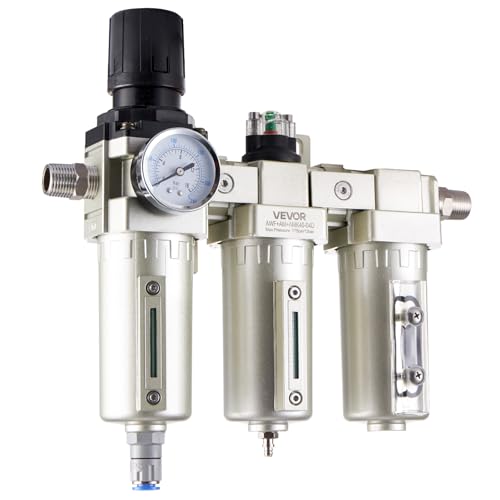
This three-stage filtration package delivers 5μm, 0.3μm, and 0.1μm filtration plus a desiccant drying stage, targeting both moisture and particulates. It supports up to 175 PSI, making it suitable for tools and equipment that require clean, dry air. The built-in auto drain minimizes maintenance, and the staged filtration offers a clear path to drier air for spray guns and impact tools. Best for: users needing a compact, all-in-one drying solution with strong filtration.
Best for: shops with moderate air demand looking for reliable dryness and filtration. Caution: check that your system can accommodate the 175 PSI max working pressure and compatible piping sizes.
NANPU Z Series 3-Stage System

Best for paint and high-demand industrial tasks needing precise filtration. The NANPU ZPA1 series uses sintered, fine, and activated charcoal filters for robust removal, including moisture and oil aerosols. It supports up to 218 PSI and delivers 127 CFM at 6 bar inlet pressure, making it suitable for high-output spray booths and plasma cutting environments. Choose this for strong filtration performance under higher pressure. Caution: higher initial footprint and setup may be required for integration with existing lines.
NANPU 4-Stage Industrial System

Best for serious dryness in demanding environments. This four-stage setup includes particulate, coalescing, and desiccant stages with a dedicated air regulator. It handles 30-175 PSI, with a clear maintenance indicator (blue/pink desiccant) to signal exhaustion and a red indicator for filter replacement. Choose this when ultra-dry air is essential for finishes, plasma work, or precision tooling. Limitations: more consumables to track and replace periodically.
Buying Guide
What to consider when selecting an air filtration system:
- Airflow capacity vs. your system demand: Match CFM or PSI ranges to your compressor output and tools.
- Filtration stages: More stages typically reduce moisture and oil more effectively but may require more maintenance.
- Moisture control method: Refrigerated dryers remove humidity at higher flow rates; desiccant-based systems provide extremely dry air but need more upkeep.
- Auto drainage: Builds a maintenance-friendly setup, especially in continuous operation.
- System integration: Check inlet/outlet sizes, mounting, and electrical requirements to fit your existing layout.
FAQ
- What is the main difference between refrigerated dryers and desiccant dryers?
Refrigerated dryers remove moisture by cooling and condensing water out of the air, suitable for general dry air needs. Desiccant dryers remove moisture through adsorption and are better for extremely dry air, such as painting or plasma work. - Why is auto drainage important?
Auto drainage reduces manual maintenance, preventing moisture buildup that can cause corrosion or tool malfunctions. - How do I know which PSI rating I need?
Choose a system that covers your maximum operating pressure plus a safety margin. Verify tool requirements and regulator compatibility. - Can I mix products from different brands?
Yes, but ensure compatibility in fittings, pressures, and filtration stages to avoid bottlenecks in the system. - What maintenance is required for these filtration systems?
Regularly replace filters and desiccant as indicated by indicators, inspect bowls and sight glasses, and check seals for leaks.