Low hydrogen welding rods are designed to reduce hydrogen-induced cracking while delivering strong, clean welds. This guide highlights top options for American buyers, focusing on versatile all‑position performance, x‑ray quality welds, and ease of use with AC or DC reverse polarity. The listed products are suitable for general carbon steel welding, construction, maintenance, and fabrication projects. Whether you’re a hobby welder or a professional, these rods offer reliable performance across common welding scenarios.
Summary of selected products:
| Product | Diameter | Weight | Best For |
|---|---|---|---|
| ARCCAPTAIN E7018 1/8” 10LB | 1/8” | 10 lb | All positions, high x-ray quality |
| ARCCAPTAIN E7018 3/32” 5LB | 3/32” | 5 lb | Compact projects, portable sets |
| YESWELDER E7018 3/32” 10LB | 3/32” | 10 lb | All positions, good for porosity control |
| YESWELDER E7018 1/8” 10LB | 1/8” | 10 lb | Medium carbon steels, steady arc |
| METAL MARLIN E7018 H4R 1/8” 5 lb | 1/8” | 5 lb | Code-quality joints, clean welds |
ARCCAPTAIN E7018 1/8″ 10LB Low Hydrogen Rod

Diameter: 1/8″; Length: 14″; Weight: 10 lb. This E7018 iron powder electrode delivers low hydrogen content for high-quality x-ray welds. Suitable for all positions with AC or DC reverse polarity. Best for projects requiring strong, crack-resistant joints in flat to overhead positions.
- Best for general carbon steel work needing x-ray quality welds.
- Better for all-position welding with reliable slag removal.
Limitations: 1/8″ rods may be longer to handle in tight joints; ensure proper preheat practices are followed for thicker materials.
ARCCAPTAIN E7018 3/32″ 5LB Low Hydrogen Rod

Diameter: 3/32″; Length: 14″; Weight: 5 lb. This iron powder E7018 rod offers low hydrogen content and excellent x-ray welds, with high tensile strength and good resistance to cracking. It performs well in any position on AC or DC reverse polarity.
- Best for compact projects where smaller diameter suits access constraints.
- Better for steady arcs and clean slag for easy finishing.
Limitation: Smaller pack size may require more frequent rod changes on larger jobs.
YESWELDER E7018 3/32″ 10LB

Diameter: 3/32″; Length: 14″; Weight: 10 lb. Low-hydrogen iron powder electrode delivering high-quality x-ray welds. Suitable for all positions with AC or DC reverse polarity. Features steady arc, low spatter, and good re-striking ability.
- Best for portable setups with lighter rods.
- Better for clean, repair welds with minimal post-work cleanup.
Limitation: Porosity can occur on very dirty base metals; proper surface prep remains essential.
YESWELDER 1/8″ 10LB E7018 Rod

Diameter: 1/8″; Length: 14″; Weight: 10 lb. This E7018 rod provides a steady arc and high deposition efficiency. It is suitable for all-position welding on medium carbon steels without preheating under normal conditions.
- Best for thicker sections needing robust, consistent welds.
- Better for jobs where preheat is not feasible.
Limitation: Not ideal for highly dirty or oily surfaces without prior cleaning; weld prep remains essential.
METAL MARLIN E7018 H4R 1/8″ 5LB
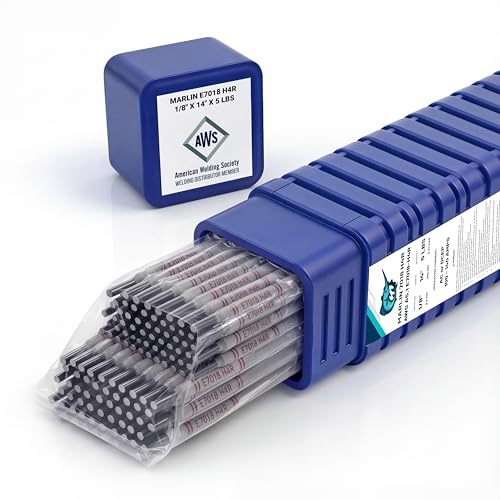
Diameter: 1/8″; Length: 14″; Weight: 5 lb. AWS-compliant E7018 low-hydrogen electrodes with all-position versatility. Tensile strength around 70,000–84,000 psi and low hydrogen content support cleaner, code-quality joints.
- Best for code-quality welds in structural or fabrication work.
- Better for joints demanding strong crack resistance in all positions.
Limitation: The 5 lb pack may be less economical for large projects compared to bigger packs.
Buying Guide: Key Considerations for Low Hydrogen Rods
What should you look for when choosing low hydrogen rods?
- Welding position versatility: All-position rods are ideal for field work and complex joints.
- Diameter and weight: Choose based on joint access, heat input, and project scale.
- Compatibility with power source: Ensure AC or DC reverse polarity support matches your welder.
- Hydrogen content and AWS classification: Look for E7018 (low hydrogen, iron powder) for stronger, crack-resistant welds.
- Material compatibility: Target carbon steel and similar alloys; avoid mismatched metals.
Practical Tips for Using Low Hydrogen Electrodes
- Pre-clean all base metals to minimize porosity and cracking risk.
- Maintain proper storage; keep rods in vacuum-sealed or dry packaging to prevent hydrogen pickup.
- Control heat input to avoid hydrogen cracking in thicker sections.
- Practice arc stability and re-striking to minimize spatter and slag build-up.
FAQ
- What makes low hydrogen rods different from standard rods?
They have reduced hydrogen content in the coating, which lowers hydrogen diffusion into the weld and reduces cracking risk. - Can I use E7018 rods on all carbon steels?
Yes, for most carbon steels, especially where all-position welding is needed; verify material specifications for critical codes. - Do I need preheating with these rods?
Preheat is not always required, but for thicker sections or problematic steels, preheating can improve weld integrity. - Are these rods suitable for outdoor field work?
All-position, low-hydrogen rods are well-suited for field work, provided proper environmental protection and storage are maintained. - How do I store replacement rods to maintain low hydrogen content?
Store in a dry, sealed container; avoid moisture exposure and keep in a controlled environment when not in use. - Is there a difference between 3/32″ and 1/8″ rods for beginners?
Smaller diameters are easier to maneuver in tight joints and are more forgiving for beginners; larger diameters deposit more material but require careful heat control.