The 4th axis CNC router expands a three-axis machine into a rotary system, enabling true cylindrical, helical, and curved carvings. It’s best for hobbyists upgrading a compact mill, woodworkers seeking cylindrical engravings, and small shops needing improved part versatility. Below are five top picks, each with a clear use case, strengths, and a practical limitation to help you choose.
| Product | Best For | Key Advantage |
|---|---|---|
| Genmitsu 4th Axis Rotary Module | Small-to-mid CNCs (4040/3030) users | High torque and flexible workpiece range |
| Wizmaker 4th Axis C4 Pro | Stable, multi-axis projects | Strong clamping and large working area |
| CNCTOPBAOS K11-65mm | Three-dimensional cylindrical work | Compact 4th axis with solid 4:1 reduction |
| FoxAlien 4th Axis Rotary Module (Masuter 3S) | Curved surface carving | High-torque, 10:1 reducer for cylinder work |
| CNCTOPBAOS K12-100mm | Versatile CNC engraving and milling | 6:1 reduction with robust MT2 tailstock |
Genmitsu 4th Axis Rotary Module for 4040/3030 Series CNC Machines

This rotary module adds a drop-in 4th axis to compatible Genmitsu machines, enabling multi-angle carving and potential full rotary work with appropriate software. The NEMA17 planetary geared stepper motor provides high torque for rotating workpieces with precision. It suits advanced hobbyists upgrading 4040-PRO or 3030-PROVer machines who want curved features beyond basic 3-axis capabilities.
Best for: Enthusiasts seeking robust torque and flexible tailstock options for varied part lengths. Choose this if your machine is within the Genmitsu 4040/3030 family and you plan to perform rotary work with offline controller integration.
Caution: For the 4040 series, an offline controller (ASIN: B0C582HQ6Z) is recommended to drive the 4th axis; the 3030 series includes the offline controller by default.
Wizmaker 4th Axis C4 Pro

Wizmaker’s C4 Pro delivers four-axis linkage with solid stabilization and a large clamping envelope. It’s designed for stable, concentric machining and easy installation, making it well-suited to users adding rotary capability to a compact workshop. The 70mm clamping diameter and 200mm length accommodate a broad set of project pieces.
Best for: Users who want strong stability and a straightforward install for varied cylindrical projects. Better for larger stock than some compact options.
Caution: Four-axis linkage adds complexity; ensure your software supports multi-axis toolpaths to maximize accuracy.
CNCTOPBAOS K11-65mm CNC 4th Axis with 3-Jaw Chuck

The K11-65mm offers a compact 4th axis with a three-jaw chuck and a 4:1 reduction. It’s geared toward precise cylindrical work with a straightforward tailstock setup for shorter projects. The gear output shaft diameter is 20mm, and the design emphasizes centering precision and stable performance in a compact form factor.
Best for: Small to medium cylindrical parts where quick setup and reliable centering are key. Choose this if you want a compact, value-focused rotary axis with a three-jaw chuck for flexible gripping.
Caution: The 65mm center height may limit very tall stock; verify your spindle clearance for taller projects.
FoxAlien 4th Axis Rotary Module for Masuter 3S and XE-Ultra
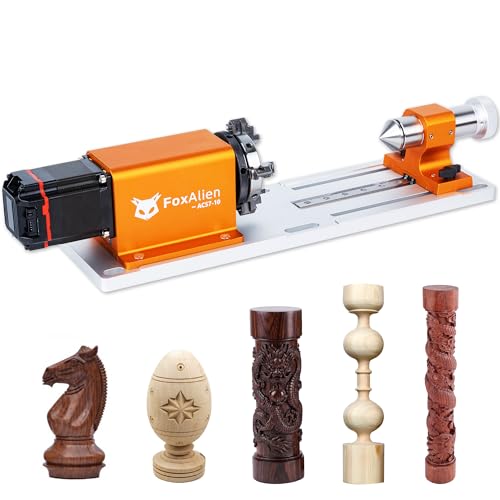
This module uses a NEMA23 closed-loop motor and a 10:1 harmonic reducer to deliver high torque for cylindrical engraving. It’s compatible with specific FoxAlien models like Masuter 3S and XE-Ultra series, offering strong rotary performance for curved surfaces and mugs. The 4-jaw chuck provides secure holding for diverse shapes.
Best for: Users of FoxAlien routers needing reliable, high-torque rotary performance for cylindrical and curved designs. Choose this if your machine is in the FoxAlien ecosystem and you want strong closed-loop control.
Caution: Not compatible with all FoxAlien models (not supported on Masuter Pro or some Vasto/V1 variants); check compatibility with your controller and machine series before purchasing.
CNCTOPBAOS K12-100mm CNC 4th Axis with 3-Jaw Chuck

The K12-100mm model expands to a larger 100mm chuck and a 6:1 reduction, offering a robust option for more substantial cylindrical work. It includes a 65mm MT2 tailstock and a hollow shaft with an outer output shaft of 30mm, enabling longer stock and more versatile setups for engraving and milling tasks.
Best for: Projects requiring longer workpieces and stronger clamping with a higher-output shaft. Choose this if you need a larger diameter capacity and greater stock flexibility.
Caution: Heavier assembly requires careful alignment and stable mounting; ensure your machine’s frame can support the weight and vibration of larger rotary work.
Buying Guide
What should I look for in a 4th axis?
Torque and motor type determine how well a rotary axis handles cylindrical and curved work. Closed-loop steppers reduce missed steps on high-torque tasks. Consider gear reduction, chuck type (3-jaw vs 4-jaw), and tailstock compatibility for stability during long milling runs.
Which size and capacity matter?
Center height, total height, and chuck diameter define the maximum workpiece you can clamp and rotate. Match these specs to your typical stock length and diameter to avoid overhang or clearance issues.
Software and controller considerations
Some 4th axis modules require an offline controller or specific software for generating rotary toolpaths. Confirm compatibility with your CAM software and whether offline control is needed for your machine series.
Mounting and stability
A rigid mounting surface and a solid clamp system reduce wobble and improve accuracy. Look for included tailstocks or robust mounting patterns that fit your machine’s bed without adding excessive height.
What about compatibility?
Check your CNC machine’s brand and model family to ensure the rotary module aligns with the spindle, drive system, and controller. Some modules are designed for specific series, while others offer broader compatibility with standard MT2/through-hole configurations.
Maintenance and safety
Rotary axes add moving parts and belts; ensure guards or shields where applicable and follow safe spindle operation practices. Regular inspection of gears, belts, and bearings helps maintain precision over time.
FAQ
- Do I need an offline controller for all 4th axis setups? Some kits require an offline controller for G-code, especially on certain Genmitsu and CNCTOPBAOS configurations. Verify with the product page for your exact model.
- What is the difference between 3-jaw and 4-jaw chucks? A 3-jaw chuck centers round stock quickly, while a 4-jaw chuck provides independent jaw adjustment for off-center or square stock, offering higher versatility for irregular shapes.
- Can a 4th axis be used for all materials? Rotary axes are versatile for wood and soft metals, but performance varies by material density and machine rigidity. Heavy metals may require higher torque and more stable mounting.
- Is a tailstock necessary? Tailstocks improve long-stock stability and reduce runout, especially for longer cylinders. If your project is short or frequently changing stock, a tailstock might be optional.
- Will a 4th axis affect my existing spindle speed? Generally not, but added weight and inertia can influence acceleration. Ensure your controller and firmware are configured for the additional axis load.
- How do I verify compatibility with my CNC router? Check the table dimensions, mounting pattern, shaft size, and whether your machine’s software supports rotary toolpaths for 4th-axis integration.