If you’re looking for efficient heat transfer between two water circuits, a water-to-water heat exchanger is a reliable choice. These units suit radiant floor heating, domestic hot water loops, snow melt systems, and industrial process heating. This guide highlights five well-suited options, explains who they’re best for, and points out practical limitations. Read on to compare capacity, construction, and design features at a glance. A quick summary table follows to help you decide which model matches your application before diving into each product detail.
| Product | Capacity (approx.) | Plates / Size | ||
|---|---|---|---|---|
| AB Plate Heat Exchanger, 4″x12″ 30 Plates | 250k–330k BTU/h | 30 plates, 4″x12″ | 316L stainless steel with copper brazed edges | Residential floor heating and water heating loops |
| VEVOR Brazed Plate Heat Exchanger, 80 Plates | 780k–1080k BTU/h | 80 plates, 5″x12″ | 316L stainless steel with copper brazing | High-demand radiant or process heating |
| AB Water to Air Heat Exchanger, 20×20 | Up to 360kBtu/h in some setups | 20×20 with 1″ copper ports | Steel shell; copper/aluminum fins | Outdoor wood furnaces and forced-air heating |
| ALECOIL 5″x12″ 50 Plates | 748k BTU/h | 50 plates, 5″x12″ | 316L stainless steel with copper brazing | Water heating, floor heating, commercial cooling |
| ALECOIL 5″x12″-100 Plates | 1,452k BTU/h | 100 plates, 5″x12″ | 316L stainless steel with copper brazing | Large-scale or industrial applications |
AB Plate Heat Exchanger, 4″x12″ 30 Plates

Best for compact radiant floor heating and domestic hot water loops. Constructed from 316L stainless steel with copper brazed edges, this unit emphasizes leakage resistance and durability under high temperature and pressure. The 30 plates create a balanced flow, delivering 250,000–330,000 BTU per hour depending on the application. Smooth threaded connections simplify installation and reduce leak risk. Choose this if you need a rugged, mid-range water-to-water exchanger in a tighter space. A limitation is that its size may limit very high-flow systems without parallel units.
VEVOR Brazed Plate Heat Exchanger, 80 Plates
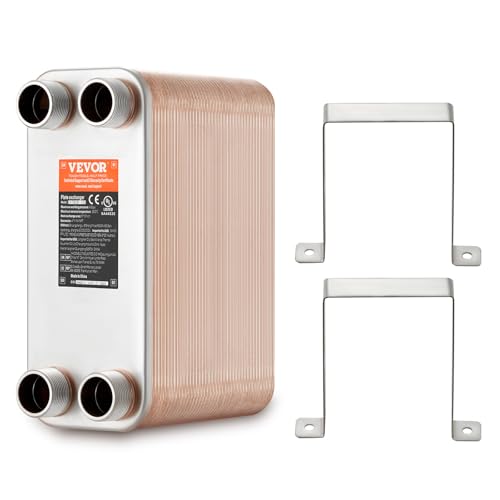
Best for high-demand radiant or process heating. Its 80 plates and 5″x12″ size maximize heat transfer surface, enabling 780,000–1,080,000 BTU per hour depending on setup. Built from 316L stainless steel with copper brazing, it’s designed to withstand high pressure and extreme temperatures. The asymmetrical plate arrangement enhances turbulence, improving efficiency. Suitable for larger homes or small to mid-scale commercial systems. A potential limitation is higher material cost and footprint compared to smaller exchangers.
AB Water To Air Heat Exchanger, 20×20

Best for combining water-to-air heat exchange with renewable energy sources. This unit supports energy-efficient setups using boilers, solar panels, or other heat sources. It has a claimed capacity up to 360,000 BTU per hour in applicable configurations, with multiple fins and copper-tube columns designed to boost heat transfer. The steel shell and base brazing promote reliability under pressure. Choose this for air-heating or cooling through water-assisted systems. A caution: ensure compatibility with your air handler and verify proper fin spacing for your application.
ALECOIL 5″x12″ 50 Plates

Best for mid-range to high-demand residential and light commercial heating. The 50 plates and 5″x12″ footprint provide strong heat transfer, with a capacity of 748,000 BTU per hour. The asymmetric fish bone plate design creates turbulence for efficient heat exchange while reducing secondary-side pressure drop, allowing smaller pumps and lower energy use. Materials are 316L stainless steel with copper brazing for durability. Limitations include potentially higher upfront cost compared with smaller models for low-flow applications.
ALECOIL 5″x12″-100 Plates

Best for large installations or industrial processes requiring high heat transfer. The 100-plate configuration offers about 1,452,000 BTU/h capacity, with a 5″x12″ footprint and 1-1/4″ ports. The design emphasizes high-temperature tolerance and strong turbulence for improved efficiency. The fish bone plate approach reduces pressure drop and can lower pumping requirements. A consideration is that larger units may require more space and careful installation planning to maximize efficiency.
Buying Guide
Key factors to review when selecting a water-to-water heat exchanger:
- Capacity needs: match BTU/h to your load; oversizing wastes energy, undersizing reduces efficiency.
- Plates and area: more plates increase surface area for heat transfer; ensure physical space aligns with installation.
- Material and brazing: 316L stainless steel with copper brazing offers corrosion resistance and strength; verify compatibility with your water chemistry.
- Port size and connections: port measurements (MPT) determine hose and pump compatibility; plan for easy maintenance access.
- Flow considerations: fish bone plate design reduces pressure drop but verify your pump and piping can support the chosen configuration.
- Environmental conditions: some models perform better in outdoor, high-temperature, or high-pressure environments; consider enclosure and mounting.
- Renewable integration: if using boilers, solar, or heat pumps, confirm the exchanger supports your source and control strategy.
FAQ
- What is a water-to-water heat exchanger best used for?
It transfers heat between two water circuits, suitable for radiant floor heating, snow melting, and industrial process heating.
- How do I choose the right number of plates?
More plates increase transfer area and capacity; select based on desired BTU/h and flow requirements, balancing space and cost.
- Are copper brazed plates reliable?
Yes. Copper brazing at edges provides leak resistance and high-temperature tolerance when paired with 316L stainless steel.
- Can I use a water-to-water exchanger with renewable energy?
Yes. Many models work well with boilers, solar thermal, or heat pumps; verify compatibility with your renewable source and controls.
- What maintenance is needed?
Regular checks for leaks, cleaning of fins if applicable, and ensuring seals and ports remain tight helps maintain efficiency.