Keep liquid levels precise with ultrasonic sensors that monitor tanks, ponds, and reservoirs in real time. This guide showcases five reliable options designed for a variety of liquids—from water to edible oils—providing remote access, high accuracy, and robust construction. Each product highlights key features to help you compare sensing ranges, connectivity, and output options, so you can choose the best fit for your application.
| Product | Brand | Range | Connectivity | Output |
|---|---|---|---|---|
| HTSZIOT 8m Well Depth Detector | HTSZIOT | 0.4–8 m | WiFi (Tuya Smart / Smart Life) | Alerts / Remote Monitoring |
| Ultrasonic Level Sensor Meter Indicator Water Tank | Walfront | 1–5 m | Wireless 433 MHz | 4.3″ Display |
| Ultrasonic Water Level Sensor (0–10 m) | Fockety | 0–10 m | Analog 4–20 mA | LED Display |
| Ultrasonic Water Level Sensor (0–5 m) | Fockety | 0–5 m | Analog 4–20 mA | LED Display |
| Mopeka Pro200 | Mopeka | Tank dependent up to 30″ | Bluetooth & Wired | App Visibility |
HTSZIOT 8m Well Depth Detector Outdoor Liquid Measurement Alarm

The HTSZIOT device provides accurate liquid level detection across 0.4 to 8 meters, suitable for water tanks, edible oil tanks, and storage tanks. It supports WiFi connectivity for remote monitoring via Tuya Smart or Smart Life apps, enabling real-time visibility from anywhere. An intelligent early warning system can be customized for high and low liquid levels, sending push notifications to a mobile app to prevent overflow or drying events.
Ultrasonic Level Sensor Meter Indicator Water Tank

Walfront’s unit measures 1–5 meters with ±0.05-meter precision, suitable for water, oil, or milk storage tanks. It uses a 433 MHz wireless link between transmitter (IP65) and receiver within about 30 meters indoors. A 4.3-inch anti-glare display shows depth and temperature, supporting reliable monitoring in challenging environments.
Ultrasonic Water Level Sensor With LED Display (0–10 m)

This fully digital ultrasonic level sensor features a 0.25–0.6 meter blind zone and an accuracy range of ±0.25% to ±0.5%. It uses a 4-20 mA output with a 4-digit LED display for precise liquid depth readouts and supports modular circuit design for durability and repeatable measurements. It can back up and store key parameters, including level, volume, and weight calculations.
Ultrasonic Water Level Sensor 0–5 m
This model mirrors the 0–10 m variant with a 0.25–0.6 m blind zone and ±0.25%–0.5% error. It uses a 4-20 mA output, a four-digit LED display, and a modular design featuring industrial-grade microcontrollers and temperature compensation for stable performance across varying temperatures and voltages.
Mopeka Pro200 – Bluetooth & Wired Ultrasonic Sensor
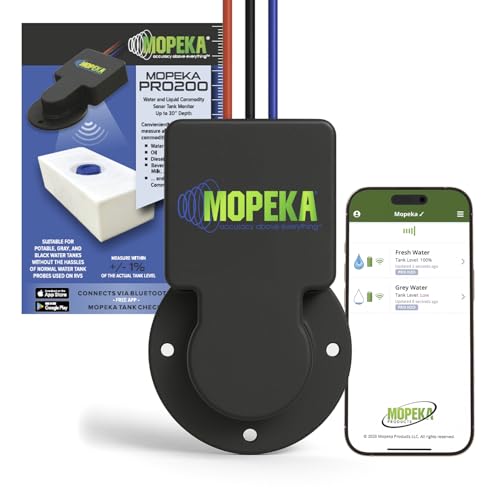
The Pro200 offers enhanced accuracy up to 99% for tanks up to 30 inches deep, with both Bluetooth and wired connections to suit RVs, boats, and other non-pressurized tanks. It integrates with Mopeka’s Co-Pilot and Tank Check apps for real-time monitoring, and requires no onboard batteries, drawing power from existing 12V wiring in vehicles.
Flowline DL24-01 EchoPod Ultrasonic Level Transmitter

The Flowline DL24-01 provides continuous level measurement output up to 9.8 feet (3 meters). It features WebCal configuration via USB, offering a straightforward setup process for small tanks with a narrow beam width and a short 4-inch dead band, enabling accurate measurements in compact spaces.
KKnoon Wireless Ultrasonic Water Level Monitor

KKnoon’s device emphasizes comprehensive monitoring with high/low alarms, empty-tank alerts, and solar charging for off-grid scenarios. It also measures indoor and tank temperatures, providing broader data to optimize water usage and tank management, powered by a rechargeable battery with solar replenishment.
EPTTECH Smart TLC2326P Remote Detector

The TLC2326P offers long measuring distance from 10 cm to 2.9 m and supports a WiFi-connected display that requires router access. It runs on a power adapter (5V) and connects to your network for remote data and alert capabilities, suitable for larger tanks and outdoor installations requiring smart connectivity.
Buying Guide
Key purchase considerations depend on your use case, environment, and data needs:
- Range and accuracy: Choose a model that covers your tank size with acceptable measurement precision. Consider blind zones and environmental factors that may affect readings.
- Power and connectivity: Decide between WiFi-enabled devices for remote monitoring and local wireless or wired options. Check compatibility with your existing apps or control systems.
- Output and integration: Look for 4–20 mA, digital displays, or full digital interfaces. Ensure the sensor’s outputs align with your data logging or SCADA system.
- Durability and environment: Assess IP ratings, enclosure materials, and temperature ranges to ensure reliable operation in tanks, outdoors, or oily/greasy liquids.
- Alarms and automation: Evaluate high/low level warnings, auto-drying or overflow prevention, and whether devices support automated alerts via mobile apps or local controllers.
Comparative considerations
- Remote monitoring vs. local display: WiFi-enabled sensors provide real-time access from anywhere, while wired or local-display models are simpler and may be more robust in harsh environments.
- Output formats: Decide between analog (4–20 mA) for integration with industrial panels and digital interfaces for easy viewing and logging.
- Power sources: Battery-operated or solar-powered units offer flexibility in remote locations; wired power ensures continuous operation in fixed installations.
- Tank compatibility: Consider tank material, liquid properties, and required protection (IP ratings) to select a suitable sensor.