Two-stage air compressors are designed for high-demanding tasks, offering higher pressure and better efficiency than single-stage models. This guide highlights five reliable two-stage units that suit shops, automotive bays, and industrial setups. Each option targets different workloads, from continuous duty and large tanks to energy efficiency and quieter operation. Use this overview to compare suitability for your space, noise tolerance, and power availability.
| Product | Best For | Key Specs | Why Pick |
|---|---|---|---|
| Ingersoll Rand 7.5HP 2 Stage (2475N7.5) 80-Gallon | Heavy-duty automotive shops | 7.5 HP, 175 psig, 80 gal ASME tank | High continuous duty, robust cast-iron pump life |
| POLAR AIR Industrial 5HP 60 Gal 2-Stage (PS05V060Y1) | Smaller shops with efficiency focus | 5 HP, 60 gal, 230V, 2-stage | Energy-efficient, USA-assembled, long-pump life |
| Ingersoll Rand 2340N5-V 5hp 80 gal Two-Stage | General-purpose heavy use | 5 HP, 80 gal, 14.3 CFM @ 90 PSI | Long-life cast iron, continuous duty |
| Ingersoll Rand 2340L5-V 5 hp Type 30 2 Stage | Industrial reliability with maintenance ease | 2-stage, cast iron, 100% continuous duty | Ease of service, durable design |
| POLAR AIR Industrial Plus 7.5HP 80 Gal 2-Stage ( PSP07V080V1 ) | Manufacturing or automotive environments | 7.5 HP, 80 gal, 31 CFM @ 175 PSI | High output, heavy-duty build, USA-assembled |
Ingersoll Rand 7.5HP Two-Stage 80-Gallon

Best for heavy, continuous-duty shop tasks. Features durable cast-iron construction and independently cast cylinders for easier service. Maximum operating pressure is 175 psig with an 80-gallon ASME receiver, making it suitable for demanding applications. Best for technicians who need longevity and minimal downtime. Caution: Larger footprint requires adequate floor space and proper ventilation.
POLAR AIR 5HP 60 Gal Two-Stage PS05V060Y1

Best for energy-conscious workflows in midsize shops. This unit emphasizes energy efficiency with a 5 HP motor and 60-gallon tank, delivering dependable air with a reduced energy footprint. Ideal for consistent air delivery in manufacturing or automotive work. Caution: Assembled in the USA, but relies on select globally sourced parts—verify component warranties locally.
DEWALT 60 Gallon 5 HP Stationary
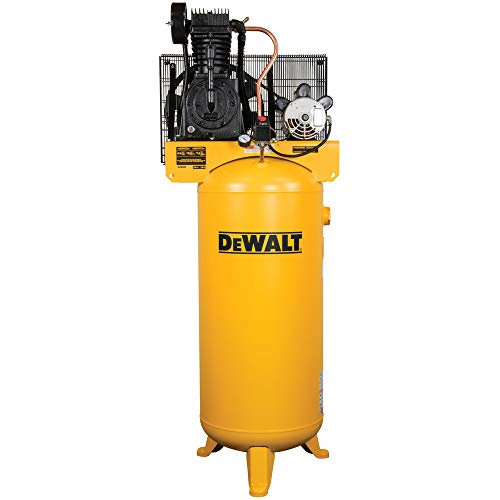
Best for quieter shop environments with solid output. While primarily known for a 5 HP motor and 230V operation, this unit operates quietly at about 65 dB and provides reliable performance with a respectable SCFM at higher PSI. Choose this if noise-sensitive workspaces are a concern. Limitation: It’s a single model in the broader two-stage lineup and may not match the peak CFM of larger dual-stage units for extremely heavy-demand tasks.
Ingersoll Rand 2340N5-V 5hp 80 gal Two-Stage

Best for consistent multi-purpose use in durable settings. This model offers 5 HP with an 80-gallon tank and 14.3 CFM at 90 PSI, delivering 100% continuous duty with cast iron construction. It’s suitable for shops needing reliable, long-term operation. Caution: Ensure adequate electrical supply and space for a two-stage setup.
POLAR AIR Industrial Plus 7.5HP 80 Gal Two-Stage PSP07V080V1

Best for high-demand manufacturing environments. With 7.5 HP and an 80-gallon vertical tank, this unit delivers 31 CFM at 175 PSI, balancing high output with efficient power use. It’s assembled in the USA for quality control and includes a long-life pressure-lubed pump. Caution: Higher power draw means your electrical system should support 230V single-phase operation with proper circuit protection.
Buying Guide: How to Choose a Two-Stage Air Compressor
Two-stage compressors compress air in two steps for higher pressures and improved efficiency. When selecting, consider tank size, CFM at your operating PSI, duty cycle, and motor power. Larger tanks support longer runtimes between fills, while higher CFM helps with continuous tools like impact wrenches and sanders. Energy efficiency and noise levels are practical for shop floors with concurrent tasks.
- Size and space: Match tank capacity and footprint to your workshop layout. An 80-gallon tank is common for heavy duties but requires more floor space.
- Duty cycle and reliability: Look for units designed for continuous duty if you run tools for long periods without breaks.
- Pressure and airflow: Check maximum PSI and CFM at your target PSI to ensure your tools receive adequate air.
- Power availability: Ensure your electrical supply matches the motor requirements (often 230V single-phase for shop units).
- Maintenance: Cast-iron pistons and accessible service points reduce downtime and maintenance costs.
- Noise: If the workspace is shared or near living spaces, consider models marketed for quieter operation.
Frequently Asked Questions
- What is the main difference between single-stage and two-stage compressors?
Two-stage compressors compress air in two steps, typically offering higher pressure, better efficiency, and longer life under heavy use compared to single-stage units. - What capacity should I choose for a home workshop?
For basic auto repairs and light painting, an 60–80 gallon two-stage unit is a common starting point. For continuous, high-demand tasks, opt for 80 gallons or more with higher CFM. - Do I need a receiver tank with a two-stage compressor?
Yes, most two-stage models include a large tank (often 60–80 gallons) to store pressurized air and stabilize delivery under high load. - What maintenance should I expect for a two-stage compressor?
Regular oil changes (for oil-lubed models), checking hoses and fittings, inspecting valves, and cleaning or replacing filters are typical maintenance tasks. - Is energy efficiency important for my purchase decision?
Yes. Higher CFM per horsepower reduces energy costs and heat buildup, especially in busy shops where the compressor runs frequently. - Can I install a two-stage compressor in a small space?
Yes, but ensure adequate clearance for airflow, service access, and vibration isolation. Some models offer vertical tanks to save floor space.
This article presents five two-stage air compressors suitable for demanding workshops. The selections emphasize long service life, reliable continuous duty, and efficiency, helping buyers compare capacity, power, and potential fitting scenarios.