When accuracy matters, a reliable temperature calibrator is essential. This guide highlights five top options suited for technicians, engineers, and lab professionals seeking precise thermocouple and RTD calibration, signal simulation, and process testing. Each model offers specific strengths—choose based on your type of work, required accuracy, and the thermocouple types you use most.
| Product | Best For | Key Capability |
|---|---|---|
| FRU Professional Thermocouple Simulator Calibrator | Industrial technicians needing versatile thermocouple simulations | Multi-type thermocouple compatibility for diverse testing |
| SIFAM TINSLEY VA710 Process Calibrator | Laboratory and field engineers needing accurate ambient compensation | 8 thermocouple types with ambient temp compensation |
| GuliTech Victor/RuoShui 02S | Users needing robust 8-thermocouple support and clear outputs | 8 thermocouple types, basic 0.05% accuracy, DC voltage outputs |
| Fluke 724 Temperature Calibrator | Precision testers requiring dual display and broad sensor support | RTDs, thermocouples, ohms, volts; simultaneous input/output viewing |
| GuliTech Victor/RuoShui 01S | Process calibration with versatile temperature source and outputs | 8 thermocouple outputs, multiple thermistor options, 0.05% accuracy |
FRU Professional Thermocouple Simulator Calibrator

Best for technicians who require reliable simulation of thermocouple signals for precise temperature measurement and testing. The device emphasizes professional-grade reliability and supports multiple thermocouple types, making it a versatile tester for industrial and lab settings. A potential limitation is the absence of explicit performance specifications beyond “multi-type compatibility,” so users should confirm compatibility with their exact thermocouple types before purchase.
SIFAM TINSLEY VA710 Process Calibrator

This model is best for professionals needing ambient temperature compensation and the ability to source and measure eight thermocouple types (J, K, T, E, R, S, B, N) or millivolts. It’s well-suited for lab work and field calibrations where ambient conditions influence readings. A minor caveat: detailed accuracy figures beyond “display and compensation” aren’t listed here, so verify exact error margins for critical tasks.
GuliTech Victor/RuoShui 02S Thermocouple Calibrator

The 02S model is best for users needing eight thermocouple types with clear output options and a basic accuracy spec around 0.05%. It provides DC voltage outputs in addition to thermocouple outputs (R/S/K/E/J/T/B/N). Choose this if you want strong thermocouple versatility at a straightforward price point. A limitation is that higher-precision tasks may require models with tighter error margins beyond 0.05%.
Fluke 724 Temperature Calibrator
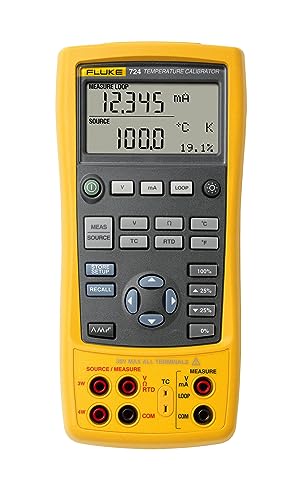
The Fluke 724 is best for professionals needing a dual-display interface to view input and output simultaneously. It supports RTDs, thermocouples, ohms, and volts for sensor and transmitter testing, with the ability to source and simulate multiple types of signals for calibrating transmitters. Best for teams requiring a single, versatile instrument; may be overkill for simple single-signal calibration tasks.
GuliTech Victor/RuoShui 01S Temperature Source

The 01S model is ideal for process calibration requiring a stable temperature source and multiple outputs, including eight thermocouple types and several thermistor options. It provides a practical mix of accuracy and versatility. Choose this if you need broader thermistor support alongside thermocouples; avoid this if you require ultra-high precision beyond 0.05% in some tasks.
Buying Guide
What should you consider when selecting a temperature calibrator?
- Thermocouple Type Compatibility: Ensure the device supports the thermocouple types you use (K, J, T, E, N, R, S, B, etc.).
- Accuracy and Resolution: Look for a clearly stated accuracy percentage (e.g., 0.05%) and output resolution to match your calibration needs.
- Output Options: Consider whether you need DC voltage outputs, resistance (ohms), or RTD/thermocouple simulation capabilities for transmitter calibration.
- Ambient Compensation: If calibrations occur in variable environments, ambient temperature compensation can improve real-world accuracy.
- Display and Readability: A dual or large display helps in cross-checking input vs. output during calibrations.
- Portability and Build: For field work, compact, rugged instruments with reliable power options are advantageous.
- Manufacturer Support: Access to updates, documentation, and compatibility notes is helpful for long-term use.
Practical comparison questions
- Is high-precision 0.01% accuracy necessary, or is 0.05% sufficient for your tasks?
- Do you primarily calibrate thermocouples, RTDs, or both?
- Will you be working in the field or primarily in a lab?
- Do you need ambient temperature compensation or multiple thermocouple types in a single unit?
Usage considerations
- Plan calibrations around the thermocouple types you use most to avoid compatibility gaps.
- Keep calibration equipment calibrated itself; use check standards if available.
- Document calibration results with timestamps and device identifiers for traceability.
FAQ
- What is a thermocouple calibrator used for? – It provides stable reference signals to test, calibrate, and verify temperature sensors and transmitters.
- Can these devices calibrate RTDs? – Some models support RTDs in addition to thermocouples; check each product’s specs.
- Why is ambient compensation important? – It accounts for temperature effects in the environment, improving accuracy during real-world use.
- What should I check before buying? – Thermocouple type coverage, accuracy, output options, and display clarity.
- Are these tools suitable for fieldwork? – Several models are designed for field use, but verify portability and power options for your tasks.
- Do these calibrators require special training? – Basic operation is straightforward, but consult the manual for advanced features and safety.