Answering the buyer’s search for reliable stationary electric air compressors, these models offer strong output, durable construction, and space-saving designs for garages, workshops, and light industrial use. They are best for professionals needing consistent airflow, DIYers tackling frequent pneumatic tasks, and shop owners seeking longer runtimes between fills. The following selections emphasize high psi, large tanks, and quieter operation where noted.
Below is a quick comparison of the selected models to help you decide at a glance:
| Product | Brand | Tank Size | Max PSI | |
|---|---|---|---|---|
| DEWALT 60 Gallon Vertical Air Compressor (3.7 HP) | DEWALT | 60 gal | 155 | Oil-lubricated pump; vertical design |
| DEWALT 60 Gallon Stationary Vertical Air Compressor (5 HP) | DEWALT | 60 gal | 230 | 65 dB; high efficiency; thermal protection |
| VEVOR 80 Gallon Stationary Compressor | VEVOR | 80 gal | 145 | Oil-free; 6.5 HP; quiet for its class |
| Campbell Hausfeld 80 Gallon Vertical (5 HP) | Campbell Hausfeld | 80 gal | 140 | Single-stage; high-volume airflow |
| Ingersoll Rand 7.5HP 2-Stage (80 gal) | Ingersoll Rand | 80 gal | 175 | 2-stage; long life, heavy-duty |
The table highlights the range of capacities, pressures, and design approaches. Use it to narrow down based on tank size, noise level, and horsepower before reading the full product details.
DEWALT 60 Gallon Vertical, 3.7 HP

The DEWALT 60 Gallon Vertical Air Compressor with a 3.7 HP electric motor and 155 PSI max provides solid, steady airflow for workshop tasks. This model is best for professionals who need reliable performance with space-saving vertical design and a robust oil-lubricated pump. It suits garages and light industrial work where a steady, high-volume air supply is essential.
Who it’s best for: professionals and serious DIYers who prioritize durability and consistent output in a dedicated workspace. Why selected: strong max pressure and a compact vertical footprint maximize shop floor efficiency.
Caution: Oil-lubricated pumps require regular maintenance to sustain long-term performance and may need periodic oil top-ups.
DEWALT 60 Gallon Stationary Vertical, 5 HP
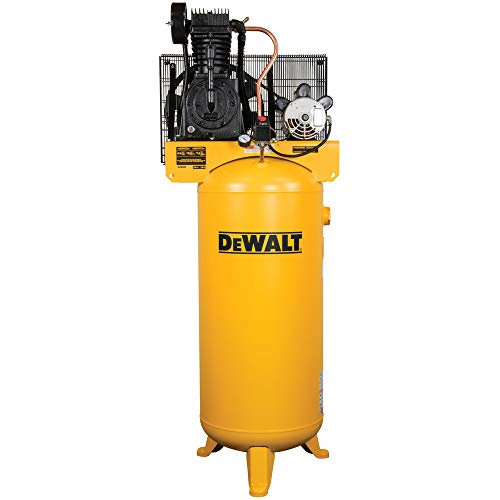
This DEWALT model delivers higher output with a 5 HP, 230-volt motor, and 65 dB operation at typical loads. It provides 13.5 SCFM at 175 PSI and 15.3 SCFM at 100 PSI, making it well-suited for continuous tools and more demanding shop air needs. The quiet operation makes it a good choice for home workshops or shared spaces requiring lower noise.
Best for: tradespeople and workshop owners who need robust airflow with quieter operation. Why selected: a strong balance of performance and noise control in a stationary 60-gallon unit.
Caution: Higher power requirement (230 V) may necessitate proper electrical framing and dedicated circuits in some setups.
VEVOR 80 Gallon Oil-Free Stationary

The VEVOR 80-Gallon unit runs on a 6.5 HP oil-free motor delivering up to 15.5 SCFM at 90 PSI with a low-noise profile of 86 dB. Its oil-free design reduces maintenance and simplifies operation, making it a good fit for busy shops that require longer run times without frequent oil changes.
Best for: facilities needing large air supply with reduced maintenance. Why selected: high tank capacity paired with a quieter oil-free system supports extended projects and minimal downtime.
Caution: Oil-free systems can generate different wear profiles; ensure airflow needs align with the 90 PSI rating for tools requiring higher pressure.
Campbell Hausfeld 80 Gallon Vertical, 5 HP
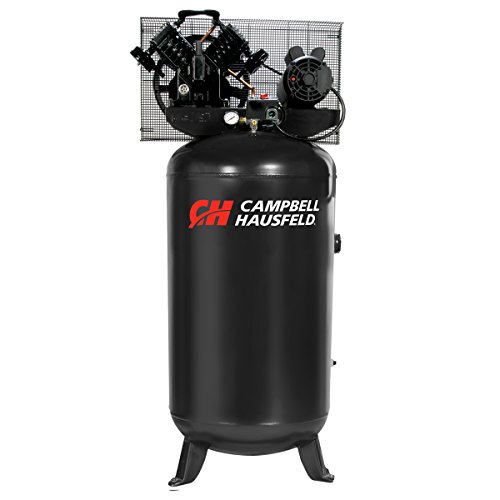
This 80-gallon vertical tank model delivers up to 140 PSI with 16.0 CFM at 90 PSI. The 5 HP single-stage motor provides consistent air output for sanding, spraying, and cutting, while the vertical design saves floor space in garages and shops with limited layouts.
Best for: serious hobbyists and professional shops needing long operation windows per run. Why selected: strong CFM at a practical PSI level supports a wide range of pneumatic tools.
Caution: Single-stage design may limit peak efficiency on very demanding, continuous-duty tasks compared with multi-stage options.
Ingersoll Rand 7.5HP 2-Stage, 80 Gallon

The Ingersoll Rand 2-stage compressor offers 7.5 HP of continuous duty power with a maximum 175 PSI and an 80-gallon ASME receiver. It’s designed for the most demanding applications, delivering strong punch for heavy pneumatic tools and extended operation life.
Best for: industrial settings or workshops needing continuous, high-pressure air for heavy tooling. Why selected: 2-stage design provides efficient compression and high output for tough tasks.
Caution: Higher upfront complexity and potential maintenance needs associated with two-stage systems; ensure proper setup and service access.
Buying Guide: Stationary Electric Air Compressors
- Tank size and duty cycle: Larger tanks (60–80 gal) support longer run times between refills, ideal for continuous tooling. Choose smaller tanks if space is tight or tool usage is intermittent.
- Max pressure and CFM: 175 PSI and at least 13–16 CFM at 90 PSI are common targets for common workshop tools. For spray finishing or heavy tools, higher CFM at lower PSI can improve performance.
- Single-stage vs. two-stage: Single-stage units are typically sufficient for most DIY and light-commercial tasks. Two-stage units offer higher efficiency and power for demanding workloads but may cost more and require more maintenance.
- Oil-lubed vs. oil-free: Oil-lubed pumps tend to be more durable under heavy use but require oil maintenance. Oil-free designs reduce maintenance but may have higher wear rates in extreme duty scenarios and can be noisier depending on model.
- Noise level: If the compressor will operate in a shared or residential space, look for models with lower dB ratings (around 65–70 dB). Oil-free designs can also influence noise depending on construction.
- Electrical requirements: Some units run on standard 230V circuits, while others may require dedicated circuits for higher horsepower motors. Check electrical setup before purchasing.
- Space and footprint: Vertical tanks save floor space, which is helpful in tight garages or workshops. Consider ceiling height and nearby workstations when selecting a placement.
Frequently Asked Questions
- What is a stationary air compressor best suited for?
Best for fixed workshop setups where air demand is steady and frequent, such as painting, sanding, and tool operation.
- How much PSI do I need for most tools?
Most common shop tools perform well around 90–175 PSI, with higher PSI needed for spray finishing or heavy-demand tools.
- Is oil-free better than oil-lubed for a busy shop?
Oil-free reduces maintenance while oil-lubed can be more durable over very heavy use; choose based on maintenance willingness and workload.
- Do I need a dedicated circuit for a 5 HP or larger compressor?
Yes, many 5 HP and higher units require dedicated electrical circuits to ensure stable performance and safety.
- What maintenance is required for oil-lubed compressors?
Regular oil checks, lubrication, and drain maintenance help maintain performance and longevity.
- Can I use a portable air hose with a stationary compressor?
Yes, a stationary unit typically provides a stable air supply to portable hoses for shop use.