Answering the need for reliable skid steer brush cutter solutions, this guide highlights top attachments that maximize cutting speed, durability, and versatility for heavy vegetation, rough terrain, and field maintenance. Ideal buyers include farmers, land-clearing crews, landscapers, and property owners tackling thick brush. Below, you’ll find quick picks, a comparative table, and a buying guide to help choose the right skid steer brush hog for your loader and project.
| Product | Cut Width | Best For | Key Benefit | Limitations |
|---|---|---|---|---|
| 72″ Wide Skid Steer Brush Cutter Attachment (Generic) | 66″ cutting width | Rough terrain, big areas | Bi-directional blades with stump jumper | Requires 14-20 gpm hydraulic flow |
| Wolfequip 66″ Brush Hog | 66″ | Large landscapes | Open front deck for debris flow | Rugged deck; heavier unit |
| GIYI 63″ Wide Brush Cutter | 1460 mm (~57.6″) | Tight trails and corridors | Heavy-duty steel, versatile flow/pressure | Lower cutting width than others |
| Landy 65 Inch Skid Steer Brush Cutter | 65″ deck | Standard flow hydraulic systems | Built for 15-20 GPM; stump jumper | May not suit very high-flow machines |
| MOTOQUEEN Replacement Blades (2 Pack) | 14.5″ blade size | Blade replacements | Heavy-duty NM400 steel | Replacement blades only |
72″ Wide Skid Steer Brush Cutter Attachment
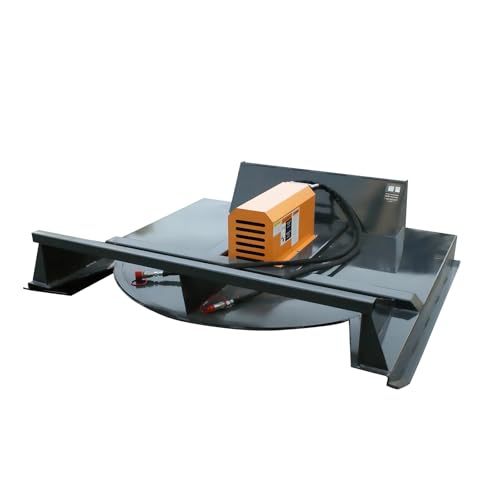
This attachment features a 66″ cutting width and a 72″ wide mowing deck, enabling rapid clearing of large areas. It uses 2 bi-directional blades and a 25HP gear box to cut up to 3″ diameter material. A stump jumper helps traverse uneven terrain with less deck damage, improving reliability on rough landscapes. Best for heavy-duty land clearing, pasture maintenance, and brush removal where speed matters. Hydraulic compatibility requires 14-20 GPM for smooth operation. Universal skid steer mounting supports broad compatibility.
Who it’s for: contractors and landowners needing fast, overgrown-vegetation clearing on sizable parcels. Why selected: a wide deck, solid cutting power, and stump-jumper design offer efficient performance in rough terrain. Caution: ensure your hydraulic system meets the 14-20 GPM requirement to avoid reduced cutting efficiency.
Wolfequip 66″ Brush Hog Brush Cutter Attachment

This 66-inch brush cutter combines wide cutting coverage with a robust deck, delivering efficient clearing over large areas with fewer passes. It features a 0.25-inch thick steel deck and an 8-inch deck height for durability in demanding land-clearing tasks. The recommended hydraulic flow of 16–22 GPM at 3000 PSI ensures dependable power for tough vegetation. Best for large fields and property borders where speed and resilience matter. Caution: heavier deck may require compatible mounting hardware and lifting capacity on some machines.
GIYI 63″ Wide Skid Steer Brush Cutter

With a 1460 mm cutting width (about 57.6″), this GIYI model covers more ground quickly and operates within 10-22 MPa pressure and 30-60 L/min flow. Its heavy-duty steel frame and anti-rust coating provide reliable performance in harsh conditions. Best for clearing lakeside properties, construction sites, and drainage ditches where a balance of width and maneuverability is needed. Caution: narrower than other 66-inch units, so plan pass counts accordingly for very dense brush.
Landy 65 Inch Skid Steer Brush Cutter

Designed for standard hydraulic systems with a 15-20 GPM flow, this 65″ deck lands on most skid steer loaders without upgrades. It features twin 0.4″ thick blades (23.6″ x 3″) spinning at 1060 RPM for efficient cutting and a built-in stump jumper to protect the deck over obstacles. Best for users seeking a reliable, no-fuss upgrade for heavy vegetation management. Caution: ensure your loader can handle the 1060 RPM blade speed safely and check for clearance if working in tight spaces.
MOTOQUEEN Replacement Blades For Wolverine BC-13-72W

These heavy-duty replacement blades are crafted from NM400 steel to withstand impact and maintain cutting performance in dense brush and saplings. They fit Wolverine BC-13-72W models and measure 14-1/2″ long, 2-3/4″ wide, 3/8″ thick, with a 1″ mounting hole. Best for maintaining cutting efficiency and blade life on proven brush hogs. Caution: verify exact blade dimensions before ordering to ensure compatibility.
Buying Guide
What to consider when choosing a skid steer brush hog:
- Deck width and cutting width: Wider decks cover ground quickly but require more clearance. Choose based on property size and typical turn radius.
- Hydraulic compatibility: Confirm your loader’s flow rate (GPM) and pressure (PSI). Attachments specify optimal ranges for peak performance.
- Deck protection: Stump jumpers and reinforced decks reduce damage when encountering stumps, roots, and rocks.
- Blade design: Bi-directional blades cut from multiple angles; blade thickness and material affect durability and replacement cycles.
- Mounting compatibility: Ensure the attachment fits your skid steer model and quick-attach system.
- Debris management: Open-front decks and guarded housings influence how debris is expelled and prevented from wrapping around augers or undercarriages.
- Maintenance access: Easy access to blades and belts simplifies routine service and reduces downtime.
FAQ
- Q: What does “stump jumper” do on a brush cutter?
A: It helps the deck glide over obstacles like roots and small stumps, reducing damage and improving cutting continuity. - Q: How do I know which GPM my skid steer needs for a brush hog?
A: Check the attachment’s recommended GPM range and compare it to your loader’s hydraulic specification; match within the supplier’s range for best results. - Q: Are replacement blades worth buying separately?
A: Yes, for ongoing clearing tasks, replacing worn blades maintains cutting efficiency and prevents extra wear on the motor and gearbox. - Q: Can I use a 65″ deck on a small skid steer?
A: It depends on turning radius and clearance. Smaller machines may handle 65″ less efficiently; verify loader capacity and path clearance first. - Q: Is a wider deck always better?
A: Not always. Wider decks cover more ground but require more stable mounting points and space to maneuver, so balance width with loader capability and field conditions. - Q: Do these attachments require special maintenance?
Yes, regularly inspect bolts, replace worn blades promptly, and ensure the stump jumper remains free of debris to prevent jamming.