Answering the need for reliable vibration and shock checks, this guide highlights five top devices suited for maintenance teams, engineers, and facilities managers. Each product targets specific measurement needs—from handheld meters for quick checks to multi-axis dataloggers for detailed trend analysis. Best fits include: portable meters for on-site health checks, higher-precision units for motor and HVAC diagnostics, and 3-axis loggers for recording peak events. The following quick-reference table helps you compare the essentials at a glance.
| Product | Brand | Best For | Key Strength |
|---|---|---|---|
| Triplett VB40 | Triplett | On-the-spot health checks | Wide ranges, NIST traceability |
| PM633C Digital Vibration Meter | Primyteion | Mechanical equipment with data storage | Broad frequency, TFT display, data transfer |
| VIBTrend 9080-1 | TPI | Software-supported analysis | Compact, software-ready |
| 9070-1 IP67 Vibration Meter | TPI | Rugged environments | IP67 rating, robust build |
| VBDL100 3-Axis Datalogger | Triplett | Shock and peak analysis | 3-axis logging, NIST traceability |
Note: Each product section below includes who it’s best for, why it was selected, and a practical limitation to consider. Use the Buying Guide to tailor your choice to your use case, environment, and data needs.
Triplett VB40 Vibration Meter And Datalogger
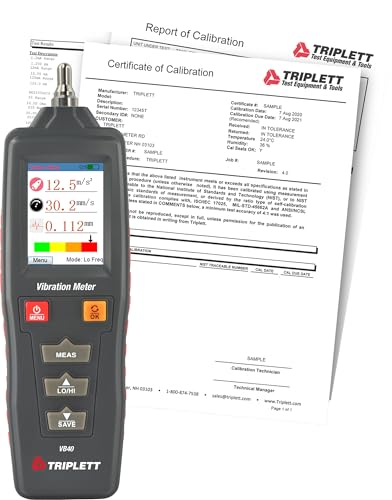
The Triplett VB40 combines a handheld vibration meter with datalogging and a certificate of traceability to NIST. It measures acceleration, velocity (RMS), and displacement with several ranges and a broad frequency window. The device is best for technicians who need on-site health checks and traceable data for maintenance records. A limitation is its basic accuracy relative to professional lab-grade instruments, so use it for routine monitoring rather than precise failure analysis.
PM633C Digital Vibration Meter
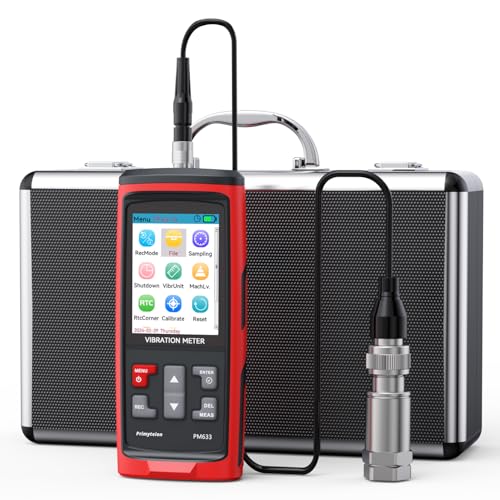
The PM633C from Primyteion is designed for mechanical equipment vibration analysis, offering acceleration, velocity, and displacement readings, plus temperature. Its TFT color display and data storage capabilities suit maintenance teams that need ongoing trend data. Best for: facilities teams seeking a more feature-rich handheld meter with data export. Caution: complex settings may require a user manual review to maximize accuracy and calibration routines.
Vibration Meter With VibTrend Software 9080-1

Test Products International’s VibTrend software-enabled option targets users who want to pair a vibration meter with software analysis. While the product is lightweight and straightforward, the software integration (and data transfer capabilities) can be advantageous for engineers documenting equipment health over time. Best for: shops and maintenance teams that rely on software-assisted diagnostics. Limitation: software setup and data management may require training to use effectively.
IP67 Rated Vibration Meter 9070-1

The 9070-1 from TPI is an IP67-rated vibration meter, built for rugged environments where dust and moisture resistance matter. It supports core vibration measurements and is suitable for field technicians working in harsh conditions. Best for: outdoor or dirty environments where durability is critical. Caveat: IP67 rating does not automatically guarantee accuracy under all high-vibration scenarios; verify calibration needs for your use case.
Triplett VBDL100 3-Axis Vibration Datalogger

The VBDL100 records 3-axis G-force and related peaks, enabling detailed shock and vibration data capture. Its 18g measurement range and user-configurable logging rate suit environments where peak events must be tracked for compliance or quality control. Best for: engineers needing peak event analysis and archival records. Limitation: data storage and retrieval depend on proper configuration; ensure logging parameters match test goals.
Buying Guide: How To Choose The Right Shock And Vibration Tool
What measurement needs do you have? Choose a handheld meter for quick checks or a datalogger for long-term trending. If you require multi-axis data, prioritize 3-axis logging options. If you work in harsh environments, consider IP ratings and rugged builds.
What ranges and frequencies are essential? Look for acceleration, velocity, and displacement ranges that cover your equipment. Higher frequency ranges help with high-speed rotating machinery, while wider acceleration ranges suit heavier equipment.
Do you need data export or software analysis? Some meters pair with PC software for trend analysis, alarming, and reporting. If your workflow relies on software, confirm compatibility and data transfer methods before purchase.
How important is traceability? If compliance or calibration documentation matters, select devices with NIST traceability certificates or clear calibration options. This supports audit-ready reporting in maintenance programs.
What is your environment like? For dirty or outdoor settings, prioritize dust and water resistance (IP ratings) and rugged housings. For clean lab environments, a lighter, compact meter may suffice.
Frequently Asked Questions
- What is the difference between acceleration, velocity, and displacement in vibration testing? Acceleration measures the rate of velocity change and is sensitive to high-frequency content. Velocity measures the speed of movement, useful for mid-band analysis. Displacement tracks the physical movement amplitude and is often used for low-frequency studies.
- Why would I choose a 3-axis datalogger? A 3-axis datalogger captures motion in three dimensions, enabling comprehensive peak analysis and correlation across axes for complex shocks and vibrations.
- Do I need ISO or NIST traceability? Traceability is important for audits, calibration records, and standardized reporting. It helps ensure measurements are comparable over time or across sites.
- Can these devices measure temperature or other related parameters? Some models include temperature sensing and line graph displays, which can help correlate vibration with thermal effects or motor conditions.
- Is IP67 protection necessary for vibration meters? IP67 protection is valuable in challenging environments. It reduces risk from dust and immersion, but may not directly improve measurement accuracy in all scenarios.
- How should I store and manage vibration data? Use devices that support data export to PC software or cloud platforms, and organize data with clear naming conventions and timestamps for easy retrieval.