When selecting a round body air cylinder, consider fit for space, bore size, stroke, and mounting options to match your application. This guide highlights five efficient round-body pneumatic cylinders and explains who benefits most from each model. It helps buyers choose devices for compact automation, linear actuation, or corrosion-resistant environments. The featured cylinders cover both aluminum and stainless steel bodies, single- and double-acting configurations, and common mounting styles.
Buyer types best served by the featured products include: compact automation installers needing a small footprint and precise stroke; hobbyist and light-industrial users seeking affordable, dependable round-body cylinders; and engineers requiring corrosion resistance for wet or washdown environments. The summary table below provides a quick reference for bore size, stroke, material, and mounting style to aid side-by-side comparisons.
| Product | Bore | Stroke | Material | Actuation | |
|---|---|---|---|---|---|
| HNJPC MAL32x300 | 1 1/4 in (32 mm) | 12 in (300 mm) | Aluminum | Double Acting | Round Body, Compact |
| HNJPC MAL40x75 | 1 1/2 in (40 mm) | 3 in (75 mm) | Aluminum | Double Acting | Round Body, Compact |
| SMC NCMC106-0300 | 1-1/16 in | 3 in | Stainless Steel | Double Acting | Rear Pivot |
| SMC NCMB106-0100S | 1-1/16 in | 1 in | Stainless Steel | Single Acting | Front Nose |
| SMC NCMB075-0150S | 3/4 in | 1-1/2 in | Stainless Steel | Single Acting | Front Nose |
HNJPC MAL Mini Pneumatic Cylinder MAL32x300
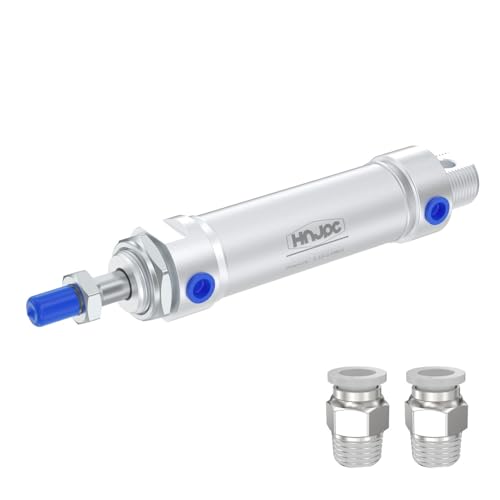
Best for: Applications needing a long stroke in a compact round body. The MAL32x300 offers a 12-inch stroke with a 1 1/4-inch bore, enabling extended travel in tight spaces. Its aluminum construction supports lighter loads in automation setups requiring quick actuator movement.
Why selected: This model combines a compact round body with a longer stroke, making it suitable for press feeds, pick-and-place, or linear actuations where space is limited but travel is essential. Its G1/8 threaded mounting hole aligns with common pneumatic fittings.
Limitation: The data does not specify cushion or end-of-stroke damping, so users should ensure installation provides adequate mechanical stops to prevent impact damage. Operating range is listed as 0–145 PSI (0–1 MPa).
HNJPC MAL Mini Pneumatic Cylinder MAL40x75
Best for: Short-stroke, compact setups requiring higher bore for heavier piston loads. The MAL40x75’s 1 1/2 inch bore and 3 inch stroke offer a balance between force and travel in constrained lines or machine frames.
Why selected: A compact round body design paired with a slightly larger bore supports moderate actuation force while maintaining a small footprint, ideal for small automation modules or adjustable fixtures.
Limitation: Limited stroke for long travel tasks; ensure the 75 mm stroke fits the intended cycle. It uses an aluminum body with a G1/4 mounting hole and 0–145 PSI operating range.
HNJPC MAL Mini Pneumatic Cylinder MAL32x150
Best for: Light- to medium-duty linear actuation where a longer travel distance is needed without increasing bore size. The 1 1/4 inch bore with 6-inch stroke provides robust reach in compact axial layouts.
Why selected: The long 150 mm stroke within a compact round body allows more motion per cycle in small machines, conveyors, and assembly lines. It features magnetic integration for piston position sensing in some setups.
Limitation: Magnetic feature is noted in the product name but not described in features; confirm magnetic sensing compatibility if needed for automation.
SMC NCMC106-0300 Stainless Steel Round Cylinder

Best for: Heavier-duty, double-acting actuation in corrosive or wash-down environments. Stainless steel body provides corrosion resistance and reliability in demanding settings.
Why selected: Double-acting cylinders offer push and pull capabilities, which is essential for precise linear motion. A rear pivot mounting option supports versatile installation in equipment frames.
Limitation: Not switch-ready and not cushioned; plan for end-of-stroke cushioning or mechanical stops to reduce impact forces.
SMC NCMB106-0100S Stainless Steel Round Cylinder
Best for: Single-acting, spring-return cylinders in compact automation tasks where back-driving is not required. Front nose mounting offers straightforward installation.
Why selected: The spring-return design simplifies simple push-to-extend operations and reduces wiring or control complexity in basic pneumatic circuits.
Limitation: Spring return may limit holding force and exact control of position compared to double-acting models; ensure the cycle requirements align with spring tension.
SMC NCMB075-0150S Stainless Steel Round Cylinder
Best for: Compact, light-duty applications requiring a small bore with a moderate stroke and stainless steel durability. Front nose mounting simplifies mounting in constrained spaces.
Why selected: The 3/4 inch bore with 1-1/2 inch stroke offers a balanced choice for compact fixtures, enabling reliable actuation in tight tool-frames and small machines.
Limitation: Smaller bore means lower force; avoid high-load tasks or long travel in high-resistance applications without upgrading to a larger bore model.
Buying Guide: Round Body Air Cylinders
Key purchase considerations include bore size, stroke length, material, and actuation type. For corrosion resistance, stainless steel bodies excel in washdown or humidity-prone environments. Aluminum bodies are lighter and often adequate for standard automation tasks. Double-acting cylinders provide both extension and retraction force, while single-acting cylinders with springs offer simpler control and lower cost but different hold characteristics.
What mounting style fits your setup? Front nose and rear pivot mounts accommodate various machine frames. For compact layouts, round-body cylinders with integrated magnets or mounting options can simplify sensor integration. If space is extremely tight, consider longer strokes within a smaller bore to maximize travel without enlarging the footprint.
How to compare specifications quickly? Use this quick checklist: bore diameter for available force, stroke length for travel, mounting type for installation alignment, and material for environmental resistance. Check whether a product is switch-ready and whether cushions are included or required to minimize end-of-stroke impact.
Practical tips: verify the operating pressure range (PSI/MPa) to match your system, ensure threaded holes and port sizes align with your fittings, and confirm whether the cylinder requires external cushioning or mechanical stops to protect the rod and mounts during operation.
Frequently Asked Questions
- What is a round body air cylinder? A pneumatic cylinder with a cylindrical exterior design used for linear motion, available in aluminum or stainless steel, and in single or double-acting configurations.
- When should I choose stainless steel over aluminum? Choose stainless steel for corrosive or washdown environments; choose aluminum for lighter weight and standard automation tasks.
- What does single-acting versus double-acting mean? Single-acting uses one air port with a spring return; double-acting uses two ports for extending and retracting the piston.
- Do round-body cylinders require cushions? Cushions are often optional; they reduce end-of-stroke impact but may not be present in all models. Confirm cushioning in the product data.
- Which mounting style is most versatile? Front nose and rear pivot mounting cover a wide range of installations and often offer the easiest alignment in compact frames.
- How do I pick the right bore and stroke? Select bore based on required force; stroke should match the needed travel distance without excessive over-travel in the mechanism.