Looking for a glycerin-filled pressure gauge to minimize needle flutter and deliver steady readings across dynamic systems? This guide highlights five reliable options ideal for water pumps, air lines, irrigation, and more. Each pick uses glycerin to dampen pulsations, helping you read pressure accurately in challenging environments. The top picks are best for hobbyists, homeowners, and professionals who need dependable performance under vibration. Below, compare features, ideal uses, and limitations to help you decide which gauge fits your setup.
| Product | Best For | Key Benefit |
|---|---|---|
| SENCTRL 0-100 Psi Glycerin Filled | Home workshop, water pumps, tanks | Compact 2.5″ dial with corrosion-resistant case |
| SENCTRL 60 Psi Glycerin Filled | Pool filters, small irrigation, pressure testing | Dual-scale 0-60 psi for tighter ranges |
| MEASUREMAN 1/4 NPT 0-100 Psi | Industrial and domestic gas/liquid lines | Clear dual-scale display, robust 304 SS case |
| SENCTRL 0-300 Psi Glycerin Filled | HVAC, air compressors, hydraulic checks | Higher range with durable stainless case |
| Winters 2-1/2″ Dial, 0-100 Psi | Industrial pumps, machining, machinery | Single-scale, rugged construction, IP65 rating |
SENCTRL 0-100 Psi Glycerin Filled Gauge

This glycerin-filled, 2.5″ dial gauge uses brass and stainless steel wetted parts to measure non-corrosive liquids and gases, including water and oil pressure tests. The 304 stainless steel case resists corrosion, while glycerin filling dampens pointer flutter from vibration and pulsation. It provides dual-scale readouts (0-100 psi / 0-700 kPa), enabling quick comparisons across metric standards. Best for small-to-medium systems like water pumps or well pumps where stability matters. Caution: ensure compatible media to avoid misreadings from incompatible fluids.
SENCTRL 60 Psi Glycerin Filled Gauge

Designed for tighter pressure ranges, this 2.5″ dial, 1/4″ NPT lower mount gauge is enclosed in a 304 stainless steel case with glycerin filling. It measures 0-60 psi / 0-400 kPa with the same anti-vibration benefits as larger models. Best for pool sand filters, small water pumps, and pressure-testing tasks where precision within a narrow band is essential. Better for applications where space is limited but a stable, rapid reading is needed. Limitation: lower maximum pressure may not suit heavy-duty hydraulic systems.
MEASUREMAN 1/4 NPT 0-100 Psi Gauge
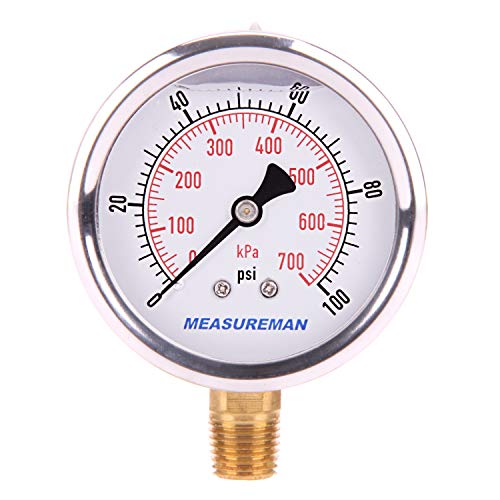
This glycerin-filled gauge features a 2.5″ dial, 1/4″ NPT lower mount, and a 304 stainless steel case. It reads from 0-100 psi / 0-700 kPa, with a clear dual-scale display for quick interpretation. Best for both industrial and domestic gas and liquid lines, including water systems and air pressures. It’s suitable for environments with vibration; however, ensure a proper seal when connecting to low-flow or pulsating lines to avoid ghost readings.
SENCTRL 0-300 Psi Glycerin Filled Gauge
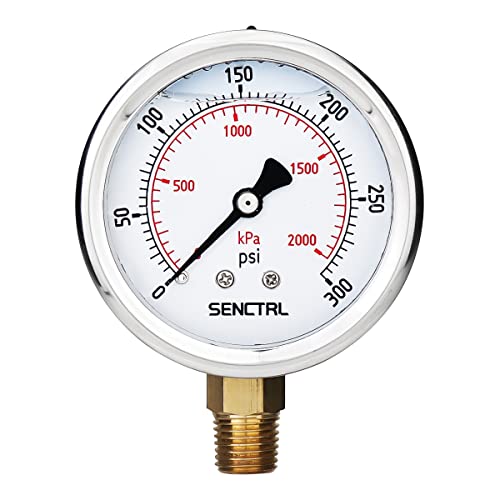
Targeting higher-pressure applications, this 2.5″ dial gauge extends to 0-300 psi / 0-2000 kPa. The stainless steel case and glycerin filling reduce pointer flutter in dynamic systems like HVAC and air compressors. Best for mid-to-high range testing and monitoring. Choose this if your system requires broader pressure coverage beyond 100 psi. Limitation: larger maximum may be unnecessary for very low-pressure setups.
Winters 2-1/2″ Dial Glycerin Filled Gauge

This industrial-grade gauge uses brass internals with a 304 stainless steel case and a glycerin fill. It offers a single-scale 0-100 psi readout, ideal where a straightforward, robust measurement is required. IP65-rated for dust and water resistance makes it suitable for harsher environments like machinery rooms or exposed plumbing. Best for long-term installations where protection against contaminants and vibration matters. Limitation: single-scale design may require additional gauges for multi-parameter monitoring.
Buying Guide: Key Purchase Considerations
- Pressure range: Match the gauge range to your system’s typical maximum to avoid over- or under-range readings.
- Mounting style: Lower mount vs. back mount affects installation space and accessibility.
- Wetted materials: Brass and stainless steel resist corrosion with water, oil, and many gases; verify compatibility with your media.
- Glycerin filling: Reduces pointer flutter and dampens vibrational pulses; essential in pulsating or dynamic lines.
- Dial size: A 2.5″ dial offers readable values at a distance; larger dials are easier to interpret in busy environments.
- Environmental protection: IP65 or higher ratings protect against dust and water ingress in outdoor or workshop settings.
Common Scenarios And Which Gauge Fits best
- Water pumps and irrigation: 0-100 psi models from SENCTRL or MEASUREMAN provide quick readings with strong vibration resistance.
- Pool filters and small pressure tests: 0-60 psi SENCTRL model offers precise readings without overspec.
- HVAC and air compressors: 0-300 psi SENCTRL gauge supports higher demand without scaling up to large, heavier instruments.
- Industrial machinery with exposure to dust or moisture: Winters gauge with IP65 protection ensures longevity in rough environments.
- Multiple-use kits or batch testing: A set like Saysurey’s 6-piece collection provides flexible options for various tasks.
FAQ
- What does glycerin filling do in a pressure gauge? It dampens needle movement caused by pulsation or vibration, giving steadier and more readable readings.
- Can glycerin-filled gauges be used with water and oil safely? Yes, provided the wetted materials are compatible with the media; brass and stainless steel are common and versatile.
- Are glycerin-filled gauges suitable for outdoor use? Many models feature stainless cases and IP ratings that help resist weather and dust exposure.
- What is the advantage of a multi-scale gauge? Dual or multiple scales let you read in different units (psi and kPa) without conversion, which saves time in testing scenarios.
- When should I choose a higher psi range gauge? Choose higher ranges if your system routinely exceeds 100 psi to avoid inaccurate readings or over-range damage.
- Is a larger dial always better? Larger dials improve readability at a distance, but consider space constraints and mounting options in your setup.