Answering the needs of machine shops, hobbyists, and DIY fabricators who require clean, ready-to-machine stainless steel blanks. This guide highlights five precision-ground stainless steel plate options and who each is best for. Choose these when you need tight tolerance stock for fast CNC setup and reliable flatness. The following quick-reference table helps compare core traits at a glance.
| Product | Best For | Typical Thickness | Flatness Promise |
|---|---|---|---|
| TCI Precision 316 Stainless .250″ x 6″ x 6″ | General machining, small parts | 0.250″ | Ground on two sides, milled on length/width |
| TCI Precision 316 Stainless .125″ x 8″ x 8″ | CNC-ready blanks for larger runs | 0.125″ | Ground two sides for thickness, milled four sides |
| TCI Precision 316 Stainless .250″ x 8″ x 8″ | Medium-sized precision parts | 0.250″ | Ground two sides, milled four sides |
| PEROPROS T316 Stainless Sheet 12 Gauge | Thin-gauge stainless for high corrosion resistance | 12 Gauge (approx. 2 mm) | Precision grade for flatness |
| TCI Precision 304 Stainless .250″ x 8″ x 8″ | Standard 304 blanks for diverse projects | 0.250″ | Ground two sides, milled four sides |
TCI Precision Metals 316 Stainless Steel Sheets .250″ Thick 6×6

Features: Machine-ready blanks in a wide range of pre-configured sizes. Parts are clean and prepped, ready for final machining. Ground and milled on two sides for thickness with +/- .002″ tolerance and milled on length and width to +/- .002″. Reduces prep and overall cycle time by delivering ready-to-machine stock.
Best for: Small to mid-sized parts where a clean, flat blank with tight thickness tolerance speeds up setup.
Why selected: It offers a compact 6×6 footprint with robust precision grinding, ideal for repeatable machining cycles.
Caution: Verify that the 6×6 area accommodates your fixture; limited edge length may constrain very large parts.
TCI Precision 316 Stainless Plate Sheet .125″ Thick 8×8
Features: Machine-ready blanks in a wide range of pre-configured sizes. Ground and milled on two sides for thickness and flatness; milled on four sides for width and length. Reduces prep time and allows direct loading onto CNC centers.
Best for: Projects requiring more material density while staying lightweight, with quick CNC onboarding.
Why selected: The 0.125″ thickness is a good compromise between rigidity and weight for precision components.
Caution: Thinner stock may be more prone to warping if not handled with appropriate fixturing during machining.
TCI Precision 316 Stainless Sheets .250″ 1.000″ Square

Features: Standard machine-ready blanks in common sizes, with 6-side line stainless sheets precision-ground on two sides for thickness and flatness (+/-.002″), and milled on length and width (+/-.002″). Reduces prep and cycle time by delivering ready-to-machine stock.
Best for: Small-batch production where quick setup and repeatability matters for grid-like components.
Why selected: A versatile option in a familiar 3×3 footprint for compact assemblies.
Caution: Ensure the 3×3 footprint matches fixture and clamping capabilities on your CNC or manual mills.
PEROPROS T316 Stainless Sheet 12 Gauge
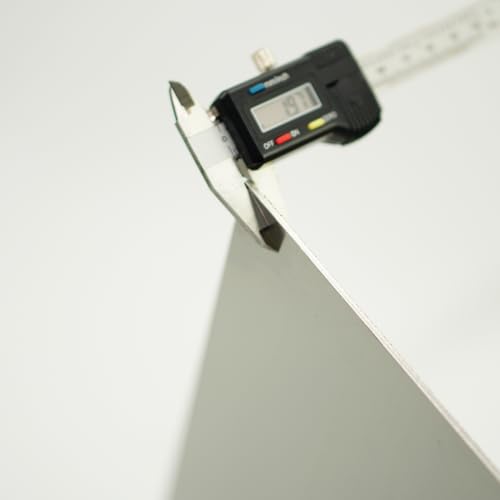
Features: Approximate overall dimensions 11-11/16″ x 11-11/16″, 12 gauge (about 2 mm) thick. Corrosion resistant 316 grade with molybdenum for enhanced plating and medical/dining use suitability. Protective film helps prevent scratches.
Best for: Applications needing higher corrosion resistance in compact panels or accessories.
Why selected: 316 grade offers superior corrosion resistance for environments with chlorides or harsh cleaners.
Caution: Verify the surface finish and protective film status before processing to avoid surface defects after machining.
TCI Precision 304 Stainless .250″ x 8″ x 8″

Features: Machine-ready blanks in standard sizes. Ground and milled on two sides (thickness) to +/- .002″ and milled on four sides for length and width to +/- .002″. Reduces prep time and overall cycle time by delivering clean stock straight from receipt.
Best for: Projects requiring 304 stainless with good formability and weldability for diverse fabrication tasks.
Why selected: The 8×8 size is a practical balance between material area and fixture compatibility for many shop setups.
Caution: 304 has slightly lower corrosion resistance than 316 in certain aggressive environments; consider environment before use.
Buying Guide
- Material grade choice: 304 offers good corrosion resistance and formability; 316 adds enhanced corrosion resistance in chloride-rich environments. Choose based on exposure and cleaning protocols.
- Thickness and tolerance: If your parts demand tight thickness control, prioritize blanks ground to +/- .002″ and milled on all sides. Thinner stock may need careful handling during fixturing.
- Size and fixture compatibility: Match the blank footprint to your fixture/workholding. Smaller footprints enable easier clamping, while larger sheets support more surface area per part.
- Finish and prep time: Machine-ready blanks reduce setup time. If you have manual grinding capabilities, standard blanks may still require some prep.
- Corrosion considerations: For food, medical, or high-saline environments, favor 316 or higher alloy content to maximize longevity.
- Cost versus yield: Larger sheets may reduce per-piece cost in high-volume runs, but require bigger fixtures and more handling.
FAQ
- What does “precision ground” mean for stainless plate? It means the material has been ground on the thickness direction to tight tolerances and milled on the length and width to preserve flatness and squareness for easy machining.
- Which stainless grade is best for corrosion resistance? 316 stainless steel generally offers better corrosion resistance than 304, especially in chloride-containing environments.
- Are machine-ready blanks suitable for CNC milling? Yes. They arrive clean, prepped, and ready to load directly onto CNC machines, reducing setup time.
- When should I choose 125″ thickness versus 250″ thickness? Thinner blanks reduce weight and cost for lighter parts, while thicker blanks provide more rigidity for deeper cuts or heavier-duty parts.
- Can I use these blanks for waterjet or laser cutting? Yes, but verify your process parameters align with the material’s flatness and edge quality requirements.
- Is there a risk with thinner sheets warping? Thinner stock can be more susceptible to warping if not properly fixtured or if subjected to uneven clamping during processing.