Precision flow metering valves are essential for achieving exact dilution ratios, minimizing waste, and ensuring consistent results in soft washing, pool chemical management, laboratory, and industrial settings. This guide highlights five top options, clarifying who each product is best for and why. Whether you need micro-adjustable flow for chemical dosing or rugged metal bodies for high-pressure applications, these valves offer clear, repeatable control. The following selections emphasize compatibility, material quality, and practical operation for American buyers.
Summary of chosen products:
| Product | Best For | Key Benefit |
|---|---|---|
| Soft Wash Metering Valve (3/4″), 0.75 Inch, Black | Soft wash professionals and DIYers | Precise dilution control for consistent results |
| SeDeplacer R172086 1/2-Inch Control Valve Replacement | Inline chlorinators and feeders | Corrosion-resistant control with flexible rotary switches |
| H2 Flow Controls FV-C FlowVis 2 x 2.5in | General flow metering with check valve | Clear scale in GPM/LPM, versatile installation |
| High Pressure Precision Needle Valve, Stainless Steel | Instrument isolation and calibration | Ultra-fine 9-turn metering and solid 304 stainless body |
| Barstock Needle Valve, 304 Stainless Steel | Laboratory and calibration work | Robust barstock design with easy-to-count T-handle |
Soft Wash Metering Valve (3/4″), 0.75 Inch

Best for small to mid-size soft wash setups needing precise chemical dilution. The valve is sold individually, with multiple sizes available (1/2″, 3/4″, 1″). It provides fine-tuned flow control to achieve accurate dilution ratios, supporting consistent cleaning results. Best for contractors and homeowners performing regular soft wash maintenance. Caution: single-valve packaging may show reference images with multiple valves; order the exact size you need.
SeDeplacer R172086 1/2-Inch Control Valve Replacement

Best for inline chlorine/bromine feeders and pool/spa systems needing precise meter control. This 1/2-inch valve features a dual end connection with flexible rotary switches to adjust flow, helping prevent blockage and corrosive exposure. Made from corrosion-resistant plastic for dependable, low-leakage operation. Choose this if your setup uses Pentair Rainbow feeders or similar inline chlorinators. Limitation: plastic construction may offer less mechanical durability under very high-pressure conditions compared to metal valves.
H2 Flow Controls FV-C FlowVis 2 x 2.5in. Complete

Best for situations requiring a combined flow meter and check valve in a compact package. It features a clear scale in GPM or optional LPM and supports horizontal, vertical, upside-down, or side-by-side installations. This makes it ideal for tight plumbing spaces or complex line configurations where readability and orientation flexibility matter. Limitation: readouts rely on external setup; ensure the scale is properly calibrated for your system.
High Pressure Precision Needle Valve, Stainless Steel

Best for critical metering tasks such as lab gas chromatography and hydraulic speed control. This 3/8″-6mm orifice NPT valve uses a 9-turn precision stem for ultra-fine adjustments and is CNC machined from solid 304 stainless steel for durability. Choose this when you need repeatable, low-leakage control under high-pressure conditions. Caution: slightly firmer turning effort is normal due to tight thread fit and robust sealing.
Barstock Needle Valve, 304 Stainless Steel
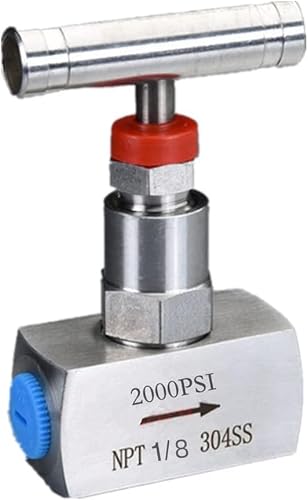
Best for laboratory calibration and instrument isolation requiring robust, durable construction. The barstock body, machined from solid 304 stainless steel, supports up to 2000 PSI and offers a solid sealing performance beyond lightweight alternatives. The T-handle design provides easier, repeatable adjustments and clear turn-count monitoring. Limitation: requires slightly more manual effort to turn due to the precise engagement of threads and seals.
Buying Guide
What to consider when choosing a precision flow metering valve
- Pressure rating and compatibility: Verify the valve’s maximum pressure and whether it matches your system’s needs (high-pressure vs low-pressure, gas vs liquid).
- Material and corrosion resistance: Stainless steel or tough plastics contribute to longevity in chemical or chlorinated environments.
- Flow adjustment precision: Look for the number of turns, knot-free seats, and fine-threaded stems for repeatable metering accuracy.
- Connection size and type: Ensure the valve matches your existing plumbing (NPT, inline fittings, or specialized connectors).
- Readability and installation orientation: A clear scale and flexible orientation options simplify setup and ongoing monitoring.
- Maintenance and longevity: Consider whether the design supports easy disassembly for seals and seats replacement if needed.
How to pick between metal vs plastic valves
- Metal valves (stainless steel) offer superior durability and sealing in high-pressure or high-temperature environments but may be heavier and pricier.
- Plastic valves are often lighter and resistant to certain chemicals but can be less robust under repetitive high-pressure cycles.
Installation and use tips
- Follow manufacturer guidelines for torque and sealing compounds to prevent leaks.
- Calibrate flow settings with your system’s test runs to ensure accurate dosing or metering.
- Record the turn counts for repeatable setups, especially in processes requiring exact dilutions or calibration steps.
FAQ
- What is a precision flow metering valve best used for? It is used to finely control the flow rate of liquids or gases, enabling accurate dosing, dilution, and calibration in various systems.
- How many turns are needed for fine adjustments? Some models require multiple turns (for example, up to 9 turns) to move from fully closed to fully open for precise control.
- Can these valves handle high pressures? Many are designed for high-pressure applications, but always check the specific PSI rating to ensure compatibility.
- Are metal valves more durable than plastic ones? Generally, yes for demanding environments, though plastic valves may suffice for lighter-duty or chemical-specific uses.
- Is compatibility with pool or spa feeders important? If your system uses inline feeders, choose a valve designed for such connections and materials.
- Do I need special tools to install these valves? Most require standard plumbing tools; refer to each product’s installation notes for details.