Portable ultrasonic flaw detectors are essential for quick, non-destructive testing of metals, composites, and other materials. They’re ideal for maintenance teams, quality inspectors, and field engineers who need precise flaw sizing, thickness measurements, and rapid data capture anywhere. This guide highlights five reliable models tailored to different needs—from rugged, all-metal use to feature-rich analysers with PDF reporting and data export.
| Product | Brand | Best For |
|---|---|---|
| GOYOJO GUF750 Ultrasonic Flaw Detector | GOYOJO | Sub-millimeter flaw resolution in metals; field inspections |
| SUNNYSONG KUT 680 | SUNNYSONG | Versatile defect detection and PDF reporting |
| VTSYIQI NDT Ultrasonic Flaw Detector | VTSYIQI | High channel count and configurable DAC/AVG curves |
| TMTECK TFD807C Portable UT Flaw Detector | TMTECK | Long-range steel testing with digital display |
| RASNDTV KUT681 Digital Flaw Detector | RASNDTV | Ergonomic, waterproof design with weld inspection tools |
Note: Each product is described with its intended buyer. Choose based on your material, range needs, data handling, and environmental conditions.
GOYOJO GUF750: Ultra-Precise, Portable UT
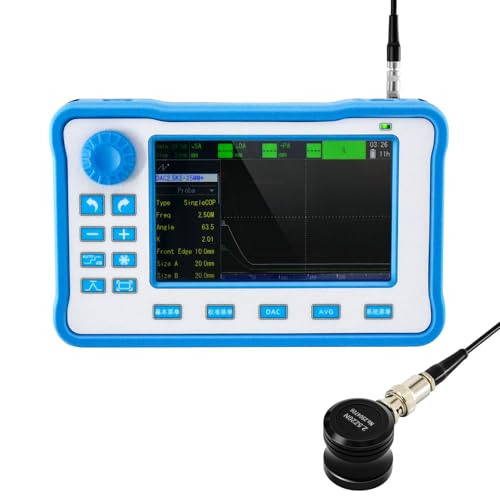
The GOYOJO GUF750 offers a wide 0.1-20 MHz bandwidth and high sampling (100 MSPS hardware, 400 MSPS equivalent) for sub-millimeter flaw resolution. It includes dual-gate alarms, RF/full-wave demodulation, and supports AWS D1.1 and NB/T 47013 standards. A 5-inch IPS touchscreen and 700-group cross-sectional imaging enable detailed B-scan synthesis, thickness maps, and easy SD-card export of A/B-scans. Best for engineers who need high-resolution imaging and strict standard compliance in rugged environments.
Best for: Field technicians and quality engineers who require precise, standards-compliant flaw detection and robust imaging. Caution: The device’s advanced features may require a higher learning curve for new users.
SUNNYSONG KUT 680: Versatile Portable Flaw Detector

The SUNNYSONG KUT 680 is a versatile digital ultrasonic flaw detector designed for steel metallurgy, metalworking, and quality inspection. It supports PDF flaw reports directly and can save color or grayscale screenshots to USB drives. This makes it ideal for teams that need portable reporting and easy data sharing on-site. It’s best for shops or field crews that prioritize documentation efficiency and flexible data outputs.
Best for: Inspectors who need on-site reporting and straightforward data export. Caution: Report generation features are more prominent than advanced imaging capabilities.
VTSYIQI NDT Ultrasonic Flaw Detector

The VTSYIQI NDT detector emphasizes a wide measurement range and multiple curves (DAC, AVG) with a high channel capacity. It supports 0.2-20 MHz frequency and up to 10,000 mm measuring range, plus automatic probe calibration. It’s designed for heavy industrial environments where multiple defects must be mapped across large components. The product targets users who need configurable testing parameters and robust data handling for complex parts.
Best for: Large-scale testing environments needing configurable DAC/AVG curves and high measurement range. Caution: The feature set can be complex; training may be beneficial.
TMTECK TFD807C: Long-Range Steel Testing

The TMTECK TFD807C combines ARM+FPGA hardware with a full-digital color TFT LCD display and a master-slave menu for efficient operation in the field. It supports long-range steel testing up to 15,000 mm, with four operating interface styles and a fast 60 Hz LCD update. Its ergonomic design and quick rotary knob support quick adjustments in varied lighting and outdoor conditions. Best for: Users prioritizing long-range capability and a rugged, user-friendly interface. Caution: The feature set is broad; some users may only need basic testing modes.
RASNDTV KUT681: Ergonomic and Durable

The RASNDTV KUT681 focuses on ergonomic design, waterproof and oil-proof construction, and a 360-degree rotating damping bracket with a rubber sheath. It’s designed for damage-free use in harsh environments and supports weld inspection workflows with a transparent glass panel. This model is best for maintenance crews working in outdoor or challenging settings where durability and ease of use matter most. Caution: The description emphasizes ruggedness; high-end measurement features may vary by model year.
Buying Guide: Key Considerations
- Application scope: Choose based on material type (steel, composites), expected defects (cracks, porosity), and required measurement range.
- Data handling: Consider whether you need PDF reports, USB data export, or SD card storage. Wireless transfer can be a plus in the field.
- Imaging capabilities: If you require B-scan imaging, high-frame recording, and thickness mapping, prioritize models with advanced imaging and wide bandwidth.
- User interface: Look for intuitive controls, screen readability outdoors, and the availability of presets for common inspection tasks.
- Environment and durability: For fieldwork, durability, waterproofing, and operating temperature ranges are critical.
- Calibration and standards: Ensure compliance with applicable standards (e.g., AWS D1.1) and easy automatic calibration if needed.
Frequently Asked Questions
- What is a portable ultrasonic flaw detector used for?
– It detects internal flaws, measures thickness, and characterizes defects in metals and some composites, often on-site or in workshops. - What should I look for when choosing a flaw detector?
– Bandwidth, data export options, imaging capabilities, durability, ease of use, and compatibility with your standard testing needs. - Are high-channel detectors necessary for all applications?
– Not always. High-channel detectors are useful for complex parts or multiple inspection points but may add cost and complexity for simple tasks. - Do these devices require training?
– Basic operation is straightforward, but advanced features (DAC/AVG curves, B-scan synthesis) benefit from training. - Can these units work with standard transducers?
– Most support common probe types, but verify probe compatibility with the specific model before purchase. - What maintenance is needed?
– Regular calibration checks, probe maintenance, battery care, and firmware updates help sustain accuracy and reliability.