When choosing a portable toxic gas detector, the top objective is fast, accurate detection across multiple gases with clear alarms. This guide highlights five capable models ideal for workers, homeowners, and safety professionals who need reliable, on-the-go monitoring. Each option is evaluated for best use case, limitations, and how to maximize safety in confined spaces, job sites, or home environments. The summary below helps you compare key features at a glance.
| Product | Best For | Key Strength |
|---|---|---|
| TopTes Guard-101 | Worksites needing 4-gas monitoring | Triple alarm with fast response |
| Forsensal 4 Gas Detector with Pump | Extended reach in ducts and pits | Pump-assisted sampling and calibration kit |
| TopTes PT199 | Home safety for gas leaks | Rapid detection of natural gas and propane |
| TopTes Guard-863Pro | Industrial or demanding environments | 5-year O2 sensor; data export |
| HAOKESITE 4 Gas Monitor | Confined spaces and construction sites | Voice prompts and 1800mAh battery |
TopTes Guard-101 Gas Detector — 4 Gas Monitor
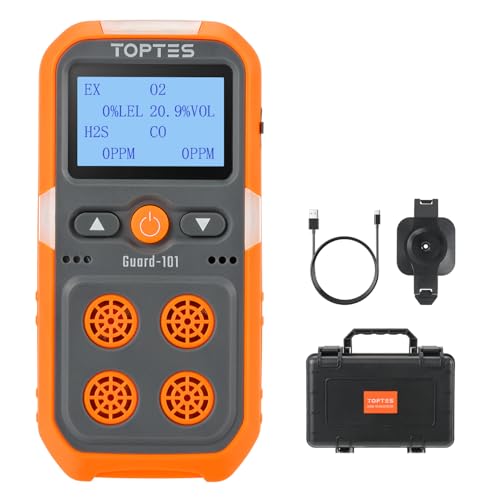
The TopTes Guard-101 is a compact 4-gas monitor for H2S, CO, LEL, and O2 with a long battery life and triple alarms. It features a robust ABS housing, waterproof and explosion-proof design, and a back clip for easy carrying. An initial password prevents accidental operation, and alarms include LED, vibration, and audible alerts. Data storage stores alarm records for traceability. Best for field workers who need rapid, continuous monitoring in diverse environments.
Best for: Field technicians and maintenance crews who require reliable, on-site gas detection with easy data review. Limitations: The device’s 14-hour battery life is solid, but high-frequency alarms can drain power more quickly in active environments.
Forsensal 4 Gas Detector With Pump

This 4-gas monitor includes a built-in pump, enabling active sampling for CO, O2, H2S, and EX with a large LCD display and calibration capabilities. It ships with a calibration kit and a 3000mAh battery for extended use. It’s suited for users who need to test gas concentrations in ducts, manholes, and other hard-to-reach areas. The device supports record viewing and gas-type-specific curves.
Best for: Professionals working in confined spaces or complex ventilation systems. Limitation: The pump-assisted operation may require periodic maintenance and calibration checks to ensure accuracy.
TopTes PT199 Natural Gas Leak Detector
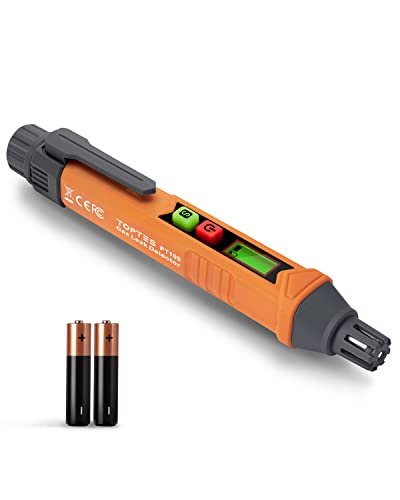
The PT199 is designed to locate combustible gas leaks, including natural gas, methane, propane, and butane. It provides rapid 0.5-second alarms with a red LCD indicator at high levels. It operates with two included AAA batteries and includes a warm-up period. It’s a practical choice for quick in-home safety checks and leak locating.
Best for: Homeowners and small-space safety scenarios where quick leak pinpointing is essential. Limitation: It focuses on combustible gases and is not a full four-gas monitor for industrial needs.
TopTes Guard-863Pro 4 Gas Monitor

The Guard-863Pro adds a TFT color screen, an upgraded O2 sensor with a five-year lifespan, and USB data export for alarm and operation records. It detects H2S, CO, LEL, and O2 with a fast 0.5-second response and a triple alarm system. This model emphasizes durable construction and data traceability for professional environments.
Best for: Industrial settings requiring precise data visualization and long-term sensor life. Limitation: Higher feature set may entail a steeper learning curve for new users.
HAOKESITE 4 Gas Monitor With LCD

This device detects EX (0-100% LEL), H2S, O2, and CO, providing four alarm modes (voice, 120 dB siren, vibration, and light). It includes factory calibration, a high-capacity 1800mAh battery, and a clear LCD readout. The device is suitable for complex environments where audible alerts are critical for safety.
Best for: Construction sites and underground work where prominent audible alarms improve awareness. Limitation: Some users may prefer models with data export for record-keeping.
Buying Guide: Key Purchase Considerations
- Gas coverage: Determine whether you need 4 gases or a single-gas focus. Four-gas models cover essential hazards like H2S, CO, O2, and LEL.
- Alarm system: Look for triple alarms (sound, light, vibration) for environments with noise or limited visibility.
- Sampling method: Choose a diffusion sensor for general use or a pump-equipped detector for hard-to-reach areas.
- Sensor life and maintenance: Consider O2 sensor lifespan and calibration needs; longer sensor life reduces maintenance downtime.
- Battery life: Longer battery life supports extended monitoring in remote or job-site conditions; check standby vs. active usage performance.
- Data logging and export: If records are required for compliance, select models with USB data export or memory storage.
- Durability: Look for waterproof, dustproof, and explosion-proof ratings when working in harsh environments.
- User interface: A clear LCD or TFT display helps reading gas concentrations quickly, especially in low-light conditions.
Frequently Asked Questions
- What is a portable toxic gas detector used for?
It detects hazardous gases in the immediate environment and alerts the user through alarms to prevent exposure and ensure safety.
- Should I choose a pump or diffusion gas detector?
Pump detectors actively sample air and are better for confined spaces or long-running tests; diffusion detectors are simpler and lighter for general use.
- How important is the sensor’s lifespan?
Sensor lifespan affects maintenance intervals and long-term reliability, especially for critical gases like O2 and H2S.
- What does a triple alarm provide?
Audible alerts, visible indicators, and vibration alerts increase the likelihood of timely responses in noisy or obscured environments.
- Can data export improve safety compliance?
Yes. Exported alarm logs and calibration data support audits, training, and incident investigations.
- Is a rechargeable battery essential?
Rechargeable batteries reduce downtime and long-term running costs, particularly on extended job sites.