The following selections focus on spare-ready plate heat exchangers used in heating, cooling, and wort/chiller applications. This guide helps buyers pick reliable options, with notes on suitability, installation, and potential limitations. Each product is chosen for robustness, material quality, and practical operating ranges. The table below summarizes the five recommended units and who they’re best for.
| Product | Brand | Plates | Ports | |
|---|---|---|---|---|
| BestEquip 3″x7.5″ 40 Plate Brazed Exchanger (B3-12A) | BestEquip | 40 | 4 MNPT | Compact hydronic heating or wort cooling with solid durability |
| VEVOR Brazed Plate Exchanger EATB28-50 | VEVOR | 50 | 5″ x 12″ | Large heat transfer area for high-demand heating/cooling |
| INTBUYING 100 Plate Exchanger | INTBUYING | 100 | 1″ MPT | Water-to-water heating with substantial capacity |
| AB Plate Heat Exchanger 4″x12″ 30 Plates | AB | 30 | 1″ MPT | Copper-edged, versatile for floor heating and snow melting |
| Ferroday 20 Plate Wort Chiller | Ferroday | 20 | 1/2″ NPT | Compact wort cooling for homebrewing |
BestEquip 40 Plate Brazed Exchanger B3-12A

BestEquip’s 40-plate braze exchanger uses 316L stainless steel sheets, brazed at edges to form a rugged unit resistant to high pressure and temperature. Its turbulent-flow design improves heat transfer by moving media in opposite directions, delivering strong performance for both heating and cooling tasks. This model is CE-certified and energy-optimized, heating water to a preset temperature without electricity usage. Best for compact hydronic systems or wort chillers needing a robust, seal-tight exchanger. A limitation is the 40-plate size, which may be overkill for very small flows.
Who this is best for
- Small to mid-sized hydronic heating installations
- Homebrewers needing a reliable wort chiller with low energy footprint
VEVOR 50-Plate Exchanger EATB28-50

VEVOR’s 50-plate design emphasizes high heat transfer area with 316L stainless steel and copper brazing at edges for a robust, leak-resistant assembly. The asymmetric herringbone plate pattern creates turbulent flow, maximizing efficiency across a wide operating window. This unit supports high-temperature and high-pressure scenarios, making it suitable for floor heating, water heating, or snow-melting projects. A potential limitation is the size and weight, which may require careful handling during installation.
Who this is best for
- Systems needing substantial heat transfer capacity
- Applications requiring durable, leak-resistant construction
INTBUYING 100 Plate Exchanger SUS304
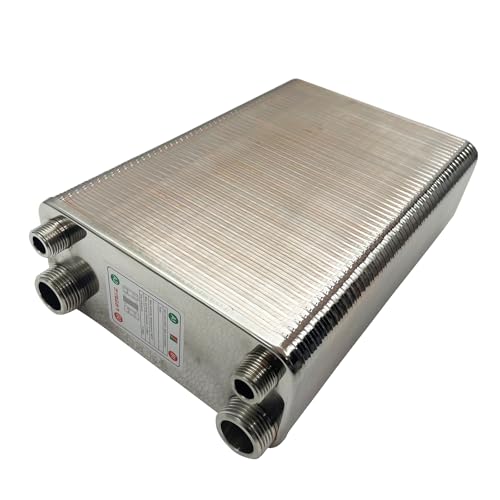
This INTBUYING model uses 304 food-grade stainless steel with a copper Braze at joints, and a copper filter to prevent debris build-up in the water channels. Vacuum welding increases welding area, enhancing pressure strength and reducing flow resistance to meet varied water needs. It is well-suited for water-to-water heating and multi-circuit setups in larger residential or light commercial systems. The main caveat is that maintenance and cleaning can be more involved with high plate counts, requiring systematic flushing and inspection schedule.
Who this is best for
- Builders or contractors running multi-zone or high-capacity water heating
- Facilities seeking durable, food-grade stainless steel with strong welds
AB 4″x12″ 30 Plates Exchanger

AB’s plate exchanger features 316L stainless steel sheets brazed with 99.9% copper at the edges for a rugged, leak-resistant core. The unit emphasizes energy efficiency with smooth threading for easy hookups and slim plate design to optimize heat transfer. The 30-plate arrangement yields a typical 250,000–330,000 BTU/hr capacity, suitable for floor heating, hot water supply, or snow melting. A potential limitation is a fixed plate count, which may require choosing a different model for substantially different flow rates.
Who this is best for
- Projects requiring compact footprint with solid heating/cooling performance
- Situations prioritizing easy assembly and reliable copper-assisted heat transfer
Ferroday 20 Plate Wort Chiller

Ferroday’s wort chiller uses 304 stainless steel plates with copper brazing to minimize oxidation during the heat exchange process. With 20 plates, this compact unit is designed to chill wort quickly compared to immersion chillers, making it well-suited for homebrewers seeking faster turnover. Cleaning is limited by non-disassembly; recommended approach involves circulating cleaning solution followed by clear water. Best for smaller batches or home setups where space is a constraint. It may not be ideal for very large volumes due to plate count.
Buying Guide: Key Purchase Considerations
What size and plate count do I need?
Plate count directly affects heat transfer capacity and pressure tolerance. Higher plate counts yield larger surface areas and typically higher BTU/hr, but also increase unit size. Match plate count to your required throughput and available space.
What materials ensure durability and safety?
Stainless steel 316L is common for durability and corrosion resistance. Copper brazing at edges improves sealing and heat transfer but can raise material costs. Food-grade stainless (304 or 316L) is important for potable water or wort applications.
How important is pressure and temperature tolerance?
Operating range should align with system pressure, maximum temperatures, and potential surge conditions. Brazed plate exchangers are generally strong but require correct installation to prevent leaks under high pressure.
What about ease of installation and maintenance?
Consider port sizes and threading (MPT/BSP) and whether your setup supports quick connections. Maintenance varies: some models allow easier disassembly for cleaning, while others are sealed brazed units.
Is energy efficiency a priority?
Many models emphasize energy-saving by reducing pumping requirements through efficient heat transfer designs and reduced pressure drops. When choosing, compare the pressure drop and temperature change achievable with your flow conditions.
Frequently Asked Questions
- What is a plate heat exchanger? A device that transfers heat between two fluids using plates, maximizing surface area for efficient transfer while keeping fluids separate.
- Are brazed plate exchangers suitable for home use? Yes, they are common in home heating, beer wort chilling, and small industrial applications due to compact size and strong sealing.
- How do I choose between 40 vs 50 vs 100 plates? Higher plate counts increase capacity and efficiency but require more space and potentially more maintenance. Select based on desired BTU/hr and available installation space.
- Can I mix fluids in a plate heat exchanger? Not typically; these devices are designed for two separate fluids to avoid cross-contamination, but you should verify compatibility with your specific fluids.
- What should I check during installation? Ensure proper port sizing, tight connections, and correct orientation. Avoid over-tightening to prevent leaks at brazed joints.
- Can these be used for cooling wort? Yes, several models are well-suited for wort cooling, delivering fast chill times while maintaining cleanability and material safety.
For buyers seeking specific spares, these five options cover compact to high-capacity needs, with material quality, robust construction, and practical installation considerations. Each choice aligns with common heating or cooling workflows while offering clear advantages for particular use cases.