Answering the question “which plastic recycling shredder machine should I buy?” this guide highlights practical options for small workshops, makers, and hobby recyclers. Each product is described with its best use case, what it’s best for, and a clear caution. This overview helps buyers compare size, capacity, and blade configurations to pick the right shredder for efficient plastic recycling workflow.
Summary table of chosen products:
| Product | Motor / Power | Approx. Capacity | Best For | |
|---|---|---|---|---|
| VEVOR Plastic Shredder Crusher (SDK-11) | 3HP / 2.2KW | 100-150 kg/h | General hard plastics like PVC, ABS, PET | 6mm |
| agreilduite 1.5kW Plastic Shredder | 1.5KW | 10-20 kg/h | 3D printing waste, supports bulky parts | ~5mm |
| VEVOR 7.5HP Plastic Shredder | 7.5HP / 5.5KW | 200-300 kg/h | Higher-volume shredding, continuous use | 8mm |
| VEVOR 5.5HP Plastic Shredder | 5.5HP / 4.0KW | 150-200 kg/h | Balanced size and throughput | 8mm |
| INTBUYING Electric Plastic Shredder | 2.2KW | 50-100 kg/h | Flexible small-to-medium projects | 6mm |
VEVOR SDK-11 3HP Plastic Shredder Crusher

This shredder combines a 3HP (2.2KW) copper motor with 1740 RPM for steady performance and a 6mm mesh to deliver 100-150 kg/h crushing capacity. It handles PC, PVC, ABS, PET, EPS, PU, HDPE, rubber, leaves, wood, and nylon. Note: Bottles are not suitable for this unit. The 11 SKD-11 blades (9 rotating + 2 fixed) provide sharp, durable cutting power. A double-layer soundproof design minimizes noise, making it suitable for small workshops. Best for bulk plastic materials and mixed waste streams where quiet operation matters. Caution: Avoid glass or metal debris to protect blades.
agreilduite 1.5kW Plastic Shredder
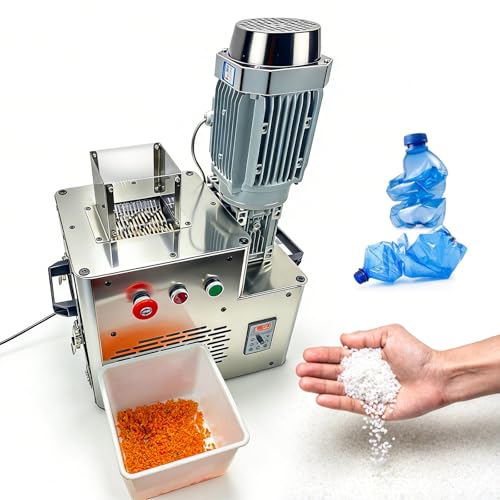
Designed for recycling failed 3D prints, supports, and filament scraps. It produces uniform ~5mm plastic pellets for extrusion or molding. The machine features a wide feeding port (12×15 cm) that accommodates bulky prints and thick scraps, reducing prep time. Best for small-scale 3D printing waste recycling workflows. Use this if your primary material is ABS, PLA, PP, or similar plastics. Limitation: Pellets are irregular in shape, which may affect some downstream processes.
VEVOR 7.5HP Plastic Shredder Crusher

This high-capacity shredder uses a 7.5HP (5.5KW) motor at 1755 RPM and an 8mm mesh to achieve 200-300 kg/h. It shares the same SKD-11 blade construction as other VEVOR models and emphasizes low noise and stable operation through double-layer soundproofing. Best for mid-to-large scale projects where consistent high throughput is needed. Caution: Like other heavy-duty units, ensure adequate ventilation and stable mounting to minimize vibration.
VEVOR 5.5HP Plastic Shredder
With a 5.5HP (4.0KW) motor, 1750 RPM, and 8mm mesh, this model handles 150-200 kg/h. It shreds a wide range of materials including PC, PVC, ABS, PET, EPS, and more. Best for moderate-volume operations seeking a balanced price-to-throughput ratio. A practical choice for makers moving toward larger batch recycling. Limitation: Blades set uses SKD-11 blades; check replacement availability if used heavily.
INTBUYING Electric Plastic Shredder
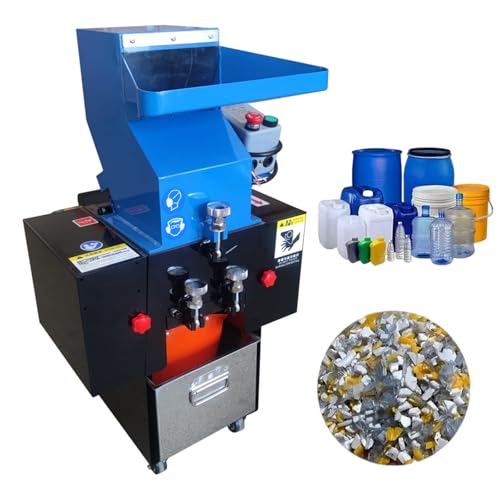
A versatile 2.2KW plastic crusher with a 110×180 mm feed port and a 6mm mesh, producing 50-100 kg/h. It supports PC, PVC, ABS, PET, EPS, PU, HDPE, nylon, and other plastics, suitable for small recyclers and educational labs. Best for compact spaces and projects that do not require extremely high throughput. Caution: Performance depends on material homogeneity; bulky, mixed waste may slow processing.
agreilduite 3D Printer Plastic Shredder

This model is designed for recycling failed 3D prints, supports, and filament scraps. It yields consistent ~5mm plastic pellets compatible with filament extruders and pellet-fed 3D printers. The large feeding port makes it easier to handle bulky prints. Best for small studios processing 3D printing waste. Limitation: Pellets may be irregular, so some downstream processes may require sieving or re-melting.
Buying Guide
What should you consider when choosing a plastic recycling shredder?
- Throughput needs: Match capacity (kg/h) to your daily volume. Higher horsepower models deliver more throughput but cost more and require more space.
- Material variety: If you recycle mixed plastics or 3D-print waste, ensure the machine handles ABS, PLA, PET, PVC, and Nylon without frequent blade wear.
- Blade design and maintenance: SKD-11 blades are common and durable. Look for blades that are easy to remove, sharpen, and replace.
- Filtration size: Mesh size (e.g., 6mm, 8mm) determines final pellet or particle size. Smaller mesh gives finer outputs but may increase processing time.
- Noise and stability: Double-layer soundproofing helps in small workshops. A stable mounting or wheel system is important for mobile setups.
- Feeding port size: Larger openings reduce pre-cutting and boost efficiency for bulky items like prints or containers.
- Power and footprint: Higher power units require proper electrical supply and floor space. Consider 1-phase vs. 3-phase options for installation.
FAQ
- What plastics can these shredders process?
Most models are designed for a range of plastics including ABS, PVC, PET, PC, PU, HDPE, PLA, and similar materials. Some units emphasize 3D printing waste or general plastic waste streams.
- Is a higher horsepower always better?
Higher horsepower increases throughput but also cost and space needs. Choose based on daily volume and available space.
- Do these machines produce uniform pellets?
Many models produce pellets around 5–8 mm, which are suitable for extrusion and molding. Pellet uniformity can vary with material type and blade wear.
- Are these machines suitable for home use?
Smaller units with 1.5–2.2 kW motors are generally better for home workshops due to size and noise considerations. Larger models suit small shops.
- What maintenance is required?
Regularly inspect blades, tighten fasteners, and clean the chamber after use. Avoid shredding glass or metal to protect blades and machinery.
- Do they require special electrical power?
Some models run on standard 220V 60Hz supply, while higher-capacity units may require 3-phase power. Verify your facility’s electrical capabilities before purchase.