Finding the right pipe weld positioner can boost efficiency, accuracy, and overall welding quality. This guide highlights five top options designed to secure, rotate, and tilt pipe fittings and tubes for butt welds and fittings. Each product is evaluated by capacity, maneuverability, and usability to help you choose the best fit for on-site and workshop welding tasks.
| Product | Brand | Load Capacity | Key Feature |
|---|---|---|---|
| Welders 3rd Hand – Portable Pipe Welding Clamp | Sawyer Mfg Company | Lightweight, portable | Precise butt weld alignment |
| Welding Positioner 485 lbs | KAKA INDUSTRIAL | 481 lbs horizontal; 220 lbs vertical | 0-135° tilt; stepless speed |
| Tank Turning Welding Rolls | PreAsion | Up to 2200 lbs | Adjustable 2″-24″ diameter |
| Pipe Tank Welding Linkage Roller | INTSUPERMAI | Up to 2200 lbs | Rotation with welding linkage |
| 10KG Rotary Welding Positioner | LEHUNDI | Up to 22 lbs at 0°; 11 lbs at 90° | 0-90° tilt; 2-20 rpm |
The selected products cover a range of needs—from lightweight, portable clamps for quick alignment to heavy-duty turntables for demanding pipe welding. Use this guide to compare capabilities and choose a positioner that fits your workflow, material type, and workspace constraints.
Welders 3rd Hand – Portable Pipe Welding Clamp

The Sawyer Mfg Welders 3rd Hand is designed to deliver precise alignment for butt welds and pipe fittings. Its clamping system provides a firm grip on workpieces and allows swift adjustments, improving efficiency on diverse metals including aluminum and steel. The tool is compact and portable, making it suitable for both on-site welding and workshop use. Features emphasize consistent accuracy and ease of use, helping welders achieve repeatable results with minimal setup time.
Welding Positioner 485 lbs Tilt and Rotation

The KAKA INDUSTRIAL welding positioner offers substantial horizontal and vertical load ratings, with a tilt range up to 135° and stepless speed control. The 110V single-phase motor and 0-5 rpm rotation speed support precise control for welding operations, especially for larger pipe sections. With a robust turning mechanism and a self-locking worm gear, it helps maintain position during welds and allows easy manual adjustments as needed.
Tank Turning Welding Rolls

PreAsion tank turning rolls provide a heavy-duty solution with a 2200 lb loading capacity and polyurethane rollers to maximize friction and reduce slipping between workpiece and rollers. The adjustable diameter range supports workpieces from 2 inches to 24 inches, making it versatile for various piping projects. Rotation speed can be set within a defined range and displayed numerically, enabling precise control of feed rate and welding pace.
Linkage Roller Rotary Welding Rolls
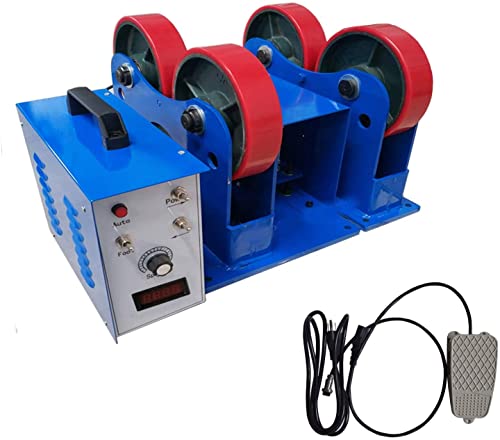
INTSUPERMAI’s welding linkage roller system is designed for pipeline welding and can be used alongside welding machines like submerged arc welders. It emphasizes safety (grounding requirements) and stable horizontal operation. The setup is suited for operators who need a reliable support structure for long sections or inside/outside pipe welding, with emphasis on dry, ventilated workspace for optimal performance.
10KG Rotary Welding Positioner – LEHUNDI

The LEHUNDI 10KG rotary welding positioner is a compact, portable option with a 180 mm working table. It tilts from 0 to 90 degrees and offers a rotational speed range of 2-20 rpm, providing stable, precise positioning for lighter welding tasks. The three-jaw chuck ensures solid clamping of small to mid-size components, delivering reliable support for accurate welds in constrained spaces or desktop setups.
Small Rotary Positioner For Parts

Treliamd’s compact rotary positioner offers a 0-90° range with a 20W motor and 10 rpm maximum speed, designed for smaller parts and desktop operation. It includes a three-jaw chuck with a precise clamping range to prevent movement during welding. The unit is ideal for hobbyists or small shops needing reliable, space-saving positioning for precise welds on lightweight components.
Buying Guide
What to consider when choosing a pipe weld positioner
- Weight capacity: Match the positioner’s load capacity to the heaviest workpiece you will weld to avoid overloading the unit and compromising stability.
- Rotation and tilt range: Determine whether you need continuous rotation, 0-90 degrees, or up to 135 degrees tilt for your typical weld orientation.
- Speed control: Stepless or fixed-speed controls enable smoother feed and consistent welds, especially for long runs or vertical welds.
- Table size and footprint: Consider workspace constraints; larger tables provide more support but require more space.
- Power requirements: Check voltage and power draw (single-phase vs three-phase) to ensure compatibility with your shop’s electrical supply.
- Clamping mechanism: A secure chuck or clamps must accommodate tubing and pipe diameters common in your projects without slipping.
- Safety and grounding: Proper grounding and stable mounts reduce hazards and improve operator safety during operations.
- Portability: For on-site work, weigh and arrange for easy transport. Portable units should combine light weight with sufficient rigidity.
Comparative considerations
- Heavy-duty versus lightweight: Heavy-duty positioners excel in industrial environments and large pipe welds, while lightweight clamps suit quick alignment and small-diameter work.
- Manual versus powered tilt: Manual tilting is simpler and cheaper, but powered tilt or variable speed rotation offers greater control for complex welds or batch runs.
- Accessibility and maintenance: Select units with readily available spare parts, straightforward maintenance, and clear safety instructions.
When evaluating options, align product capabilities with your typical projects, space, and power availability. A balance between strength, ease of use, and portability will yield the best long-term value for welding operations involving pipe and tube alignment.