Finding a reliable pipe leak detector is essential for preserving water and avoiding costly damage. This article highlights five top options and explains who each device is best for. The selection focuses on models that balance precision, ease of use, and portability for both indoor and outdoor applications. The buyers most likely to benefit are homeowners addressing small leaks, contractors working in varied environments, and facilities managers seeking scalable detection tools.
| Product | Best For | Key Benefit |
|---|---|---|
| PQWT PQ125A | Homeowners and basic professional users | Two sensor types for versatile indoor detection |
| PQWT PQ125C | Indoor & outdoor use | Three sensors for mixed environments |
| PQWT PQ125B | Outdoor and industrial contexts | Outdoor-focused sensor set with listening rod |
| PQWT PQ125C (third listing) | General to precise positioning | Clear general and location modes with 3 sensors |
| PQWT Outdoor L2000 | Outdoor pipelines | Depth capability up to 5m |
PQWT PQ125A Underground Water Leak Detector
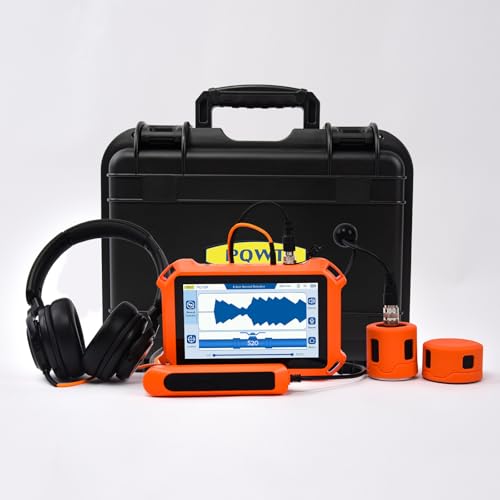
This model targets home users who prioritize straightforward operation and precise localization. It features a touchscreen UI that presents modules clearly, with guided help and error prompts. It is especially useful for homeowners and entry-level technicians who need quick leak point identification.
Best for: Beginners and interior leak checks where user-friendliness matters. The device uses two dual membrane resonance sensors to detect acoustic leaks, including inaudible sounds, by focusing on a specific frequency. This helps identify leaks behind walls or under flooring where visibility is limited.
Limitations: General Detection Mode supports broad scans, but pinpoint accuracy improves with the Location Mode, which relies on analyzing data from multiple points. Heavy ambient noise may affect sensitivity in some rooms.
PQWT PQ125C Indoor & Outdoor Leak Detector

The PQ125C is designed for both interior and exterior environments, offering a multi-sensor approach that suits varied leak scenarios. Its three-sensor framework (DMR-H40, DMR-V59, RC-S3) supports diverse usage, from walls to outdoor pipelines, making it a versatile choice for mixed sites.
Best for: Users needing a single tool for multiple environments, including outdoor terrain. The Location Mode enables precise positioning with data from multiple sensors, helping users locate leaks within a tight tolerance. It is well-suited for contractors or facilities teams managing mixed infrastructure.
Limitation: Outdoor reliability can depend on soil conditions and external noise; ensure proper ground contact and setup for best results.
PQWT PQ125C Water Leak Detector (Indoor/Outdoor, 9.84 ft / 3 m)

This listing emphasizes depth capability and dual-mode positioning, with a focus on precise placement up to 3 meters deep. It highlights three sensor options enabling targeted detection across walls, indoor pipelines, and outdoor lines. It suits users performing both quick surveys and exact leak localization.
Best for: Professionals and serious hobbyists who need depth-aware detection and precise localization across indoor and outdoor pipelines. The three-sensor system supports differentiated scenarios, from confined indoor spaces to open outdoor runs.
Limitation: The feature set mentions multi-language support, but real-world multilingual UX can vary; users should verify language availability for their region before relying on on-screen prompts.
PQWT Outdoor Pipe Leak Detector, L2000

The L2000 is built for outdoor pipeline detection with a depth capability of 5 meters. It emphasizes sound-based leakage detection through a single, versatile sensor and headphone listening. The device visually represents data as a spectrum and signal bars, aiding users in confirming leak sites by listening and reading indicators.
Best for: Outdoor utility lines and longer outdoor runs where rugged ground is involved. Its depth capability makes it a good fit for buried or surface-laid pipelines in gardens, yards, or industrial sites.
Caution: Outdoor environments may introduce ground interference; users should aim for stable ground contact and minimize nearby sources of vibration when possible.
VEVOR 1Hz-5000Hz Pipe Leak Detector
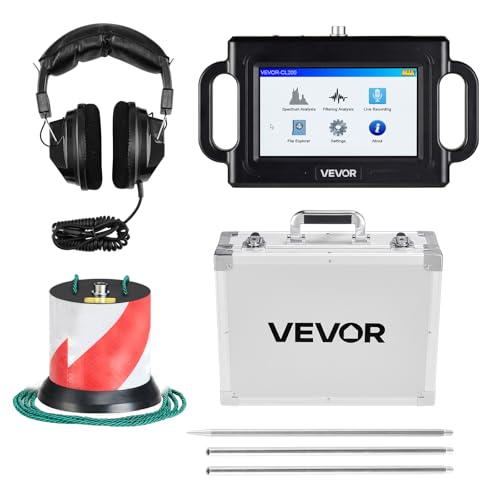
VEVOR’s device offers a wide frequency range and a 7-inch touchscreen, plus three listening rods and a headhphones setup. It is designed to adapt to metal and non-metal pipes and to handle hard or soft soils. The product emphasizes spectrum analysis and multiple fixed frequencies for professionals and straightforward selection for non-professionals.
Best for: Users who want flexible frequency options and clear visualization to differentiate leak sounds from background noise. This model can be a strong choice for both technicians and DIYers dealing with varied pipe materials and soil conditions.
Limitation: The device supports many modes and menus, which may require a learning curve for first-time users seeking rapid results.
Angoily Water Leak Sensor with Listening Stick

This compact tool prioritizes straightforward use with a listening rod for underground pipe testing. It is described as precise and reliable for detecting leaks in underground lines and mains, making it a practical choice for quick checks and fieldwork where portability matters.
Best for: Quick spot checks and fieldwork where a simple, direct testing method is preferred. It provides a focused approach for locating leaks with a listening tool rather than a full sensor suite.
Limitation: It may lack multi-point localization capabilities found in higher-end multi-sensor detectors, so use it for initial screening or confirmation after broader scans.
Buying Guide
- Sensor Variety: If you work in both indoor and outdoor environments, prioritize models with multiple sensors (DMR-H40, DMR-V59, RC-S3) to adapt to different materials and soils.
- Localization Accuracy: Look for devices offering two modes—General Detection for quick scans and Location Mode for precise pinpointing (often within centimeters).
- Depth and Range: For buried pipelines, depth capability (1 Hz–5000 Hz range, up to several meters) directly affects detection success. Outdoor-focused tools may emphasize deeper outdoor detection.
- User Interface: A touchscreen with guided prompts reduces the learning curve for non-professionals. Multi-language support can help multilingual teams.
- Portability and Durability: Consider weight, case quality, and weather resistance for outdoor use or rugged sites.
- Audio-Visual Cues: A combination of spectrum visualization and audible signals helps users corroborate leak locations, especially in noisy environments.
- Accessories: Listening rods, headphones, and carrying cases add value for fieldwork and long detection sessions.
Frequently Asked Questions
- What is the best detector for indoor wall leaks? Answer: Detectors with dual membrane sensors and precise Location Mode are typically best for indoor walls.
- Which device is best for outdoor pipelines? Answer: Models with RC-S3 sensors designed for outdoor use and deeper detection depth perform best outdoors.
- Do I need professional-grade tools to detect leaks? Answer: For complex or commercial sites, multi-sensor detectors offer more reliable localization; homeowners can start with easier-to-use, single- or dual-sensor options.
- How important is the user interface? Answer: A clear touchscreen with guided prompts reduces setup time and user error, especially for non-technical buyers.
- What should I consider about ground conditions? Answer: Soil hardness, moisture, and underground material influence sensitivity; choose a detector with adaptable sensors and mode options.
- Are these devices suitable for metal and non-metal pipes? Answer: Many models support both pipe materials, but confirm specific compatibility with your infrastructure before use.