Answering the need for reliable vacuum measurement in panel-mounted form, these options provide clear readings, robust construction, and appropriate mounting for industrial, lab, or equipment enclosures. This guide highlights five panel-mount vacuum gauges that cover glycerin-filled dampening, back-mount configurations, and stainless steel housings. They suit technicians, maintenance engineers, and equipment designers looking for stable readings in vacuum systems, pneumatic lines, and process instrumentation. The following table offers quick reference data to compare core specs at a glance.
| Product | Dial Size | Mount Type | ||
|---|---|---|---|---|
| PIC Gauge PRO-204L-254A | 2.5″ | Front Flanged Panel Mount | 0 to -30 inHg | Stainless Steel Case |
| MEANLIN MEASURE | 2.5″ | Front Flange Panel Mount | -30 to 30 psi | Stainless Steel Case |
| PIC Gauges PRO-203L-254A | 2.5″ | U-Clamp Panel Mount | 0 to -30 inHg | Stainless Steel Case |
| BOGERDACK | 2.5″ | Front Flanged Panel Mount | 0 to 10 psi | Stainless Steel Case |
| CARBO INSTRUMENTS | 2.5″ | Back Mount | 0 to -30 inHg | 304 Stainless Steel Case |
PIC Gauge PRO-204L-254A Glycerin Filled Panel Mount Gauge

The PRO-204L-254A uses a front flanged panel mount with a stainless steel case and bezel, brass internals, and a 2-1/2″ dial. It measures vacuum up to 30 inches of mercury (inHg) and includes glycerin filling for damping vibration and smoother needle movement. Best for industrial panels requiring stable vacuum readings in medium to large enclosures. Use this when you need front-entry installation with a robust metal body and a clear, high-contrast display. Caution: glycerin-filled gauges can be sensitive to extreme temperature swings that may affect fill level over long periods.
MEANLIN MEASURE Front Flange Panel Gauge
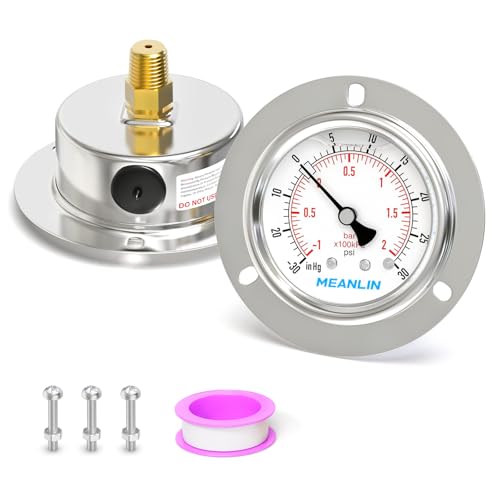
This gauge is a front flange, panel-mount unit with a 2.5″ dial, 1/4″ NPT, and a stainless steel case. It is designed to measure negative vacuum pressure (-30 inHg) and positive pressure up to 30 psi. It suits compact control panels in lab setups or compact industrial equipment. It’s best for users who need a straightforward, corrosion-resistant gauge with reliable back-to-back mounting compatibility. Limitation: features a non-glycerin filled design, which may exhibit more needle flutter under high vibration environments.
PIC Gauges PRO-203L-254A U-Clamp Panel Mount Gauge

This panel-mounted gauge uses a 2.5″ dial with a stainless steel case, brass internals, and a 30″ vacuum range (0 to -30 inHg). The U-clamp mounting supports rear-panel access in tight spaces and is suitable for broad industrial uses, including air, water, or non-corrosive media. It is best for environments needing quick panel-side installation with a durable, cost-effective gauge. Caution: brass wetted parts may limit compatibility with corrosive fluids; verify media compatibility first.
BOGERDACK 0-10PSI Panel Mount Gauge

This front-flanged glycerin-filled gauge covers 0-10 psi with a 2.5″ dial and 1/4″ MNPT back mount. It is best for compact systems requiring precise, dampened readings in water, gas, or liquid pressure applications. Choose this if you need a small, robust panel-mounted gauge with glycerin filling for vibration dampening. Limitation: the 0-10 psi range may be too narrow for larger systems needing wider vacuum or pressure coverage.
CARBO Instruments Vacuum Gauge 0 to -30 inHg

This back-mount, 2.5″ dial vacuum gauge uses a 1/4″ NPT connection and a 304 stainless steel case with brass wetted parts. It offers a dual scale inHg and bar, and is built for reliable, easy-to-read vacuum readings in professional settings. It’s best for laboratories and process lines where rear-entry installation is preferred and durability matters. Caution: back-mount access requires appropriate enclosure depth to accommodate the NPT connection and mounting hardware.
GOATACURA Glycerin Filled Vacuum Gauge

GOATACURA presents a 2″ dial, 1/4″ NPT center back mount with a 304 stainless steel case and glycerin filling for good vibration resistance. It measures vacuum to -30 inHg and is designed for vacuum systems, vacuum pumps, or tanks. Best for compact panels where space is limited and vibration is a concern. Caution: smaller 2″ dial may be harder to read at a distance compared with larger dials in noisy environments.
Buying Guide
Key considerations when choosing a panel-mount vacuum gauge include dial size, mounting style, and fill type. A 2.5″ dial is common for readable in-panel readings, while a 2″ dial saves space in tight enclosures. Front-flange mounts are easier for front-access panels, whereas back-mount or U-clamp options suit recessed installations. Glycerin-filled gauges dampen vibration and pulsation, improving readability in noisy environments, but require temperature consideration to prevent fill loss over time. Material choice matters: stainless steel housings resist corrosion and suit harsher environments, while brass internals may limit media compatibility. Consider whether you need vacuum-only or combined vacuum/pressure scales, and ensure the connection type matches your equipment (NPT vs MNPT). For panel designers, the ability to read at a glance, stable needle movement, and robust sealing are critical for long-term reliability. Compare products by: mount type, dial readability, fill type, and media compatibility.
What mounting configuration should I choose?
Front flange panels provide easy access and serviceability on the front of a panel. Back-mount gauges save panel space and may simplify rear wiring. U-clamp options are flexible for retrofits or awkward panel gaps. Choose the configuration that fits your enclosure design and maintenance workflow.
What is the benefit of glycerin filling?
Glycerin-filled gauges dampen vibration and pulsation, reducing needle flutter and improving stability in dynamic systems. They are ideal for environments with mechanical noise or pressure spikes. However, they can be more sensitive to extreme temperatures and may require recalibration if fill levels change noticeably.
How to assess suitability for fluids and gases?
Look at material compatibility: stainless steel cases resist corrosion; brass wetted parts suit non-corrosive media. If you handle aggressive chemicals or corrosive gases, verify media compatibility with the gauge’s wetted materials and the enclosure environment.
Is a larger dial always better for readability?
A larger dial improves readability at a distance but requires more panel space. If you operate in environments where quick, at-a-glance readings are necessary, prioritize a 2.5″ dial with high-contrast markings and a robust lens.
FAQ
- Q: Do panel-mount gauges support both vacuum and pressure readings?
- A: Some models offer dual scales (inHg/bar) while others are vacuum-only; check the product page for the exact range.
- Q: What is the advantage of a back-mount gauge?
- A: Back-mount configurations save front panel space and can simplify rear wiring and layout in compact cabinets.
- Q: How long do glycerin-filled gauges last under vibration?
- A: Glycerin filling improves dampening and needle stability in typical vibration environments, but service life depends on temperature and exposure to harsh conditions.
- Q: Can I install these gauges in wet environments?
- A: Stainless steel cases resist water exposure, but verify the enclosure’s ingress protection and ensure the gauge’s seals remain intact.