If you need reliable, on-demand air compression for trucks, trailers, or heavy equipment, these systems deliver fast inflation, easy in-cab control, and compact installations. They’re best for fleet owners, off-road enthusiasts, heavy-haul drivers, and DIY installers who want quick access to compressed air without bulky setups. Below are five top options that balance performance, ease of use, and installation practicality. A quick buyer summary follows the intro table.
| Product | Best For | Key Benefit |
|---|---|---|
| CNRAQR 150 PSI Air Compressor | Heavy-duty work trucks and trailers | High pressure and durable aluminum tank |
| RETRUE Onboard Air Compressor System | Air bag suspension on pickups | Fast inflation with in-cab control |
| VIAIR 380C | General tire inflation and tools | Pre-wired, plug-n-play, 200 PSI |
| LLNSEAUTO 2.5 Gallon Kit | Train or air horn setups | Large tank with multiple ports |
| maXpeedingrods On-Board Kit (Two Versions) | Trucks and vans with air spring needs | Versatile control with gauge options |
CNRAQR 150 PSI Onboard Air Compressor

The CNRAQR kit is designed for heavy-duty 12V systems with a 1.6-gallon aluminum tank. It supports up to 150 PSI working pressure and can handle intermittent pressures up to 250 PSI, making it suitable for fast inflation of truck tires or powering air tools. Best for professional fleets or serious DIYers who need robust performance in a compact form. The kit emphasizes easy installation with clear instructions and all necessary components, reducing vehicle downtime.
Who it’s best for: users needing high-pressure capability in a compact package, especially for trucks, trailers, and transport-related applications. Why selected: it combines a durable aluminum tank with strong pressure specs and straightforward setup. Caution: ensure vehicle wiring and space permit a secure mount, as installation quality affects performance.
RETRUE Onboard Air Compressor System for Truck Airbag Suspension
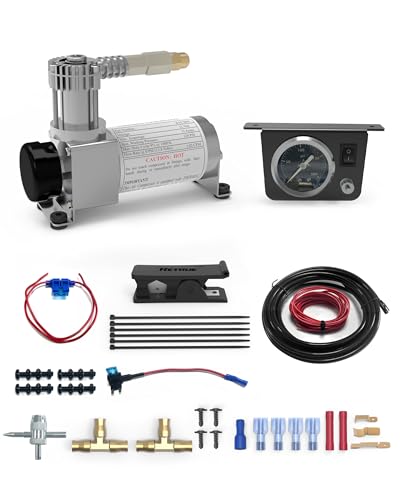
RETRUE focuses on air bag suspension control with fast inflation. The system inflates to up to 100 PSI, achieving rapid top-off of air bags in a matter of minutes (rough timings provided: around 80 seconds to 50 PSI, and under 4 minutes for full inflation). It features in-cab control so drivers can adjust pressure without leaving the seat, reducing over-inflation risk with a hold-to-inflate mechanism. Best for drivers who want quick, hands-on management of ride height and stability on the road.
Who it’s best for: pickup or SUV owners with air bag suspensions who prioritize quick, driver-accessible inflation. Why selected: strong inflating speed and in-cab control. Caution: if you rely on automatic pressure maintenance, the system focuses on manual inflation by design, so continuous automation may be limited.
VIAIR 380C Plug-N-Play Compressor

The VIAIR 380C is a self-contained 12V compressor with a 1.5-gallon tank rated up to 200 PSI. It arrives pre-wired with essential connections, enabling quick setup straight out of the box and enabling use for tire inflation and powering air tools. This kit is ideal for mobile repair crews, enthusiasts, and anyone who wants a reliable, portable option that’s ready to go with a vehicle battery connection.
Who it’s best for: users needing a ready-to-use, portable air system with high pressure for tires and air tools. Why selected: plug-and-play convenience, 200 PSI capability, and compact form. Caution: as a compact system, it may require careful planning for extended air tool use to avoid overheating or rapid depletion of the 1.5-gallon tank.
LLNSEAUTO Medium Duty 2.5 Gallon Kit

This kit provides a 2.5-gallon air tank with multiple ports, a 150 PSI max working pressure, and a range of included hardware for mounting and plumbing. It’s designed for train, air horn, or heavy-duty trailer applications and includes a gauge-ready setup with hoses and fittings to support complex installations. Best for installations that require a larger air reservoir and multiple connection points for accessories.
Who it’s best for: operators needing a bigger tank and multiple ports for complex systems such as trains or horns. Why selected: high port count and sizable tank help handle more demanding operations. Caution: installation complexity increases with tank size and port access; ensure proper mounting and routing to avoid leaks.
maXpeedingrods On-Board System (Gauge Version)
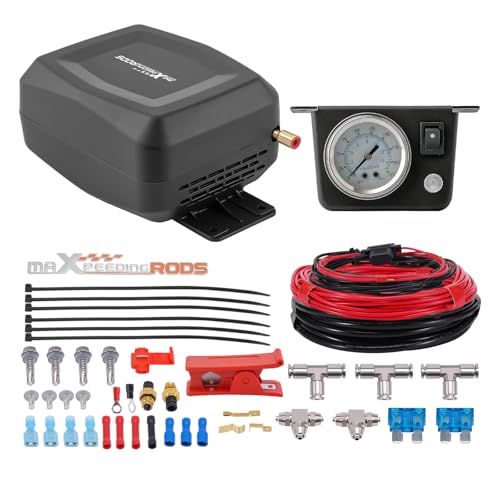
The maXpeedingrods kit emphasizes ease of use with an on-board compressor and a gauge-enabled path for monitoring air pressure. It’s designed to help trucks and vans maintain air spring pressure, with a single-path system ensuring both bags inflate together from the cab. Best for users who want straightforward control and reliable performance without dealing with separate tanks or tanks of extra lines.
Who it’s best for: fleet drivers and owners who want simple, reliable cab-side inflation for air springs. Why selected: integrated gauge and single-path operation reduce complexity. Caution: some versions require precise gauge calibration for optimum readings, and installation may vary by vehicle model.
maXpeedingrods On-Board System (Low Pressure Sensor)

This version adds a low-pressure sensor that detects when air spring pressure drops below a minimum level and restores it automatically. It supports on-the-go adjustments and can be used with most air spring brands. Best for drivers who want automatic pressure maintenance to prevent sagging and improve ride stability.
Who it’s best for: drivers who prioritize constant ride quality with automatic adjustments. Why selected: automatic pressure management reduces manual checks. Caution: automatic functions may be less predictable in rapidly changing road conditions; verify compatibility with your air springs before choosing.
Buying Guide: Key Purchase Considerations
- System type and application: Choose a system that matches your vehicle type (truck, SUV, trailer, train) and your use (tire inflation, air tools, air bags, or horn systems).
- Tank size and pressure rating: Larger tanks provide longer use between cycles; higher working pressure enables faster inflation and greater tool power, but may require more robust mounting.
- Power and installation: Determine if you need a plug-and-play, pre-wired unit or a modular kit that requires wiring and mounting. Consider space availability and heat dissipation.
- Control method: In-cab control and automatic vs manual inflation affect user experience. Automatic sensors provide convenience but may complic troubleshooting.
- Port availability and fittings: A kit with multiple ports or easy-to-connect NPT fittings simplifies adding hoses, gauges, and accessories.
- Maintenance and service: Check for availability of replacement parts, gauges, and hoses. Easier maintenance reduces downtime.
- Warranty and support: Ensure there is accessible customer support and clear warranty terms in case of issues.
Frequently Asked Questions
- How much pressure do onboard air systems typically deliver?
Most systems around 100–200 PSI working pressure, with some models supporting up to 250 PSI for extreme needs.
- Can I install an onboard air compressor myself?
Yes, many kits include installation guides and hardware. Ensure you follow safety procedures and verify electrical and air line routing for your vehicle.
- Is a larger air tank always better?
A larger tank reduces cycles and provides more air volume, but it also adds weight and space requirements. Choose based on intended use and available space.
- Do onboard air systems support air tools?
Some kits are designed to power air tools; check the maximum PSI and duty cycle to ensure compatibility with your tools.
- What maintenance is needed for onboard air systems?
Regularly inspect hoses and fittings for leaks, clean the external components, and verify gauge accuracy. Replace worn seals or valves as needed.