Whether you’re upgrading an oil-to-water cooling loop or powering a radiant floor system, choosing the right oil-to-water heat exchanger is essential for efficiency and reliability. This guide highlights five top options, explaining who each unit is best for and why it’s a good fit. It also includes a buyer’s guide and quick FAQs to help you compare features like material, capacity, and connections at a glance.
| Product | Best For | Key Benefit |
|---|---|---|
| BRAZETEK 50 Plate Brazed Heat Exchanger | Residential or light commercial hydro systems needing compact, high-efficiency transfer | 316L stainless steel, copper brazed for durability and corrosion resistance |
| QUELECO Shell and Copper Tube Oil Cooler OR-100 | Customizable setups with red copper tubes for high heat transfer | Flexible dimensions and 4.1 sq ft transfer area |
| PARSLUCK Engine Oil Cooler for Audi S6/Audi A6 | Automotive engines needing reliable oil-to-water cooling | Engine-focused oil cooling to protect components |
| AB Plate Heat Exchanger 4×12 (30 Plates) | Floor heating, snow melting, and large residential applications | Large plate count for higher BTU ranges and flexible hookups |
| AB Plate Heat Exchanger 3×8 (16 Plates) | Smaller heating or cooling projects with space constraints | Compact yet efficient 16-plate design |
Important note: All products listed here are designed for oil-to-water or water-to-water duties and are suitable for radiant heating, cooling, or industrial cooling loops. Details come from product listings and are provided to help you compare capabilities, materials, and connection types. Always verify compatibility with your system before purchase.
Brazetek 50 Plate Brazed Heat Exchanger
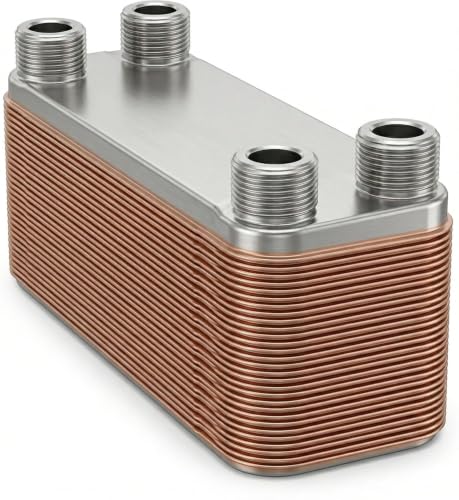
The Brazetek unit uses a herringbone plate design to create intense turbulence, maximizing heat transfer while minimizing pressure drop. It features 3/4″ MPT ports for straightforward installation in residential or light commercial piping, and it is constructed from 316L stainless steel with copper brazing in an oxygen-free furnace for durability and corrosion resistance.
Best for: Homeowners or small businesses needing a compact, high-efficiency exchanger with robust materials. This model is well-suited for radiant floor heating, water cooling, or process cooling where space is limited.
Why chosen: Its combination of stainless steel durability and copper brazing provides strong resistance to high temperature and pressure, helping to minimize pump energy costs. A potential limitation is availability of 3/4″ ports if you need larger connections.
Caution: Ensure your system pressure matches the exchanger’s rated capability to avoid leaks in high-temperature service.
QUELECO Shell And Copper Tube Oil Cooler OR-100

This shell-and-tube exchanger emphasizes customization. It can be adapted in dimension, water connectors, and capacity, with copper tubes noted for high heat transfer. The unit lists a 4.1 sq ft heat transfer area and 3/4″ ports, making it suitable for industrial or demanding hydraulic applications that require precise fitment.
Best for: Projects needing tailored dimensions or higher flexibility in connections, such as bespoke industrial cooling loops or OEM integrations.
Why chosen: The ability to customize helps align the exchanger with unique space or hydronic requirements. A limitation is that customization can affect lead times or pricing, depending on supplier capabilities.
Caution: Copper tube quality and proper brazing are critical for preventing leaks under high-temperature operation.
PARSLUCK Engine Oil Cooler For Audi S6

This engine-focused cooler provides oil-to-water cooling for late-model Audi S6 applications (2013-2018) with a focus on maintaining lubrication under elevated engine temperatures. It is designed for automotive use, helping to extend oil and engine life by removing excess heat from the oil stream.
Best for: Automotive enthusiasts or professionals focusing on critical oil cooling in high-performance engines where steady oil temperature is essential for longevity.
Why chosen: It targets a specific make/model range, which can simplify install and compatibility. A limitation is that it’s optimized for certain vehicles, so applicability to non-listed engines is limited.
Caution: Ensure the unit matches your vehicle’s oil capacity and flow requirements to avoid under- or over-cooling the oil circuit.
AB Plate Heat Exchanger 4×12 (30 Plates)

This 30-plate, 4×12 arrangement uses 316L stainless steel with 99.9% copper brazing at the edges. It offers a large heat transfer surface, making it suitable for floor heating or snow melting projects where higher BTU ranges are needed. The 1″ MPT connections support easy integration with standard piping.
Best for: Larger residential or commercial heating systems that require substantial heat transfer and reliable operation under higher flow and pressure.
Why chosen: The high plate count translates to higher BTU capacity, which makes it a strong candidate for substantial heating tasks. A caution: check space availability since larger footprints may be a factor in tight installations.
AB Plate Heat Exchanger 3×8 (16 Plates)

Designed for space-constrained installations, this 16-plate exchanger uses 316L stainless steel with copper brazing at the edges. It supports 60k to 80k BTU per hour and uses 3/4″ MPT connections. It’s a flexible choice for smaller radiant floor or dedicated cooling loops requiring efficient heat transfer without bulk.
Best for: Small to medium projects where compact size and reasonable capacity are key considerations.
Why chosen: Its compact footprint makes it easier to fit in limited spaces while still providing solid performance. A limitation is that its lower BTU range may not meet very high-load applications.
Buying Guide: Key Considerations For Oil To Water Heat Exchangers
What should you verify before buying? Material and corrosion resistance, compatibility of inlet/outlet sizes, and the system’s required heat transfer rate. In general, stainless steel construction with copper brazing provides strong durability for hot oil and water loops. Consider whether you need customized dimensions or standard ports to simplify installation.
How to choose by application? For radiant floors or snow-melt systems, larger plate counts (like 30 or 50 plates) offer higher BTU capacity. For space-limited mechanical rooms, compact units with 3/4″ ports are often best. Automotive oil cooling favors units tailored to engine oil pressures and temperatures, with robust connections to prevent leaks.
Connectors matter. MPT and NPT threads should match your piping. If you anticipate frequent disassembly or maintenance, look for smooth-thread designs that make hookups straightforward and leak-resistant.
Maintenance considerations. Copper brazed stainless-steel plates are durable, but verify corrosion resistance for your specific coolant. Regular inspection of gaskets and brazed joints helps prevent leaks and maintains efficient heat transfer.
FAQ
- What is the difference between a plate and shell-and-tube exchanger? Plate exchangers offer compact design and fast response, while shell-and-tube units handle larger flows and higher pressures but are bulkier.
- Can these exchangers handle high-temperature oil? Yes, most are designed for high-temperature hydronic oil-to-water cooling, but confirm the maximum operating temperature with the supplier.
- Do I need special tools for installation? Generally, no. Use standard wrenches for 3/4″ MPT/NPT connections and ensure proper brazing or gasket seals where required.
- Are copper and stainless steel compatible with all oils? Copper brazing is common, but verify compatibility with your specific oil and any additives to prevent corrosion.
- Is customization worth it? If your plumbing space or connection sizes are non-standard, customization can save installation hassles and improve performance.
- What maintenance is recommended? Inspect joints for leaks, clean any fouling from tubes, and verify flow rates align with design specifications.
For buyers seeking a balance of compact size, durability, and strong heat transfer, the listed options provide a spectrum from small, efficient plates to larger, high-capacity exchangers. Each product has distinct advantages depending on system requirements, space, and maintenance preferences.