Answering the need for reliable, fuel-flexible power, these natural gas powered generators are selected for commercial reliability, large-area coverage, and easy integration with backup systems. They’re best for small businesses, rental fleets, construction sites, or facilities requiring steady emergency power. The top picks offer tri-fuel capability, remote start options, and transfer switch readiness to support whole-house or building-wide outages.
| Product | Fuel Options | Running Watts | Start Type | Best For |
|---|---|---|---|---|
| DuroStar DS13000MXT | Gas, Propane, Natural Gas | 13,000 | Push Button | Large homes, whole-home backup |
| DuroMax XP13000HXT | Gas, Propane, Natural Gas | 13,000 | Electric Start | Mid-to-large homes, transfer-ready setups |
| Westinghouse 14500 | Gas, Propane, Natural Gas | 11,500 (gas) | Remote Start | Backup power for bigger homes |
| WEN TF-1450X | Gas, Propane, Natural Gas | 11,500 (gas) | Electric Start | CO protection, transfer-ready |
| Westinghouse 12500 | Gas, Propane, Natural Gas | 9,500 (gas) | Remote Start | Any-time standby and RV-ready |
1) DuroStar DS13000MXT 13,000-Watt Tri Fuel Generator

The DS13000MXT provides 13,000 watts of tri-fuel power, letting you run on gasoline, propane, or natural gas. Its CO Alert feature adds a safety layer during extended outages. This model is best for larger homes or small commercial spaces that require robust, whole-home backup power. The included transfer switch-ready 50-amp outlet simplifies integration with dedicated panels.
- Best for: Whole-home backup during outages and storms.
- Why selected: High wattage combined with true tri-fuel flexibility supports multiple fuel sources, minimizing downtime when gasoline is scarce.
- Caution: Tri-fuel systems require proper installation to ensure natural gas input pressure is within spec.
2) DuroMax XP13000HXT 13,000-Watt Tri Fuel

The XP13000HXT delivers 13,000 watts with a 500cc engine and tri-fuel capability (gas, propane, natural gas). It’s suitable for larger properties or small commercial operations that require robust power with the flexibility of fuel choice. It comes with CO Alert protection to help mitigate dangerous fumes during prolonged outages.
- Best for: Properties needing strong backup power with flexible fuel options.
- Why selected: Combines heavy-duty output with reliable fuel cycling.
- Caution: Heavier and less portable than compact models; plan for storage and ventilation.
3) Westinghouse 14500 Peak Watt Tri-Fuel
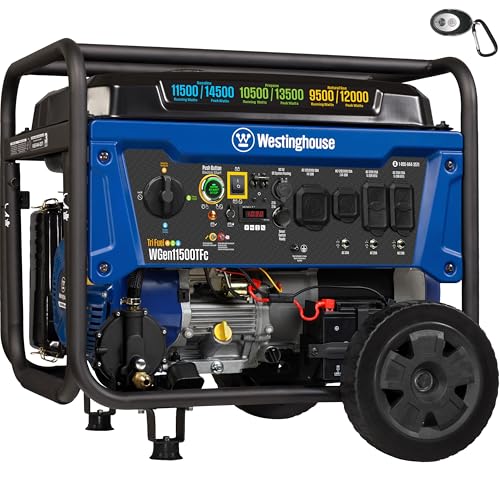
With 14,500 peak watts and 11,500 running watts (gas), plus tri-fuel capability, this model is ideal for larger homes or small commercial spaces. A 550cc engine, long runtime on a full tank, and remote electric start help busy sites manage outages with minimal manual effort. It’s transfer-switch ready for quick panel integration.
- Best for: Large properties requiring steady, high-output backup power.
- Why selected: High peak wattage and long runtime provide consistent performance during extended outages.
- Caution: Longer startup time may be noticeable in extremely cold weather.
4) WEN 14,500-Watt Tri-Fuel Generator (TF-1450X)

WEN’s TF-1450X switches between gasoline, propane, and natural gas with a simple dial, and provides 120V/240V output. It features CO watchdog protection to automatically shut down if carbon monoxide levels rise. This model is well-suited for contractors or facilities needing transferable power with CO safety checks.
- Best for: Sites needing dual-voltage output with straightforward fuel switching.
- Why selected: Clear, gas-to-propane-to-natural gas transitions for diverse job sites.
- Caution: CO watchdog relies on proper venting and fresh air for accurate readings.
5) Westinghouse 12500 Peak Watt Tri-Fuel Portable

This model offers a 12500 peak watt rating and 9500 running watts on gasoline, with propane and natural gas options as well. Remote start via key fob and a 12-hour runtime on its fuel tank support continuous operation during outages. It includes transfer switch readiness and multiple outlets for residential or commercial use.
- Best for: Standby and temporary power on job sites or homes with medium demand.
- Why selected: Balanced wattage and flexible fueling make it versatile for various backup scenarios.
- Caution: Ensure adequate space and ventilation due to engine size.
Buying Guide: Key Considerations For Tri-Fuel Generators
Fuel flexibility matters when outages disrupt one fuel supply. When selecting a tri-fuel generator, consider the following:
- Power needs: Calculate running watts for essential circuits. A higher running watt capacity supports more devices during outages.
- Fuel availability: If natural gas is unreliable at certain times, propane or gasoline storage may be preferable.
- Transfer switch readiness: For building-wide backup, choose models that are transfer switch ready or include a ready-to-install kit.
- Startup and runtime: Electric start and long runtimes reduce maintenance and downtime in emergencies.
- Safety features: CO alert or watchdog sensors prevent dangerous conditions; ensure proper ventilation during operation.
- Portability vs. footprint: Larger wattage units deliver more power but require space and secure placement.
FAQ
- What is tri-fuel capability and why is it important?
Tri-fuel means the generator can run on gasoline, propane, or natural gas, offering fuel flexibility during outages or fuel shortages.
- Are these generators suitable for whole-house backup?
Yes, many models listed are designed for whole-home or large-space backup, with transfer switch readiness and high running watts.
- What safety features should I look for?
Look for CO alert or watchdog sensors, remote start, and robust extinguishers against gas leaks. Ensure proper ventilation.
- How important is remote start for commercial use?
Remote start minimizes on-site labor during outages and improves response times for critical loads.
- Can I run these indoors?
No. All models require outdoor installation and proper exhaust venting to avoid dangerous fumes.
- Do these units require professional installation?
For transfer switch integration and natural gas connection, professional installation is recommended.