The right motor coil winding machine makes precise windings faster and more repeatable. This guide compares five reliable options suitable for hobbyists, small workshops, and light industrial use. Each pick targets a slightly different need—manual vs. automatic, low- vs. high-volume, and variable wind counts—so you can choose based on your coil size, material, and throughput. The buyer’s table below highlights key differences to help you decide quickly.
Product Summary Table
- Epidioxi Manual Coil Winding Machine (1/16″–1/2″ coils) — best for budget-minded hobbyists needing simple, repeatable manual wind counts.
- U.S. Solid Dual-Purpose Electric/Manual Coil Winding Machine — ideal for dual-use setups and small coils with counting capabilities.
- Epidioxi Automatic Coil Winding Machine (500W) — best for moderate-volume, versatile coils including guitar pickups and small motors.
- Epidioxi Automatic Winding Machine (900 RPM) — best for higher-speed, consistent wind alignment on 18–46 AWG wires.
- PreAsion 110V Automatic Coil Winding Machine — best for precise multi-step programming and memory-based winding sequences.
Epidioxi Manual Coil Winding Machine 1/16″–1/2″ Hand Winder

Best for hobbyists and small projects, this manual wind machine supports a 1.5–13 mm chuck and offers a simple counting function. The 1:8 transmission ratio provides steady wind output without overcomplication. The device is durable thanks to upgraded iron gears, making it a practical entry point for users who need repeatable turns without automation. The counter range of 0–9999 helps track wind length across dozen or more coils.
Who it’s best for: beginners or hobbyists who want predictable wind counts and value a lightweight, user-friendly instrument. Why selected: low cost, straightforward operation, and solid build. Caution: manual operation may limit throughput for larger batches.
U.S. Solid Dual-Purpose Electric/Manual Coil Winding Machine

This model blends electric and manual winding with a counting dial capable of up to 99,999 turns. It suits small motor coils, small transformers, and related components, making it versatile for electronics workshops. The 1:1 spindle-to-counter shaft ratio means every spindle turn translates directly into a count, simplifying planning for repeat jobs. A caution: if used to wind tassels or webbing, the load should stay under 300 g to avoid overloading the drive system.
Who it’s best for: shops requiring a flexible workflow that can switch between manual and powered winding. Why selected: robust counting capability and straightforward reset function—handy for producing consistent small coils.
Epidioxi Automatic Coil Winding Machine (500W)
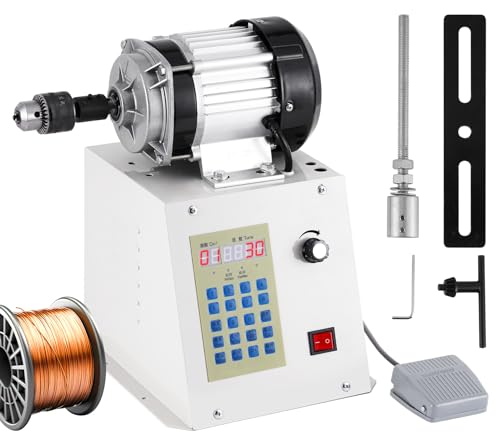
Best for mid-volume production, this 500W machine supports coils up to 50 kW motors and guitar pickups, with a 1.5–13 mm chuck and 10 mm spindle for flexible mold fitting. Ten memory groups keep different winding configurations ready, while a 0–9,999 count range keeps track of wind length. The combination of automation and memory makes it suitable for repeatable, semi-automatic winding tasks. Caution: larger motors or unusual coil geometries may require additional fixtures or clamping options.
Who it’s best for: small manufacturers or repair shops that need repeatable, semi-automatic wind cycles with memory presets. Why selected: good balance of automation, memory, and compatibility with common coil sizes.
Epidioxi Automatic Winding Machine 900RPM

Best for higher throughput, this model operates at 900 RPM with automatic wire alignment to improve pitch accuracy to within ±0.01 mm. It’s designed for consistent coil winding across 18–46 AWG wires and accepts a range of materials—from metal wires to silk threads. Its speed advantage supports mass production workflows where uniformity matters for performance. Caution: high-speed operation may require dedicated fixtures to minimize wire slippage on certain coatings.
Who it’s best for: production environments needing fast, repeatable wind cycles with tight pitch control. Why selected: highest winding speed among the selections and strong alignment features for reliability.
PreAsion 110V Automatic Coil Winding Machine

Best for programmable, memory-driven winding sequences, this 110V unit features a single-chip microcomputer design with memory capable of storing up to 1000 winding steps and nine winding parameters. It supports multi-step, multi-speed settings via the front panel keyboard, and offers a transverse guide axis with ten moving speeds. This makes it suitable for complex coil geometries and repeatable production lines. Caution: the programming interface may require time to master for first-time users.
Who it’s best for: technicians and small factories needing precise, repeatable multi-step wind profiles with robust data retention. Why selected: extensive memory, programmable speeds, and a clear path to automation without external controllers.
Buying Guide
- Coil size and material compatibility: Verify chuck size (1.5–13 mm range on several models) and wire gauge support (commonly 18–46 AWG). Choose a machine that matches your typical coil diameter, width, and wire type.
- Automation level: Manual winders are economical and simple; electric/manual hybrids offer flexibility; all-automatic units are best for higher throughput and repeatable results.
- Counting and memory features: Look for counters with adequate range (0–9999 or higher) and memory banks to store multiple winding profiles for different coil types.
- Speed vs. precision: Higher RPM improves throughput but can require better stabilization of the wire path; precision features like automatic wire alignment reduce coil defects.
- Versatility and clamp options: Ensure the device can accommodate different molds or clamps if you wind a variety of coil geometries or instrument pickups.
- Ease of use and maintenance: Simple resetTable functions and durable gears reduce downtime; check for easy access to wear parts like gears and guides.
- Power requirements: Some models are 110V; consider your workshop power supply and any relocation needs.
Frequently Asked Questions
- What coil sizes do these machines typically support? Most models list a chuck range around 1.5–13 mm and can handle common coil diameters in hobby and small-production work.
- Is manual winding sufficient for small-volume production? Yes, for limited runs and custom coils, manual or semi-automatic machines can provide consistent results at lower costs.
- Can these machines refill or replace custom fixtures? Many units support clamps or molds to adapt to different coil shapes; check compatibility for your specific design.
- What is the benefit of memory functions? Memory helps keep multiple coil profiles ready, reducing setup time between jobs and improving repeatability.
- Do all units offer a digital counter? Several models feature counters or dials to track wind turns, which aids in achieving uniform wind lengths across coils.
- What maintenance is typical for wind machines? Regular inspection of gears, belts, and clamps, plus lubrication and alignment checks, will extend device life and consistency.