Low speed high torque motors are designed to deliver strong rotational force at slow speeds, ideal for conveyors, gear boxes, and winches. This guide highlights five reliable options from major brands, detailing who they’re best for and why they stand out. Whether you’re building a DIY project, maintaining industrial equipment, or powering a long-running mechanism, these motors help you choose with clarity.
| Product | Best For | Key Benefit | Notes |
|---|---|---|---|
| High Torque AC Motor + Gear Box, 250W (VQP) | Industrial and heavy-duty machinery | 0-135 RPM adjustable speed, reversible | Single-phase, 110V |
| BRINGSMART 12V 12rpm DC Worm Gear Motor | Small automated devices | Self-locking, compact torque | 12V DC, 12 RPM |
| CHANCS 60KTYZ AC Synchronous Geared Motor | Rotisserie-style or low-noise low-speed tasks | Low noise, high torque | 110V AC, 2.5 RPM |
| Greartisan DC 12V 200RPM Gear Motor | General gear motor applications | All-metal gears, durable gearbox | 12V DC |
| XD-3420 High Torque DC Motor 12V/24V | DIY projects and generators | Wide voltage range, high torque at choice of voltage | 12V/24V |
Below, each product is broken down with its best-use scenario, a brief summary of features, and a practical note on potential limitations. Use the buying guide and FAQ to compare factors like voltage, speed, torque, and mounting style to fit your project.
High Torque AC Motor With Gearbox — 250W Geared Motor

This geared AC motor combines a 250W single-phase induction motor with a gearbox and control box. It offers a torque of 16 Nm and a variable speed range from 0 to 135 RPM. The unit is reversible, enabling forward or reverse operation. Best for heavy machinery setups requiring adjustable torque and direction control. A potential limitation is the reliance on AC power and a controller box for speed variation, which may require wiring and setup expertise.
BRINGSMART 12V 12rpm DC Worm Gear Motor

This 12V DC worm gear motor runs at 12 RPM with a self-locking feature, ideal for secure positioning in devices like rotating platforms, locks, and curtain systems. The motor uses an 8mm output shaft and can be wired to adjust rotation. Choose this if you need a compact, low-speed drive with reliable self-locking in absence of power. Limitation: very slow speed means limited rapid motion and requires appropriate control for acceleration.
CHANCS 60KTYZ Synchronous Geared Motor

This 110V synchronous geared motor delivers 2.5 RPM with torque up to 80 Kg.cm. It is designed for low-noise operation and robust performance in household or educational projects, as well as models requiring precise, steady slow motion. Best for applications needing predictable, quiet rotation. Limitation: relatively low speed and torque at a high gear ratio may limit heavy-duty tasks.
Greartisan DC 12V 200RPM Gear Motor
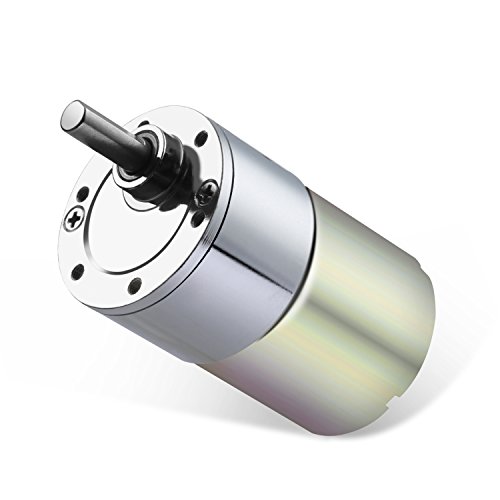
Greartisan’s DC gear motor features all-metal gears and a pure copper rotor, enhancing durability and power delivery. The D-shaped output shaft improves bearing life and mounting stability. It’s well-suited for equipment needing steady torque at moderate speed, including small conveyors or DIY robotics. Caution: verify mounting compatibility due to shaft shape and dimensions in your design.
XD-3420 High Torque DC Motor — 12V/24V

This DC motor supports both 12V and 24V, delivering high torque suitable for DIY generators and power-down applications. It provides a broad voltage range for flexible use and can drive simple machines with higher torque needs. Choose this if you want a versatile motor for experiments or hobby projects. Limitation: high torque at higher voltages requires careful control to avoid mechanical stress on attached components.
BRINGSMART 12V 6rpm DC Worm Gear Motor

This 12V worm gear motor delivers 6 RPM with a 25 kg.cm torque, featuring all-metal gears and a self-locking output shaft. It is well suited for toys, small automation, or safe-locking mechanisms where precise low-speed motion is required. Caution: may be underpowered for demanding loads; ensure torque requirements align with the 25 kg.cm specification.
SINOCMP Hydraulic Motor — 353 RPM, 2059 lb-in

This hydraulic motor is a direct swap for Eaton Char-Lynn H Series with 9.7 cu/in displacement. It delivers 2059 lb-in torque at 353 RPM and is designed for high-torque, low-speed applications in industrial settings, including brushes and agricultural equipment. Best for systems using hydraulic power, offering robust LSHT performance. Limitation: requires hydraulic supply and compatible fittings to install.
Buying Guide
What matters most when selecting a low speed high torque motor? Consider voltage type (AC vs DC vs hydraulic drive), speed range, torque, mounting style, and control requirements. For general automation, a DC geared motor with self-locking helps position and hold loads without power. For heavy-duty conveyors or machinery, an AC motor with a gearbox provides stable torque at variable speeds. When space is limited, compact worm gear motors offer high torque in small packages, though speed is very low. For quiet operation, synchronous geared motors can minimize noise while delivering consistent rotation.
Key purchase considerations
- Torque and speed balance: Match the required torque at the target speed to avoid overloading or undersizing the motor.
- Duty cycle and load profile: Continuous vs intermittent use affects motor selection and cooling needs.
- Voltage and power availability: Choose AC, DC, or hydraulic depending on existing systems and control needs.
- Gearbox type and mounting: Ensure shaft output, mounting flange, and gear ratio align with the application.
- Control compatibility: Assess whether a speed controller or encoder is needed for precise operating cycles.
FAQ
- Q: What is a low-speed high-torque motor best used for? A: Applications like conveyors, winches, gear-driven devices, and machinery that require strong torque at slow rotation.
- Q: Do I need a controller for these motors? A: Some motors include controllers or gearboxes, while others require external controllers or wiring for speed adjustment.
- Q: Are DC motors better than AC for low-speed tasks? A: DC motors offer easy speed control, but AC motors with gearboxes can be more robust for heavy-duty, steady operation.
- Q: How important is the gearbox ratio? A: Very important; it determines the final output speed and torque. Choose a ratio that meets your target RPM and torque requirements.
- Q: Can these motors run continuously? A: Many are designed for continuous operation within their torque limits, but check manufacturer specifications and cooling needs for your setup.
- Q: What about mounting considerations? A: Verify shaft diameter, coupling compatibility, and mounting holes to ensure secure installation.