Choosing the right load cell solution is essential for accurate tank weighing and monitoring. The following selection highlights reliable load cells and HX711-compatible amplifiers that support a range of capacities, from compact 1 kg sensors to high-capacity inline models suitable for large tanks. Each option emphasizes durability, ease of integration with microcontrollers, and clear output signals for precise measurement in industrial or DIY tank applications.
| Product | Capacity | Brand | Key Use |
|---|---|---|---|
| NOYITO 1kg-20kg Load Cell & HX711 Combo Pack | 1 kg / 5 kg / 10 kg / 20 kg | NOYITO | Versatile kit with breakout HX711 for precise readings |
| WWZMDiB Load Cell Amplifier + HX711 (1/5/10/20 kg) | 1 kg / 5 kg / 10 kg / 20 kg | WWZMDiB | Compact, multi-capacity sensor module |
| Wishiot 2 Sets 20kg Load Cell Kit with HX711 | 20 kg | Wishiot | Two sensors for larger tank setups |
| ShangHJ 4 Sets Digital Load Cell + HX711 (1 kg) | 1 kg | NC | Multiple unit kit for modular monitoring |
| STCELLS Inline Load Cell (500 kg to 2,000 kg) | 20 kg to 5 tons (varies by model) | STCELLS | High-capacity inline load cells for larger tanks |
NOYITO 1kg 5kg 10kg 20kg Load Cell & HX711 Combo Pack

NOYITO’s 1 kg to 20 kg load cell bundle pairs with the HX711 amplifier to deliver precise force measurements across small to medium tanks. The aluminum alloy construction provides durability, with strain gauges pre-attached and wires designed for reliability. The kit supports 0–5 kg, 5–10 kg, and 10–20 kg ranges, making it adaptable for various tank scales and liquid volumes. The 22 cm wires and four-lead configuration ensure straightforward integration with microcontrollers like Arduino or Raspberry Pi. Typical outputs translate resistance changes into a usable voltage signal for real-time monitoring.
WWZMDiB 1KG/5KG/10KG/20KG Load Cell Amplifier Kit

This WWZMDiB module combines a load cell amplifier with multiple supported capacities (1 kg, 5 kg, 10 kg, 20 kg). The included 24-bit HX711 ADC delivers high-precision readings, while the voltage range (2.6–5.5V) allows flexibility in power supply choices for tank monitoring systems. The module is suitable for measuring force, pressure, displacement, and related parameters, enabling accurate tank scale data for inventory, processing, or batching operations. Setup emphasizes compact integration with existing tank hardware and microcontroller projects.
Wishiot 2 Sets 20kg Load Cell Kit
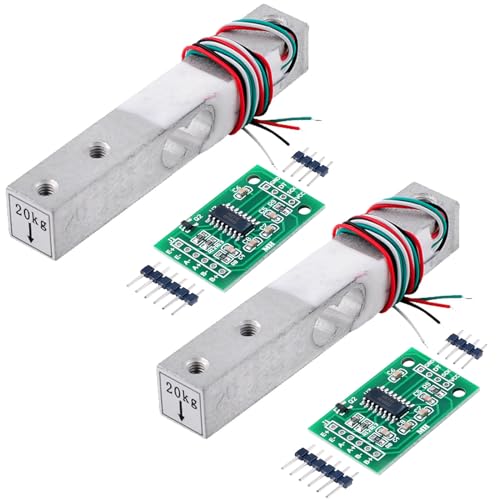
Wishiot’s dual 20 kg load cell kit provides a robust solution for larger tank setups. The kit uses four-lead wiring (Red to E+, Black to E-, Green to A+, White to A-) and operates with a 5–10V supply. The force output appears as a voltage change, which can be read directly by HX711 or similar ADCs. The 20 kg capacity makes it suitable for moderate industrial tanks, fermentation vessels, or large-scale beverage processing applications where stable weight measurement is essential.
STCELLS Inline Load Cell Mini (2000 kg Capacity)

The STCELLS inline load cell model is built for high-capacity applications, suitable for larger tanks or industrial vessels. With alloy steel construction and capacities reaching up to 2,000 kg, these inline sensors are designed for stable, high-accuracy weighing under demanding conditions. This makes them apt for bulk liquid storage, chemical tanks, or other high-volume processes where precise level or weight measurements are critical. The inline design simplifies installation in pipe or tank assemblies where direct load transfer is required.
Wishiot 2PCS Digital Load Cell 1kg-20kg (Two 10kg Units)

This Wishiot two-pack offers two precise load cells with the same four-lead interface, enabling synchronized measurements for larger tanks or multi-compartment vessels. The 10 kg or 20 kg ranges (depending on model) support scalable setups where redundancy or multiple measurement points are beneficial. As with other Wishiot kits, the output is a voltage signal proportional to force, ideal for Arduino, Raspberry Pi, or similar platforms.
Buying Guide: Key Considerations For Tank Load Cells
- Capacity and range: Choose a load cell that matches the tank size and expected load. For small to mid-size tanks, 1–20 kg sensors are common; for large tanks, inline or higher-capacity models (50 kg–2,000 kg) are better suited.
- Form factor and mounting: Inline sensors are ideal for direct load transfer in pipes or vessel supports; small platform or S-beam types are easier to integrate on compact tanks or palletized systems.
- Output and electronics: HX711-based amplifiers are widely used for hobbyist and prototype projects; ensure the ADC resolution (e.g., 24-bit) meets your required precision and that voltage supply matches your controller.
- Durability and environment: For tanks with corrosive liquids or high humidity, select sensor housings and materials (e.g., aluminum alloy or stainless steel) that resist corrosion and provide stable readings over time.
- Wiring and installation: Four-lead configurations (E+, E-, A+, A-) simplify wiring to microcontrollers. Check lead length and connector compatibility with your control system.
- Redundancy and multi-point measurement: In large tanks, using two or more load cells can improve accuracy and distribute the load, reducing the risk of single-point failure.
- Calibration and validation: Plan for a calibration procedure using known weights to establish a reliable conversion from sensor output to weight values, especially in process environments.
- Cost and availability: Consider kit options that bundle load cells with HX711 or other amplifiers for easier procurement and consistent performance.
Incorporating load cells into tank monitoring systems enables real-time inventory management, process control, and improved safety. When selecting a product, balance capacity, mounting compatibility, and the electronics chain to ensure accurate, reliable measurements across your specific tank setup.