Whether you’re crafting one‑of‑a‑kind gifts or running a small engraving business, choosing the right laser engraver matters. This guide reviews five popular options, highlighting precision, materials compatibility, and ease of use. Read on to compare performance, features, and suitability for beginners and pros alike.
| Product | Brand | Laser Power | Working Area | Ideal For |
|---|---|---|---|---|
| ACMER S1 Laser Engraver (6000mW) | ACMER | 6000mW | 130x130mm | Detail work on wood, acrylic, metal, glass |
| LONGER Ray5 (5W) | Longer | 5W | 400x400mm | Large projects, wood, metal, acrylic |
| ACMER S1 Laser Engraver (3500mW) | ACMER | 3500mW | 130x130mm | Precise hobby projects, small items |
| LONGER Ray5 (20W) | Longer | 20W | 400x400mm | Heavy engraving, cutting through wood and acrylic |
| Carverall K15 Pro (5W) | Carverall | 5W | 200x300mm | Beginner to intermediate DIY projects |
Note: These entries are selected to reflect a range of power, working areas, and use cases—from compact, beginner-friendly units to higher‑power machines capable of more demanding tasks. Specifications come from manufacturer descriptions and listed features.
ACMER S1 6000mW Engraver

The Acmer S1 6000mW laser offers high-precision engraving with a 455±5nm diode and a 2mm focal length. It supports speeds up to 10,000 mm/min and promises repeatable positioning accuracy of 0.01 mm. The device is designed for a variety of materials, including wood, acrylic, metal, and glass. It is described as 2‑in‑1 engraving and cutting, suitable for DIY projects, crafts, and small business needs. Setup is presented as beginner-friendly, with a quick preassembly process that reduces the learning curve for new users.
LONGER Ray5 5W Engraver

Ray5 5W from Longer features a 400x400mm working area and a 0.08×0.08 mm laser spot with engraving accuracy around 0.01 mm. Powered by a 240MHz ESP32 chipset, it emphasizes speed and compatibility with various engraving tasks. The unit is designed for use on wood, metal, acrylic, glass, and more, with a focus on offering precise results in a larger workspace. It supports offline usage and is positioned as suitable for hobbyists seeking robust performance and flexibility.
ACMER S1 3500mW Engraver

This variant combines a solid 3500mW diode laser with similar core specs to the 6000mW model, including a 2mm focal length and 0.01 mm repeatable positioning. It supports a 130x130mm working area and is described as beginner-friendly with a quick setup. The machine is suitable for engraving on wood, bamboo, leather, plastic, PCBs, ceramics, and more, making it a versatile option for small-scale crafting and professional projects alike.
LONGER Ray5 20W Engraver

The 20W Ray5 model from Longer expands capability with a 400×400 mm workspace and a powerful 20W laser. It supports cutting through pine wood, stainless steel with multiple passes, and acrylic with notable precision—thanks to a 0.08×0.1 mm laser point and 0.01 mm engraving accuracy. The device also emphasizes a high-capacity chipset and continuous operation, designed for more demanding, industrial-style engraving workflows and repeated batch work.
LONGER Ray5 2,500mW Engraver

This Smaller Ray5 model uses a 2,500 mW laser for precise 0.04×0.04 mm engraving with a 130×130 mm area. It emphasizes portability and ease of use, ideal for beginners or for those who want a compact setup for home projects. It’s compatible with common software like LightBurn and LaserGRBL and offers Wi‑Fi connectivity, plus included safety gear and a simple, one‑piece delivery approach.
Carverall K15 Pro 5W Engraver
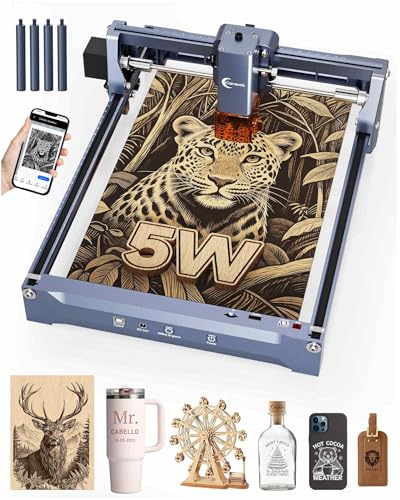
The Carverall K15 Pro provides 5W of true power and an 0.01 mm ultra-precision capability, with a working area near A4 size (200×300 mm). It supports engraving on wood, coated metal, acrylic, and leather, with a claimed installation time of about 90 seconds and basic software compatibility with CutLabX, LightBurn, and LaserGRBL. The kit includes safety glasses and starter materials, making it accessible for beginners while still offering professional-grade results for detailed projects.
Buying Guide: Key Considerations For Choosing A Laser Engraver
- Power and material compatibility: Higher wattage generally enables faster cutting and deeper engraving, especially on dense materials like hardwood or metal. Consider the materials you plan to work with most often and whether you need cutting capability beyond engraving.
- Working area: Larger beds enable bigger designs and batch work, but require more space and may come with a higher price. Match the bed size to typical project dimensions.
- Precision and speed: Look for a laser with a small spot size and high repeatable positioning accuracy. Engraving detail benefits from sub-0.01 mm precision, while production speed affects throughput.
- Software compatibility: Check whether the machine supports popular programs like LightBurn, LaserGRBL, or CutLabX. Easy setup and offline usage can be a plus for beginners.
- Ease of assembly and portability: Some models arrive nearly preassembled and are touted as beginner-friendly, while others offer more customization but require assembly and calibration.
- Safety and enclosure: Enclosed designs reduce smoke and odor exposure and improve safety, especially in home workshops. Consider built-in air filtration options if available.
- Connectivity and expansion: Wi‑Fi, USB, and offline operation options add flexibility. Some machines support multi‑machine control or color engraving features for sophisticated projects.
- Maintenance and spare parts: Availability of replacement parts, lenses, and nozzles, plus warranty terms, influence long-term costs and uptime.
- Budget vs. scale: For hobby projects, compact and lower-power units may suffice. For a small business or serious hobbyist, investing in higher power and larger work areas can pay off in throughput and versatility.