Looking for a reliable laser cutting machine supplier? This guide highlights five top options that balance power, value, and usability for hobbyists, small shops, and DIY professionals. Each pick is evaluated for material versatility, ease of assembly, and safety features to help buyers choose confidently. The buyer types most likely to benefit include beginners seeking approachable entry points, hobbyists expanding their toolkit, and small businesses requiring capable cutters for prototyping. A concise comparison table is provided below to help you compare key specs at a glance.
| Product | Laser Power | Working Area | Best For | Caution |
|---|---|---|---|---|
| Twotrees TTS-55 Pro | 5.5W | 300 x 300 mm | Hobbyists and small projects | Requires air assist integration for deeper cuts |
| CREALITY FALCON 10W | 10W | Noted for larger projects | High-speed production on wood and acrylic | Class 4 laser—ensure proper safety |
| AlgoLaser 10W | 10W | Varies with accessory options | Beginner-friendly with built-in touchscreen | Heavier footprint than entry-level units |
| Creality Falcon 5W | 5W | 400 x 415 mm | Large work area and details | Rotary kit sold separately |
| ORTUR Laser Master 2 S2 | 10W (equiv) | 390 x 410 mm | Versatile, modular setup | Requires careful eye protection due to Class 4 power |
Twotrees TTS-55 Pro Laser Engraver

The Twotrees TTS-55 Pro offers a 5.5W laser with an integrated air-assisted nozzle and red laser shield for improved safety and cleaner cuts. With a precise 0.06 x 0.46 mm spot and up to 0.1 mm engraving accuracy, this model is aimed at hobbyists and makers who want fine detail on wood, leather, acrylic, paper, stainless steel, and more. The 300 x 300 mm working area supports a variety of small to mid-sized projects. This unit is best for home workshops and small studios focusing on personalized items, signs, and craft pieces.
Who it’s best for: hobbyists or micro-business owners who want a capable, mid-sized cutter that fits a compact bench. Why selected: strong emphasis on precision and material versatility, plus air assist for cleaner cuts. Caution: air assist system integration requires careful setup to maximize safety and performance.
CREALITY FALCON 10w Laser Engraver

The CREALITY FALCON 10W model delivers a higher-powered laser and faster throughput, design features aimed at productivity. It supports engraving and cutting on wood, metal, acrylic, and more, with speeds up to 10,000 mm/min. It also includes safety features like an anti-UV eye shield and an emergency stop, and it ships with a modular rotary kit for cylindrical objects. This machine is suitable for shops that require rapid prototype iterations and higher volume tasks.
Who it’s best for: small businesses and makers needing fast, reliable results on larger or more complex pieces. Why selected: strong speed and a 72W-class potential, along with practical safety features. Caution: ensure you install and use the included safety accessories properly for best results.
Algolaser 10W Laser Engraver

The Algolaser 10W unit emphasizes an integrated 3.5-inch touchscreen and AlgoOS system, enabling easier operation for beginners and ongoing ease for hobbyists and small businesses. A 10,000 mW laser module drives clean cuts and detailed engravings on wood, coated metal, leather, acrylic, and more, with speeds up to 12,000 mm/min. A rotary roller and riser expand capabilities for cylindrical items, mugs, and tall plaques. This model is well-suited for users seeking an all-in-one, user-friendly package with expansion options.
Who it’s best for: DIY enthusiasts and newcomers who want a straightforward, guided experience with room to grow. Why selected: built-in UI reduces reliance on external software; rotary and riser add versatility. Caution: larger footprint and power requirements mean you should plan your workspace accordingly.
Creality Falcon 5W Laser Engraver
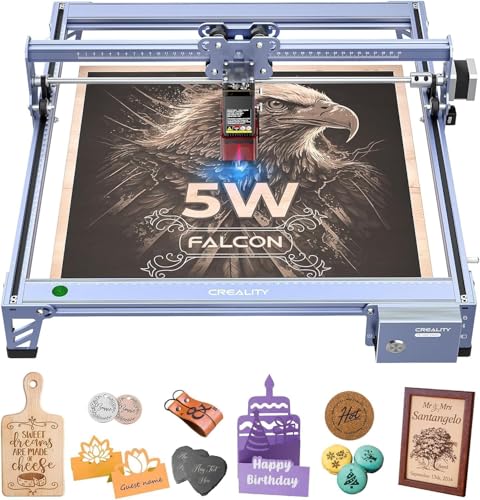
The Creality Falcon 5W provides a larger working area of 400 x 415 mm and a 0.06 x 0.06 mm spot for precise work, making it a practical pick for medium-to-large projects. It runs at speeds up to 10,000 mm/min and can be upgraded with a rotary roller and raisers to handle thicker or cylindrical items. The model is ideal for shops doing sign-making, gifts, and detailed craft projects at scale. This is a strong option when you need more workspace without jumping to an industrial setup.
Who it’s best for: makers extending from small formats to larger pieces, or shops needing a roomy bed for panels and plaques. Why selected: combination of large area, high precision, and expandable accessories. Caution: rotary and height accessories are sold separately, so plan additions in advance.
ORTUR Laser Master 2 S2 LU2-10A

The ORTUR Laser Master 2 S2 LU2-10A offers a versatile setup with a 10W-class equivalent laser and a 390 x 410 mm engraving area. It emphasizes a modular design for easy assembly, repair, and upgrades, plus compatibility with common software like LaserGRBL and LightBurn. It suits users looking for a robust, expandable platform that supports diverse file formats and integration with popular CAD/CAM workflows. This model is best for ambitious DIYers and small studios seeking long-term adaptability.
Who it’s best for: users who want a reliable, upgradeable platform with broad software compatibility. Why selected: modular design supports future parts and configurations. Caution: ensure proper eye protection and ventilation, as the power class requires diligent safety practices.
Buying Guide
Which laser power matters most?
Higher power enables deeper cuts and faster processing on dense materials. For most beginners, 5–10W is sufficient for wood, acrylic, leather, and some metals. For metal marking or thicker tasks, consider higher-class units and proper ventilation.
What working area do you need?
Smaller benches benefit from 300 x 300 mm beds; larger desks can handle 400 x 415 mm or more. For signs and plaques, a larger bed reduces the need for multiple passes.
Do you need rotary or cylindrical engraving?
Rotary attachments expand capabilities to mugs, tumblers, bottles, and curved surfaces. If you plan to work with cylindrical objects, verify included or purchasable rotary kits.
How important is safety?
Look for protective features like eyewear, emergency stop, interlocks, and air assist. Class 4 systems require strict safety protocols, proper ventilation, and fire prevention measures.
Software compatibility and ease of use
Many units support LaserGRBL, LightBurn, or their own OS interfaces. A built-in touchscreen can simplify entry-level use, while robust software support benefits advanced users.
Maintenance and upgrades
Modular designs and upgrade paths extend a machine’s life. Consider heat management, spare parts availability, and the ease of replacing components when evaluating suppliers.
FAQ
- What should I look for in a laser cutting machine supplier? Evaluate laser power, work area, software compatibility, safety features, and available upgrades. A supplier with clear documentation and spare parts support helps long-term reliability.
- Is a rotary attachment necessary? If you plan to engrave cylindrical items like tumblers or bottles, a rotary kit is essential. Some models include it, while others offer it as an add-on.
- Are higher wattage lasers always better? Not always. Higher power enables deeper cuts, but it requires stricter safety measures and suitable materials. For many hobby tasks, 5–10W is sufficient.
- Can these machines cut metal? Some laser systems can etch metal surfaces, but many are better suited for wood, acrylic, leather, and coated metals. Verify material compatibility for your use case.
- What maintenance is typical? Regular cleaning, lens replacement when necessary, and ensuring proper ventilation. Follow manufacturer guidelines for safe operation and performance.
- Do these units require professional installation? Most listed models offer relatively straightforward assembly, but ensure a properly ventilated workspace and adherence to safety instructions during setup.