When selecting an industrial-grade natural gas generator, you want power, reliability, and flexibility. This guide highlights five top tri-fuel generators that are well-suited for American homes needing dependable backup power during outages. Each option supports gasoline, propane, or natural gas, with CO detectors and remote starts to enhance safety and convenience. Best for: homeowners needing full-house power, remote sites requiring portable backup, and property managers seeking transfer-switch readiness.
| Product | Brand | Fuel Flexibility | Best For |
|---|---|---|---|
| DuroMax XP13000HXT | DuroMax | Gasoline, Propane, Natural Gas | Large homes; storm preparedness |
| DuroStar DS13000MXT | DuroStar | Gasoline, Propane, Natural Gas | Whole-home backup; transfer switch ready |
| Generac 12,500 Starting Watt Tri-Fuel | Generac | Gasoline, Propane, Natural Gas | Emergency power; reliable ignition |
| Westinghouse 14500 Peak Watt Tri-Fuel | Westinghouse | Gasoline, Propane, Natural Gas | Large loads; long runtimes |
| Westinghouse 12500 Watt Dual Fuel | Westinghouse | Gasoline, Propane | Balanced power; transfer-switch friendly |
Note: All five options support tri-fuel capability or dual fuel, come with CO detection or CO shutdown features, and offer remote start or push-button start options. Each unit is designed to power essential appliances, HVAC, sump pumps, and lighting during outages. Consider your home’s total wattage needs, fuel availability, and whether you require transfer-switch compatibility when choosing among them.
DuroMax XP13000HXT 13,000-Watt Tri Fuel Generator

Key features: 13,000 watts, 500cc OHV engine, CO Alert, tri-fuel operation (gasoline, propane, natural gas). Best for large homes or job sites needing robust whole-house power with flexible fuel options. This model is suited for buyers seeking maximum power with the freedom to switch fuels during outages. A limitation is the heavier weight and bulk, which affects portability.
Who it’s best for and why selected
Best for homeowners who want peak wattage for full-home circuits and remote sites requiring high power. The CO Alert adds safety, and tri-fuel capability ensures continued operation if one fuel source runs dry. Choose this if you’ll power HVAC and well pumps during outages.
Cautions
Heavy unit; ensure proper ventilation and a stable installation area. Confirm local gas line compatibility for natural gas use.
DuroStar DS13000MXT 13,000-Watt Tri Fuel Generator

Key features: 13,000 watts, Tri Fuel technology, remote electric start, transfer switch readiness, full power panel. Best for households needing remote start and ready-for-transfer-switch operation. It’s better for those who value effortless startup and clear fuel selection in emergencies. A possible limitation is the need for proper setup to utilize transfer-switch-ready outlets.
Who it’s best for and why selected
Best for homes with a central transfer switch, or for property managers who require straightforward remote starting and quick power restoration after outages.
Cautions
Remote start is convenient but requires battery maintenance. Verify gas line compatibility for natural gas usage in your area.
Generac 12,500 Starting Watt Tri-Fuel Portable Generator

Key features: 9,500 running watts on gasoline, 7.5-hour runtime at 50% load, COsense carbon monoxide detection, multi-fuel capability. Best for emergency home backup with a focus on safety and reliable electric start. It is a strong option for users who want efficient fuel flexibility with an emphasis on CO monitoring. Limitation: runtime varies with fuel source and load, so plan for fuel management accordingly.
Who it’s best for and why selected
Ideal for homeowners seeking dependable tri-fuel operation with integrated CO monitoring and a straightforward startup process during outages.
Cautions
Ensure adequate ventilation and keep away from living spaces to prevent CO exposure. Check compatibility with your transfer switch and electrical setup.
Westinghouse 14500 Peak Watt Tri-Fuel Generator
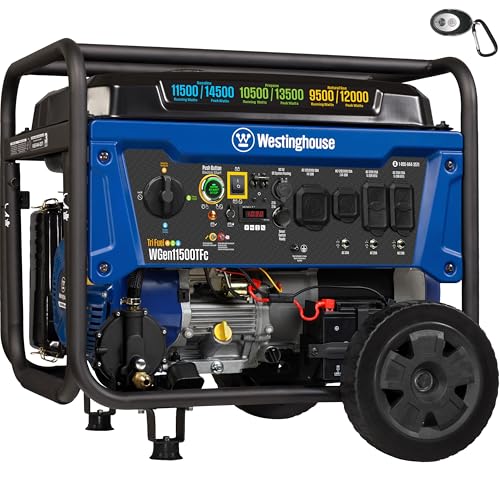
Key features: 14,500 peak watts, 11,500 running watts (gas), 13,500 peak watts/10,500 running watts (propane), 12,000 peak watts/9,500 running watts (natural gas); heavy-duty 550cc engine; 19-hour runtime on 9.5-gallon tank; CO shutdown. Best for households needing substantial peak power with long runtimes. The unit is robust for sustained outages but is relatively large and heavier to move.
Who it’s best for and why selected
Choose this if you require high peak output to handle multiple high-draw appliances and longer runtimes between refuels.
Cautions
Weight and size can impact portability. Verify fuel availability for your preferred fuel source if you plan frequent transitions.
Westinghouse 13500 Peak Watt Tri-Fuel Generator

Key features: 13,500 peak watts, 10,500 running watts (gasoline); 12,500 peak watts/9,500 running watts (propane); 10,000 peak watts/8,500 running watts (natural gas); remote start with key fob; up to 19 hours runtime on 9.5-gallon tank; multiple outlets including transfer switch-ready. Best for households that want flexible fuel options and a mix of outlets for various devices. A limitation is that peak watts can spike during startup; plan for surge loads accordingly.
Westinghouse 12500 Watt Dual Fuel Generator

Key features: 9,500 running watts and 12,500 peak watts on gasoline; 8,500 running watts and 11,200 peak watts on propane; remote start with key fob; up to 12 hours runtime on a 6.6-gallon tank; dual fuel versatility and transfer-switch-ready outlets. Best for balanced power needs and easier fuel switching. Limitation: smaller fuel tank relative to some tri-fuel models means shorter runtimes under heavy load.
WEN 14,500-Watt Tri-Fuel Generator (TF-1450X)

Key features: 14,500 surge watts, 11,500 running watts (gas); 12,500 surge watts, 10,300 running watts (propane); 10,500 surge watts, 8,750 running watts (natural gas); transfer-switch readiness; electric start; CO watchdog. Best for users needing strong tri-fuel performance with a comprehensive power panel and safety features. A caution is that heavier units require proper handling and storage considerations.
Westinghouse 12000 Peak Watt Tri-Fuel Portable Inverter

Key features: inverter technology with tri-fuel capability; 12,000W peak/9,000W running on gasoline; 11,000W peak/8,100W running on propane; 9,800W peak/7,200W running on natural gas; CO sensor; parallel capable. Best for sensitive electronics and quiet operation during outages. Limitation: inverter-based design may have lower surge capacity compared to traditional open-frame units during very high demand moments.
Buying Guide
What is your total wattage need? List essential appliances and HVAC to estimate running watts. Consider peak watts for startup loads. Choose tri-fuel if fuel flexibility is a priority, or dual fuel if you primarily rely on gasoline and propane. Check transfer-switch compatibility to simplify connecting to your home’s electrical panel. Evaluate noise levels, especially for neighborhood settings. Consider runtime on your preferred fuel source and the size of the fuel tank. Remote start and CO detection add safety and convenience—prioritize models with these features if you’ll operate during emergencies. Vibration, portability, and engine size impact setup and storage.
FAQ
- What does tri-fuel mean for a generator?
Tri-fuel generators can run on gasoline, propane, or natural gas, offering flexibility during fuel shortages or outages.
- Is CO detection important on a generator?
Yes. CO sensors shut down the engine if carbon monoxide levels become dangerous, protecting occupants.
- Should I choose a transfer-switch-ready generator?
If you want seamless connection to your home’s electrical panel, a transfer-switch-ready model simplifies power restoration after outages.
- What is runtime and why does it vary by fuel?
Run time depends on fuel type, load, and tank size; propane and natural gas often provide longer runtimes with steady pressures but different energy densities than gasoline.
- How do I know which wattage to pick?
Calculate running watts for essential circuits and add peak watts to account for startup surges. Choose a unit with a buffer above your calculated needs.
- Are inverter generators safer for electronics?
Inverters provide stable, clean power with low total harmonic distortion, making them safer for sensitive electronics.