Answering the question: which industrial hydraulic power unit fits best for demanding, heavy-duty tasks? This guide highlights five reliable options suitable for dump trailers, log splitters, lifts, and other mobile or fixed industrial setups. Each unit is evaluated for what type of buyer it suits—whether you need portable 12V DC power, 110V shop power, or 220V high-power performance. The following table summarizes the featured units to help you compare at a glance.
| Product | Power Source | Reservoir Size | Best For | Key Limitation |
|---|---|---|---|---|
| MOVECOM 12V Double Acting Hydraulic Pump (10 Quart) | 12V DC | 10 quarts | Mobile applications, dump trailers, log splitters | Relief settings fixed at factory |
| Doppy Hydraulic Power Unit (13 Quart) | 12V DC | 13 quarts | Remote hydraulic systems, quick lift operations | Single unit with external controls required |
| SHORELEV 220V Hydraulic Power Unit | 220V AC | 14L | Automotive repair shops and industrial use | Requires 220V power supply |
| VEVOR 110V 10 Quart Hydraulic Unit | 110V AC | 10 L | Auto shops, vehicle lifts and hoists | Single-acting design limits bidirectional control |
| DC HOUSE 15 Quart Double Acting Hydraulic Pump | 12V DC | 15 quarts | Dump trailers, heavy lifting, cost-conscious builds | Requires matching double-acting cylinder |
Movecom 12V Double Acting Hydraulic Pump
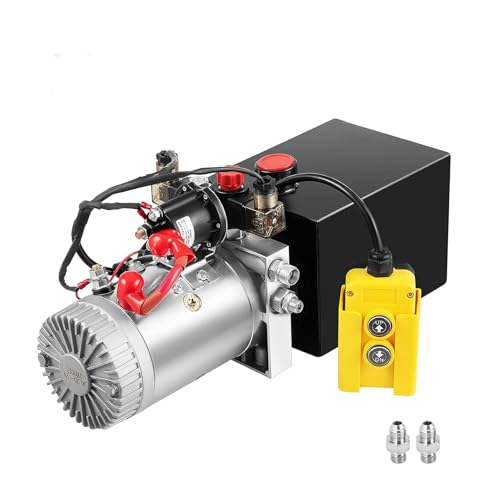
The Movecom unit uses a 12V DC 1.6 kW motor delivering up to 0.91 GPM for rapid lifting and lowering. It features a metal reservoir option in multiple capacities (4, 8, 10, 15 quarts) to fit diverse system sizes and duty cycles. SAE #6 port connections provide secure hose integration, and factory-set relief valves cap A port at 3200 PSI and B port at 1500 PSI for stable operation. Best for mobile platforms like dump trailers or small industrial rigs requiring robust, portable power with straightforward wiring.
Who it’s best for: contractors and fleet operators needing a compact, rugged DC power source for short-term lifts and portable tasks. Why selected: strong flow, durable metal reservoir choices, and clear pressure management. Limitation: fixed relief settings may limit customization for unique hydraulic circuits.
Doppy Hydraulic Power Unit (13 Quart)

This 13-quart metal reservoir power unit is designed for dump trailer operations with a 12V system and relief limits of 3200 PSI (A port) and 1500 PSI (B port). It emphasizes quick start and rapid oil output to support high-demand hydraulic tasks. The unit is built for rugged environments and remote hydraulic systems where fast response times matter. Best for: remote or mobile lifting tasks where a reliable, high-pressure single-acting pump is needed and authentic remote-control capability is desired. Caution: ensure compatibility with a matching double-acting cylinder in your setup.
Why selected: solid construction and fast-start capability. Limitation: uses a single-acting design, which means gravity-down returns may require additional components or configuration in some systems.
Shorelev 220V Hydraulic Power Unit

Shorelev delivers 220V power with a 14L plastic reservoir, designed for durability and corrosion resistance. The unit includes a simple manual push-button operation for immediate use, ideal for automotive shops or industrial settings where wall-mount design helps conserve space. This model suits setups that prioritize high power with straightforward, plug-free operation. Best for: fixed-location repair bays or industrial benches where quick manual operation is helpful. Limitation: plastic reservoir, while corrosion-resistant, may be less durable than metal in very harsh environments.
Why selected: high-power performance in a lightweight, space-saving design. Limitation: not ideal for highly metallic environments where metal reservoirs are preferred for long-term durability.
Vevor 110V Hydraulic Power Unit

Vevor’s 110V unit focuses on a compact, ready-to-use design with a 10-liter reservoir and a 2.2 kW motor. It is described as fully assembled for straightforward setup and includes extra connectors for replacement. The unit uses a single-acting pump with a relief valve to ensure safer operation. Best for: auto shops or garages needing a reliable, mid-range power unit that’s easy to install and service. Limitation: single-acting design may limit bidirectional operation without additional valves or circuitry.
Why selected: convenient out-of-the-box setup and practical capacity for common shop tasks. Limitation: functional flexibility is lower for systems requiring true dual-acting control without modification.
750W Electric Hydraulic Pump (Usoraszkt)
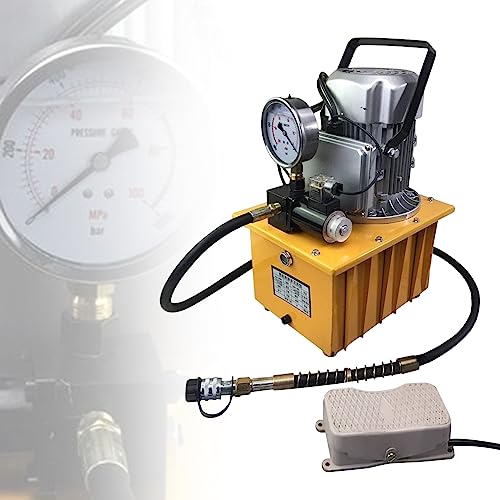
This unit uses a 750W pure copper motor and a 2-70 MPa range with 1400 rpm. It features a flexible output range (725-10,000 PSI) and includes a pedal-style control for hands-free operation, plus a viewing pressure gauge for quick monitoring. Best for: workshop tasks requiring precise control and higher pressure capabilities within a compact footprint. Limitation: higher pressure range requires careful setup to prevent overloading delicate components.
Why selected: high efficiency and user-friendly controls with clear pressure readouts. Limitation: pedal control may not suit all users who prefer joystick or remote control options.
Movecom 12V Double Acting Hydraulic Pump (8 Quart)
This variation matches the 12V DC motor and 1.6 kW specification with an 8-quart metal reservoir. It targets similar use cases as the 10-quart model but provides a slightly smaller footprint with corresponding reservoir capacity. Best for: compact systems where space is at a premium but a dual-acting pump is still required. Limitation: smaller reservoir means more frequent top-ups for continuous heavy use.
Buying Guide: Key Purchase Considerations
Power source and duty cycle: Decide between 12V DC portable units for mobile tasks or 110V/220V AC units for fixed shop setups. Consider how long the unit will run and whether it will handle continuous cycles or intermittent lifts.
Reservoir size: Larger reservoirs allow longer lifting sessions between fills. Match reservoir capacity to expected hydraulic fluid volume in your system and the number of actuators connected.
Acting vs. double-acting: Double-acting pumps control both extend and retract strokes, essential for balanced, bidirectional work. Single-acting pumps require gravity-assisted return or supplementary components.
Port sizing and safety: Check SAE port sizes (like SAE #6) for hose compatibility and ensure relief valves are appropriately rated for your applications to protect equipment and operators.
Material and construction: Metal reservoirs typically offer higher durability in harsh environments; plastic reservoirs save weight and corrosion resistance. Choose based on environment and maintenance plans.
Ease of installation: Fully assembled units with simple wiring and clear instructions save time. Look for units with included connectors or easy-to-replace parts for future service.
FAQ
- What type of hydraulic power unit is best for a dump trailer? A 12V or 24V DC unit with a sizable reservoir and a reliable relief valve is ideal for portable, on-site lifting and tilting tasks. Look for dual-acting capability for smoother control.
- Do I need a 220V unit for industrial use? If your shop has a 220V supply and you need consistent high power for multiple tasks, a 220V unit provides stable performance and can handle heavier workloads.
- Is a metal reservoir always better than plastic? Metal reservoirs offer greater durability in harsh environments, while plastic reservoirs reduce weight and may resist certain corrosion risks better in specific settings.
- Can I mix single-acting and double-acting components? It’s possible with the right valves and hardware, but double-acting systems generally require corresponding cylinders and proper control logic.
- What maintenance is needed for hydraulic power units? Regularly inspect hoses and fittings, check reservoir fluid levels, replace filters if present, and ensure relief valves remain within rated settings.
- How do I select the right reservoir size? Choose based on the total hydraulic fluid volume in your circuit and the expected duty cycle to minimize refilling interruptions.