Direct answer: For industrial and commercial spaces requiring robust particulate removal, a multi-stage HEPA air purifier with high CFM and durable construction is essential. The top picks below are best for job sites, restoration projects, workshops, and large rooms where fast air turnover matters. Each option targets heavy duty use, with clear guidance on who should choose it and why.
Buyer’s summary table
| Product | Best For | Key Benefit | Notes |
|---|---|---|---|
| VEVOR Air Scrubber | Industrial spaces needing strong filtration | 550 CFM, 3-stage filtration including H13 HEPA | Stackable, durable copper motor |
| CADPXS Shield-550 | Construction sites and restoration | 3-stage filtration, activated carbon, 550 CFM | Good odor/VOC reduction |
| ALORAIR 3-Stage Scrubber | Heavy-duty projects | Stackable, 550 CFM, durable rotomold shell | Easy to stack up to 1650 CFM |
| BlueDri Air Shield 550 | Water damage restoration and site work | 3-stage filtration, 99.97% at 0.3 microns | Higher airflow vs. competitors |
| XTREWAY 550CFM Scrubber | Renovations and industrial cleanup | 3-stage filtration, 0.3 micron capture, DC inverter motor | Stepless speed control |
VEVOR Air Scrubber With 3-Stage Filtration

The VEVOR model uses a three-stage filtration system: a MERV-10 pre-filter, an activated carbon filter, and an H13 HEPA filter. It captures 99.97% of particles down to 0.3 microns, improving indoor air quality quickly. Best for large rooms and job sites where strong particulate control is needed. The 550 CFM maximum airflow, a 15.5″ intake, and 8.5″ outlet provide broad coverage. A copper motor is highlighted for durability, and the control panel supports adjustable airflow, a resettable timer, and overheat protection. The filter-change indicator helps maintenance planning. Choose this if you need solid, all-around filtration in industrial settings. Caution: heavier units can be challenging to relocate frequently.
CADPXS Shield-550 Air Scrubber

The CADPXS Shield-550 combines a 3-stage filtration system with a MERV-10 pre-filter, HEPA stage, and activated carbon for odor and VOC reduction. It’s designed for commercial and restoration environments, supporting large particle removal on job sites and in whole-home projects. Best for contractors and restoration professionals who need reliable odor control and filtration in one unit. The unit emphasizes durability and heavy-duty use. Limitation: may require careful placement to optimize airflow in crowded spaces.
ALORAIR Air Scrubber 3-Stage
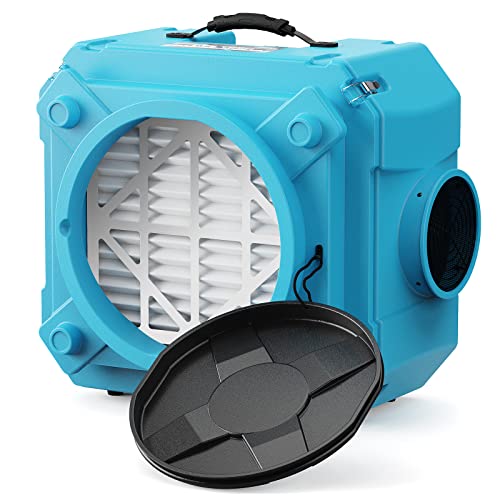
ALORAIR offers a stackable, durable air scrubber with 3-stage filtration, including a MERV-10 pre-filter, carbon filter, and HEPA filter trapping 99.97% of particles larger than 0.3 microns. Its rotomolded shell provides ruggedness for demanding environments such as construction and water/fire damage restoration. Best for crews that need to daisy-chain multiple units for higher overall airflow (up to 1650 CFM). Caution: weight and stacking require proper handling to prevent tipping.
KNKA Air Purifier For Large Rooms

KNKA’s purifier targets large spaces with AHAM VERIFIDE certification and a CADR design focused on smoke, dust, and pollen. It features dual filtration stages with a HEPA component and an activated carbon filter, and it provides room-wide circulation with multiple intake and outlet paths. Best for large home or light commercial spaces where rapid air turnover matters. Limitation: data emphasizes residential performance; for heavy industrial use, consider stronger-duty units.
BlueDri Air Shield 550 HEPA

BlueDri’s Air Shield 550 is a heavy-duty air scrubber with a three-stage filtration system. It emphasizes a higher-than-average CFM in its class and a HEPA filter capable of capturing 99.97% of particles at 0.3 microns. It’s well-suited for commercial repair, construction sites, and sewage remediation. Best for sites needing robust airflow with strong particulate capture. Caution: the unit’s size may require dedicated space for operation in tight rooms.
XTREWAY 550CFM HEPA Air Scrubber

XTREWAY offers a 550 CFM air scrubber with an advanced 3-stage filtration system (MERV-10 pre-filter, HEPA, and carbon). It uses a DC inverter motor with stepless speed control for precise airflow management, and a durable rotomolded shell. It’s designed for indoor renovation, restoration, and industrial cleanup. Best for users who want quiet operation at higher airflows and the ability to daisy-chain units for greater total capacity. Limitation: DC motor electronics might require careful power management on job sites.
Buying Guide
What should I look for in an industrial HEPA air purifier?
Key features include a true HEPA filter (capturing 99.97% of 0.3 micron particles), a robust pre-filter to protect the HEPA stage, activated carbon for odors and VOCs, high CFM suitable for room size, and durable construction (rotomolded shells are common for industrial units). Consider ease of maintenance, filter replacement indicators, and safety features such as circuit breakers and GFCI outlets when selecting a unit for job sites.
How to match CFM to room size?
Compute required airflow by multiplying room volume (cubic feet) by desired air changes per hour (ACH). For restoration and construction spaces, aim for 6–10 ACH for faster cleanup, which translates to higher CFM ratings. In larger spaces, stacking or daisy-chaining multiple units can achieve the needed total airflow without overloading a single unit.
Is 3-stage filtration always better?
Three-stage filtration adds a pre-filter, HEPA stage, and activated carbon. This setup improves particle capture, extends HEPA life by capturing larger debris first, and reduces odors and VOCs. For sites with smoke, solvents, or strong odors, a carbon stage is particularly beneficial.
Durability and mobility considerations
Industrial purifiers should use rugged housings and corrosion-resistant components. Consider the weight, portability features, and whether units are stackable or daisy-chain capable for scalable filtration in large environments. Built-in timers and overheat protection support safe, continuous operation on job sites.
Operational tips for best results
- Place units to create cross-ventilation paths and avoid obstructing air intake or exhaust.
- Replace filters according to indicators or maintenance schedules to maintain efficiency.
- When daisy-chaining units, ensure electrical circuits support the combined load and use GFCI outlets if possible.
FAQ
- Q: What does CFM tell me about a purifier? A: CFM indicates the volume of air the unit can move per minute; higher CFM means faster air turnover in larger spaces.
- Q: How often should filters be replaced on industrial purifiers? A: Replacement intervals depend on usage and environment; follow manufacturer indicators and maintenance guidelines.
- Q: Can I use these purifiers in homes? A: Yes, but they are designed for industrial or commercial use; for home spaces, select models with lower CFM and size suitability.
- Q: Are all units safe to run continuously? A: Most are designed for ongoing use, but ensure cooling and circuit protection features are in place and avoid overloading electrical circuits.
- Q: Do these units remove all odors? A: Activated carbon filters remove many odors and VOCs, but extreme or persistent odors may require additional remediation steps.
- Q: Can I connect multiple purifiers together? A: Some units support daisy-chaining through built-in outlets or external power arrangements; verify each model’s compatibility.