When selecting an industrial-grade 3D printer, prioritize multi-material capability, speed, build volume, and reliable auto-leveling. The top five options below are suited for professionals who need production-ready performance, large builds, and consistent results. This guide highlights who each printer is best for and why it stands out, with practical trade-offs to consider for high-demand manufacturing or rapid prototyping environments.
Summary of selected products:
- Bambu Lab P1S – Best for high-speed multi-color printing in enclosed, safe environments.
- Creality K2 Plus Combo – Best for large builds with 16-color capability and automatic filament management.
- Creality K2 Combo (A) – Best for ready-to-use multi-color printing with solid reliability.
- FLASHFORGE AD5X – Best for multi-color rapid prototypes with strong coreXY performance.
- QIDI Max4 Combo – Best for large, high-temperature material printing with stable chamber control.
Bambu Lab P1S 3D Printer

The Bambu Lab P1S is an enclosed, high-speed FDM printer designed for multispectral work. It supports up to 16 colors or multiple materials and features CoreXY mechanics with auto bed leveling. This model is ideal for design studios or engineering departments needing fast color-changing prints with reliable first-layer performance.
Best for: teams that require vibrant color palettes and material versatility in a compact, enclosed unit. The auto bed leveling helps maintain consistent results across multiple prints. Note: Using the Bambu Lab AMS may be necessary to access full color/material options.
Limitation: Enclosed design can add upfront cost and may require careful filament management with multi-material setups. Printing at extreme speeds can also increase vibration risk on very large parts.
Creality K2 Plus Combo 3D Printer

The Creality K2 Plus Combo offers a large 350 x 350 x 350 mm build volume and multi-color printing through the CFS system. Automatic filament selection and RFID color detection streamline workflows. Its high-speed performance is driven by efficient step-servo motors and a fast extrusion system, making it suitable for batch production or large prototypes.
Best for: users needing a bigger build area without sacrificing color variety, ideal for architecture models or industrial parts in one piece. Choose this if you want automated filament handling and large-format capability. Caution: While fast, complex multi-color jobs may require careful calibration for color consistency across sections.
Creality K2 Combo (A) 3D Printer

The Creality K2 Combo (A) provides four CFS units for up to 16 colors and a 260 x 260 x 260 mm build volume. It ships with auto leveling and a Next-Gen Direct Drive extruder, enabling reliable multi-material prints. This model is well-suited for hobbyists transitioning to professional multi-color workflows without sacrificing compactness.
Best for: users who want ready-to-run multi-color capability in a compact form factor. It’s a strong all-around choice for varied materials. Limitation: The build volume is smaller than some large-format options, so very large parts may require tiling or resizing.
FLASHFORGE AD5X Multi-Color 3D Printer

The FLASHFORGE AD5X delivers vivid multi-color printing, supporting up to four colors simultaneously. Its 1-click auto leveling and CoreXY design push speed to 600 mm/s with strong 20,000 mm/s² acceleration. This printer emphasizes efficient prototyping and batch production with reliable color handling.
Best for: teams that need fast color-enabled prototypes with straightforward calibration. Avoid this if you require extremely large builds, as the AD5X has a smaller print area compared to some large-format systems.
QIDI Max4 Combo 3D Printer
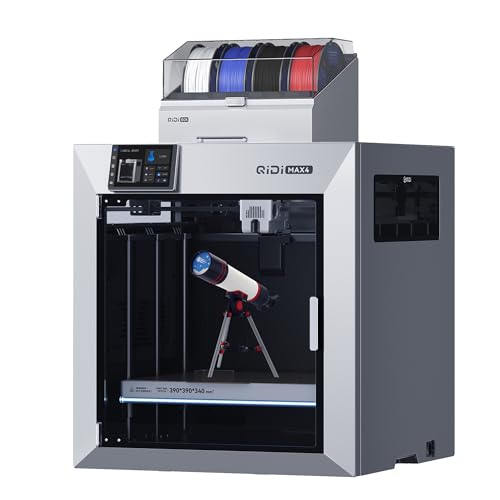
The QIDI Max4 Combo Max features a large 390 x 390 x 340 mm build volume and a heated chamber up to 65°C, enabling materials like ABS and carbon-fiber composites. With multi-color/multi-material capability up to 16 colors via QIDI BOX, it offers controlled environmental conditions and high-speed operation, supported by closed-loop axis motors for stability.
Best for: professionals seeking a large chamber with robust material compatibility and reliable multi-color capability. It’s a strong choice for high-temperature materials. Caution: High-temperature printing may require careful chamber management to prevent warping for certain materials.
Buying Guide: Key Purchase Considerations
- Printer type and enclosure: Enclosed printers reduce warping and improve safety when using high-temperature or flexible filaments. Consider whether enclosure is essential for your materials and workspace.
- Multi-color and multi-material capability: Look for systems with integrated color options (CFS, AMS, or similar). Determine the maximum number of colors and whether automatic filament detection is available.
- Build volume vs. speed: Larger build volumes enable bigger parts, but speed and acceleration determine how quickly you can complete batches. Prioritize machines with balanced performance for your workflow.
- Auto leveling and bed handling: Auto bed leveling reduces manual setup time and improves first-layer consistency across sessions. Check bed accessibility for maintenance.
- Material compatibility: Consider supported materials (PLA, PETG, ABS, carbon fiber-reinforced, high-temp filaments). Heated chambers and nozzle designs influence material options.
- Reliability and support: Look for printers with proven reliability in industrial settings and accessible customer support or service options.
- Software ecosystem: Ensure compatibility with your design pipeline and slicing software. Robust firmware and consistent updates add long-term value.
Frequently Asked Questions
- What makes an industrial-grade 3D printer different from consumer models?
Industrial-grade printers typically offer larger build volumes, higher speeds, more reliable multi-material capabilities, enclosed builds, and stronger temperature control for demanding applications.
- Is auto bed leveling essential for multi-color printing?
Auto bed leveling improves first-layer consistency, especially when switching filaments or colors frequently. It reduces manual adjustments and improves repeatability.
- Which features are most important for production environments?
Key features include large build volume, high-speed printing, stable materials handling, multi-color/material capability, and robust software integration for batch workflows.
- Can these printers handle high-temperature materials?
Yes, several models offer heated chambers or high-temperature nozzles designed for materials like ABS, PC, and CFRP composites. Verify the maximum chamber temperature and nozzle rating for your materials.
- Do these printers require extensive setup before use?
Many listed models emphasize plug-and-play readiness or near-ready assembly, but some calibration and software setup are typical before production use.
- How important is color accuracy for industrial parts?
Color accuracy matters for branding, assembly, and visualization. Multi-color systems minimize post-processing painting and speed up delivery of final parts.