When selecting equipment for industrial food production, prioritize reliability, washdown capability, and compliance with food-safety standards. This article highlights five essential products that help streamline weighing, lubrication, and general maintenance in busy kitchens and processing facilities. Each item is suited for professional use, offers clear performance benefits, and includes practical caveats to guide purchasing decisions. The following picks balance durability with ease of use for teams handling large batch production.
| Product | Best For | Why It Was Chosen |
|---|---|---|
| Adam Equipment ABW 16 Aqua Washdown Scale | Small to mid-size weighing tasks | Waterproof IP67, NSF-approved, 35 lb capacity with 0.005 lb accuracy; ideal for wet environments |
| Adam Equipment ABW 32 Aqua Washdown Scale | Medium-to-large batch weighing | 70 lb capacity, 0.01 lb accuracy; robust for daily production checks |
| Super Lube SynColon Grease | General lubrication needs | Food-grade, high-temp, water and corrosion resistant; versatile for equipment maintenance |
| CRC Food Grade Penetrating Oil | Maintenance and disassembly | Penetrates through cracks and threads; supports preventive maintenance |
| BX-434 NSF H1 Food Grade Plastic Grease | Bearings, gears, and conveyors | NSF H1 certified, cold-ready, designed for food production lines |
Adam Equipment ABW 16 Aqua Washdown Scale

Best for small to mid-size weighing tasks in wet production areas. This scale delivers a 35 lb (16 kg) capacity with 0.005 lb (2 g) readability and water protection (IP67). The design emphasizes durability in food-related settings and is backed by a UK design and US support network. It is suited for quick check-weighing, portion control, and basic counting in high-humidity environments. A potential limitation is the smaller capacity if larger batches or bulk portions are routine.
Adam Equipment ABW 32 Aqua Washdown Scale

Better for medium-to-large batch weighing in food production lines. With a 70 lb (32 kg) capacity and 0.01 lb (5 g) readability, this model handles more substantial portions without frequent re-weighs. It maintains IP67 washdown protection and NSF compliance, making it suitable for meat, dairy, and ready-to-eat product prepping scenarios. Choose this if your routine involves larger batches or bulk ingredient checks. A note: the higher capacity may affect footprint in tight spaces.
Super Lube SynColon Multi-Purpose Grease

Best for general lubrication across food processing equipment, including gearboxes and bearings in washdown environments. This NSF H1-registered, food-grade synthetic grease resists high temperatures, water, salt, and corrosion, making it well-suited for harsh production areas. It supports smoother operation and helps reduce wear on moving parts. Limitation: ensure compatibility with specific seal materials and moving parts in older machines before widespread use.
CRC Food Grade Penetrating Oil
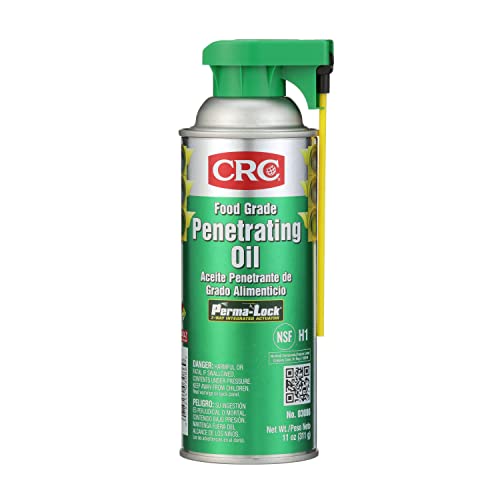
Best for maintenance and disassembly tasks on food processing equipment. This penetrating oil loosens corroded fasteners, hinges, and joints, enabling routine servicing without harsh chemicals. It supports preventive maintenance programs by facilitating easier component replacement. Caution: re-check compatibility with any seals or gaskets that may be sensitive to solvents, and always follow food-safety guidelines when applying near food contact surfaces.
BX-434 NSF H1 Food Grade Plastic Grease

Best for bearings, gears, and conveyors in meat, dairy, and cold-drink lines. The product is NSF H1 certified, designed for industrial food environments, and performs well from -15°C to 100°C. It helps maintain consistent operation in chillers, ice cream machines, and beverage lines. Limitation: verify the exact temperature range your equipment experiences, as prolonged extreme exposure may require a higher-temperature formulation.
Buying Guide
What should I look for in industrial food equipment?
Prioritize washdown capability, food-safety certifications (like NSF H1), and appropriate capacity for your batch sizes. Look for ease of use, reliable calibration, and compatibility with your existing workflows. For lubricants, confirm NSF ratings, temperature tolerance, and material compatibility with seals and plastics in your machinery.
How to assess capacity and accuracy in scales?
Choose a scale whose maximum capacity comfortably exceeds typical batches, and select readability that matches your portioning precision needs. For quick checks, smaller scales with higher readability can speed up work, while larger scales support bulk batching.
When is a penetrating oil necessary?
Penetrating oil helps free seized fasteners and joints that impede maintenance. Use sparingly on non-sensitive surfaces and ensure cleanup before returning equipment to food contact service.
Which lubricants are safest for food environments?
NSF H1 or equivalent food-grade ratings indicate lubricants suitable for incidental contact with food. Avoid cross-contamination by applying lubricants away from open food surfaces and following manufacturer guidance for re-entry times and cleanup.
How do you choose between different greases?
Consider temperature range, load, and moving-part speed. Greases with higher temperature tolerance and better water resistance improve longevity in washdown areas, while food-grade certification protects safety in production lines.
Maintenance planning tips
- Schedule regular calibration and cleaning during downtime to minimize production impact.
- Document lubricant types, application points, and intervals for audit readiness.
- Inspect seals and housings for signs of wear or chemical degradation.
FAQ
- What is the advantage of washdown scales in food plants? – They resist moisture and contaminants, making sanitation easier and reducing downtime.
- Can I use general-purpose grease on food equipment? – Use only food-grade lubricants on components exposed to incidental contact with food.
- Which tool is best for quick maintenance tasks? – Penetrating oils help free stubborn fasteners and joints, speeding up servicing.
- Are these products compatible with all food types? – Most are designed for broad food-processing use; always check manufacturer guidance for specific equipment.
- How often should scales and lubricants be checked? – Regular calibration and inspection should align with your facility’s preventive maintenance plan.
- Do these items require special storage? – Store away from extreme heat, moisture, and direct sunlight; follow label instructions for shelf life.