Answering the buyer’s search, these industrial fans and blowers are selected for durability, power, and versatility in commercial settings. This guide helps plumbers, restoration crews, contractors, and facility managers choose the right unit for drying, ventilation, or temperature control. Each product below is evaluated for best-use cases, portability, and safety considerations. A quick summary table follows the introduction to compare core specs at a glance.
| Product | Best For | Key Benefit | Best Use |
|---|---|---|---|
| Small-to-medium spaces | Three speeds, four airflow angles | Drying floors and channels | |
| Long-term ventilation | ETL durability, 585W motor | Smoke/odor clearance, exhaust | |
| Compact, hard-to-reach areas | 925 CFM, lightweight | Water damage restoration, janitorial |
Note: All units are suited for professional environments, but select features such as adjustable angles, ducting compatibility, and cord length should align with your project site constraints and safety standards.
BLOTEK 1/2hp Industrial Air Mover

Best for mid-sized job sites where adjustable airflow matters. The BLOTEK unit provides three speeds and four airflow positions (0°, 15°, 45°, 90°), allowing targeted drying or cooling. A 15-foot cord expands placement options in workshop or utility rooms. Best for contractors and facilities teams needing flexible air direction on floors or walls. Caution: The cord length may still require extension in large spaces.
VEVOR Air Mover Blower Fan, 3198 CFM

Best for rapid ventilation in warehouses or restoration sites needing strong airflow. The VEVOR model delivers 3198 CFM with a robust 585W motor and includes flexible ducting for specifying intake or exhaust paths. It’s ETL certified with a corrosion-resistant finish and non-slip feet for stable operation. Caution: Heavier weight may reduce portability for frequent repositioning.
XPOWER P-230AT Mini Mighty Air Mover
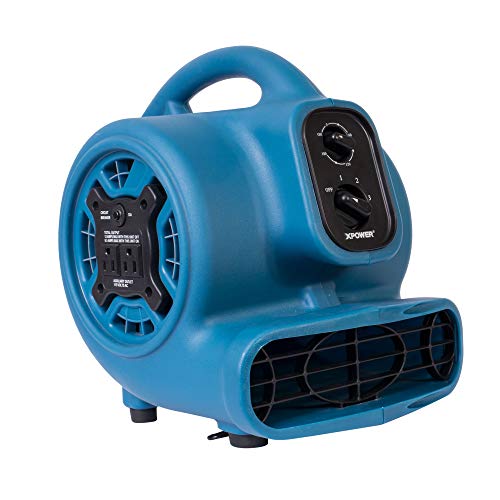
Best for drying flat surfaces and tight areas. The XPOWER P-230AT uses a 1/4 HP motor to produce up to 925 CFM while drawing just 2.3 amps. Lightweight and stackable, it’s ideal for water-damage restoration crews and janitorial use in offices or clinics. Caution: Performance drops with large open spaces where air needs to travel long distances.
Lasko High Velocity Portable Utility Fan

Better for smaller rooms or temporary cooling in offices and garages. The Lasko unit delivers up to 289 CFM across three speeds with a 270-degree pivot to target airflow. It includes two built-in outlets for power tools or devices, reducing extension cord clutter. Caution: Not designed for industrial-grade continuous operation in harsh environments.
BSMTEK Air Mover Blower Fan, 1.5HP
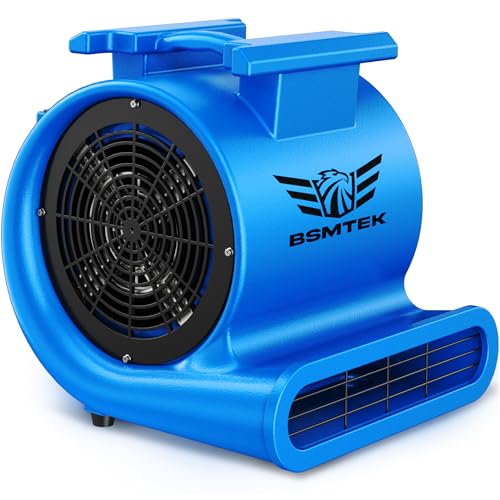
Best for heavy-duty flood restoration and large-area drying. It offers up to 10,000 CFM with three speeds and five adjustable angles. A 15-foot cord enables flexible setup, and the design supports series connection with other equipment for coordinated drying. Caution: High airflow requires secure mounting and safe guarding from obstructions due to high velocity air.
MOUNTO 12-Inch Heavy-Duty Blower

Best for crawl spaces, attics, and confined areas needing directional airflow. The MOUNTO unit delivers 2900 CFM with a 25-foot vinyl hose for extended reach. Its durable orange-coated steel construction supports prolonged use in construction or maintenance settings. Caution: The hose length may require additional ducting for very large spaces.
Buying Guide
What should you consider when buying an industrial air mover or blower?
- Airflow needs: Look for CFM ratings and whether the unit can deliver sufficient volume for your space size and material (carpet, concrete, drywall).
- Portability vs. power: Heavier units offer more power; lighter models are easier to relocate. Decide if you need frequent repositioning.
- Durability and safety: ETL or other certifications, metal housings, and overload protection contribute to long-term reliability in busy work sites.
- Direction and ducting: Airflow angles and compatibility with hoses or ducts determine how precisely you can target drying or ventilation.
- Power requirements: Check voltage, amperage, and cord length to ensure compatibility with site outlets and safety codes.
- Noise and vibration: Consider models with anti-vibration feet or quieter operation if used in occupied spaces.
Tips for selecting by scenario
- Water damage restoration: Choose high CFM, durable construction, and daisy-chain capability for multi-unit setups.
- Construction and dry-out: Favor adjustable angles and long cords to reach distant outlets without extension cords.
- Small offices and clinics: A compact unit with built-in outlets may reduce cord clutter while providing targeted airflow.
Maintenance and safety basics
- Inspect cords for wear and replace damaged cables to prevent shock hazards.
- Keep intake and exhaust clear of debris to maintain performance and avoid overheating.
- Store units in dry, ventilated spaces when not in use to extend life.
FAQ
- What is CFM and why does it matter? CFM indicates how much air the unit can move per minute; higher CFM means faster drying or ventilation in larger spaces.
- Do these machines require special outlets? Most operate on standard 110-120V outlets; check the Amperage to ensure your circuits won’t trip.
- Can I run multiple units together? Some models support daisy-chaining or stacked arrangements for broader coverage; verify the specific unit’s capabilities.
- Are higher-priced models always better? Not always; choose based on your space, required airflow, and movement needs rather than price alone.
- How long can I run these devices continuously? Use the built-in timer or follow manufacturer guidelines to avoid overheating and ensure safe operation.
- Is ducting essential for all applications? Ducting improves intake or exhaust paths in many scenarios, especially for long-distance venting or emergency drying.